


In the 90s, American carpenters named this system floating office and they made it for their children in a university studio. No design magazine mentioned them. No brand had yet thought of it as a salable product. It was two planks of wood, some sturdy supports, and the problem was solved.
Then IKEA launched the shelf LACK at €5.99 and the concept has gone from being a home carpentry secret to something found on Pinterest boards around the world. The point is that, in the meantime, the original idea has lost pieces: it has been transformed into an aesthetic, forgetting that it was first and foremost a functional solution to a real problem.
Those who work in a small space, those who need a workstation that disappears after eight hours in front of the screen, those who do not want to devote four square meters to a desk that they then use for three hours a day. This article is about that solution, not the aesthetics involved.
Two shelves, but not by accident
The construction logic is simpler than it sounds, but getting the details wrong makes the difference between a stable desk and a top that wobbles every time you touch an elbow. The shelf works on a precise principle: the support surface must be anchored to the wall with brackets capable of supporting a distributed loadnot concentrated in the center. An 80 x 40 cm surface with a person resting their hands on it creates a downward and forward force simultaneously. This means that standard angle brackets, the minute ones from the hardware store, will not do.
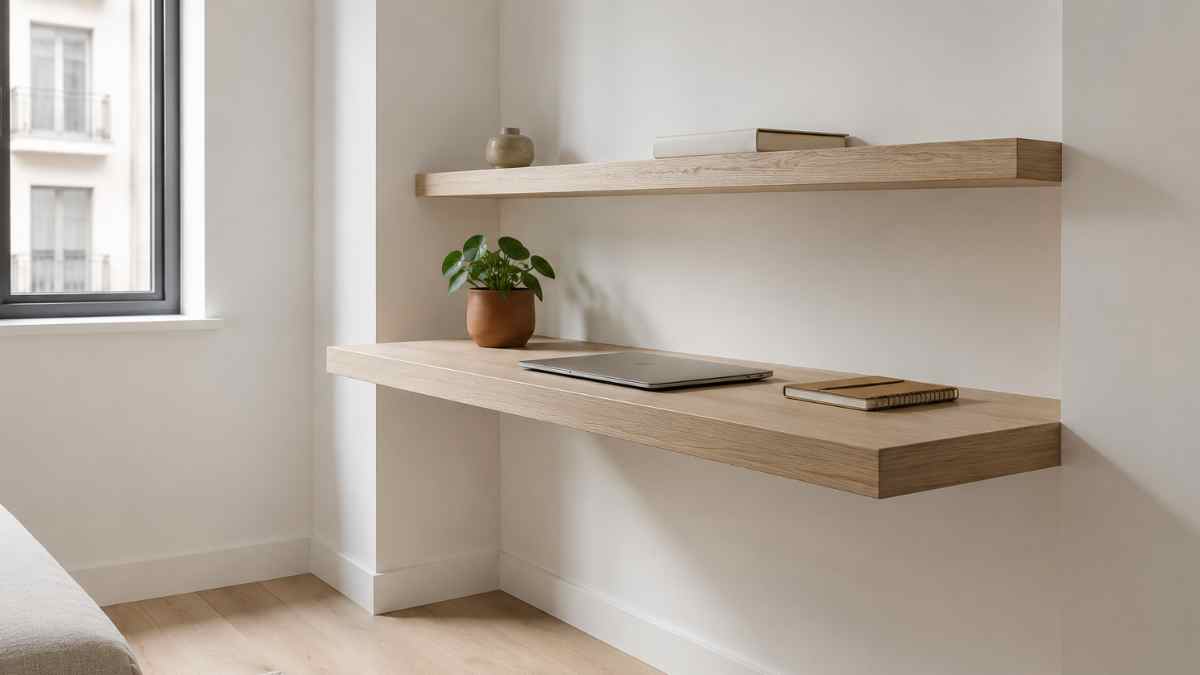
Kartell, to name one brand that has tackled the problem on the design side, has created variations on the concept with clear polycarbonate bases that are anchored to the wall with expansion systems. The price goes up (we are talking about 300-400 euros for the edition Bubble Club office, out of production but still on the used market), but the mounting system is correct: manifold expansion, not just a plug. For those who want to spend less, the solution is reinforced L-shaped brackets, with a minimum thickness of 4 mm in steel, at least 50 cm apart. A shelf with two arms that are too close together does not handle the side load well.
The design: materials that last and materials that fail
Here the options multiply and they are not all the same. Solid wood is the ideal reference: it doesn’t bend, it can be rubbed, it ages well. A 3 cm thick spruce, bought at a hardware store or from a craft sawmill, costs from 20 to 40 euros for a size of 100 x 45 cm. Requires sanding and oil or wax, but lasts for years.
The trick many miss: the grain orientation. A surface with grain parallel to the leading edge better resists bending over time. It is a detail that matters when the upper part is without legs and functions as a pure shelf. 18 mm multi-layer plywood is an honest alternative: lighter, more dimensionally stable, less beautiful. The visual trick to spruce it up is to glue a solid wood edge to the front with vinyl glue and clamps. The result looks like a full panel and costs a quarter.
To avoid: standard chipboard, the kind used in cheap furniture. It holds weight initially, but absorbs moisture, swells and performs poorly over time if the top is exposed to temperature fluctuations. Cantilever offices are usually located near windows or in rooms that are not always heated. Particleboard, there, makes you regret the choice in a few years.
The space below is half of the project
A legless desk frees up the floor. This is why it works in small spaces: a chair, a basket, a low dresser, a rug that fits under the top. Or nothing. This open space creates a visual perception of lightness that a traditional desk cannot give, even if the dimensions are the same.
String Furniture, the Swedish brand founded in the 1950s by Nils Strinning, has built an entire product philosophy on this principle. The system String systemwith perforated vertical panels and horizontal shelves in various materials and depths, it is still in production and allows you to configure a wall-mounted desk mounted on a modular bookcase. The price for a basic unit with a desktop starts at around 350-400 euros, which is not close to zero but is significantly less than a desk with a built-in wardrobe. The construction logic, however, can be extracted even with very low budgets: two perforated uprights (found at Leroy Merlin from €15 each), a top and a series of compatible supports.
The detail that makes the difference in managing the space under the top is the installation height. A traditional desk is 74-76 cm from the ground. For those working with an external monitor, it can also work at 72 cm, saving space for low drawers or document holders. For laptop users, the minimum comfort limit is 70 cm, below which you risk poor shoulder posture over time.
Make it truly invisible, not just in the photo
The rack only works in practice if you think about cable management before assembling it. A white cover with three wires ending in a floor outlet negates all the minimal aesthetics you’re looking for. The solutions are few but effective: an aluminum cable duct fixed under the top (costs 8-12 euros and can be found in electronics stores), a multi-socket screwed directly to the wall 5 cm below the top, or a hole drilled in the top itself if solid wood is used.
IKEA, in this sense, has thought about the problem with the system A signa horizontal metal channel for screwing under the table top that costs less than 15 euros and holds up to 5 kg of cables and power supplies. It is designed for BEKANT and LINNMON tables, but fixing screws are standard and fits any thickness over 2.5cm.
The other element that makes a shelf invisible is color. Painting or covering the top with the same color as the wall, or with a very narrow shade, visually eliminates the top edge. It’s not a trompe-l’oeil effect: it’s just the reduction of contrast. On a white wall, a glossy white laminate top stands out. One in matt bleached wood is incorporated. The price difference between the two is often minimal.
The desk that you cannot see is the one that, once assembled, ceases to be the element around which you will organize the room. Instead, it becomes a surface that appears when needed and disappears as a whole when you look up. For a small space, this is as much as an extra half a square meter.



