


There is a category of home purchases that are made almost by accident, often in a moment of frustration when faced with a closet that doesn’t close properly or a closet that looks like a failed file. The interior mirror cabinet also belongs to this category, with the difference that those who buy it rarely return. It’s not an aesthetic gadget or a glossy magazine accessory: it’s a constructive solution that changes the way a space is perceived and used, in and out of doors. Internal reflection visually multiplies content, takes inventory of what one has immediately and forces, almost mechanically, to maintain order. No one leaves a shelf in disarray when you see your reflection every time you open the cupboard. This psychological effect, needless to say, is underestimated in practice.
The mirror in, not out
The first thing to clarify is the difference between a piece of furniture with an external mirror and one with an internal mirror. The first is an aesthetic solution: it serves to give depth to an environment, to make a room seem larger, to create a scenographic effect. The second is a solution functional with aesthetic effects secondary but no less relevant. The mirror placed on the inner panel of the door or the bottom of the compartment visually replenishes the limited space, doubles it and allows you to see everything stored at a glance. In a closet, it means seeing both the front and back of the hangers. In a dish cabinet, it means you don’t have to move anything to check what’s at the bottom. In a bathroom cabinet, it means you instantly recognize the right bottle without looking.
Come brand Hülsta have incorporated this logic into the wall systems of Now! line, where the smoked glass rear panels work on exactly this principle. The result is not glamorous: it is realistic. Smoked glass, in particular, reduces the visual impact of reflection without eliminating its function, and is a technical option worth considering if clear mirror is too theatrical for some environments.
Where it works and where it doesn’t
Not every piece of furniture benefits from an interior mirror. The decisive variable is the depth of the apartment: below 30 cm, the reflection is too close to be useful and risks creating a chaotic effect instead of order. From 35 cm and above, the game works. Standard 60 cm deep wardrobes are the ideal frame: the internal mirror visually doubles the perceived depth of the compartment and turns each shelf into something more legible.
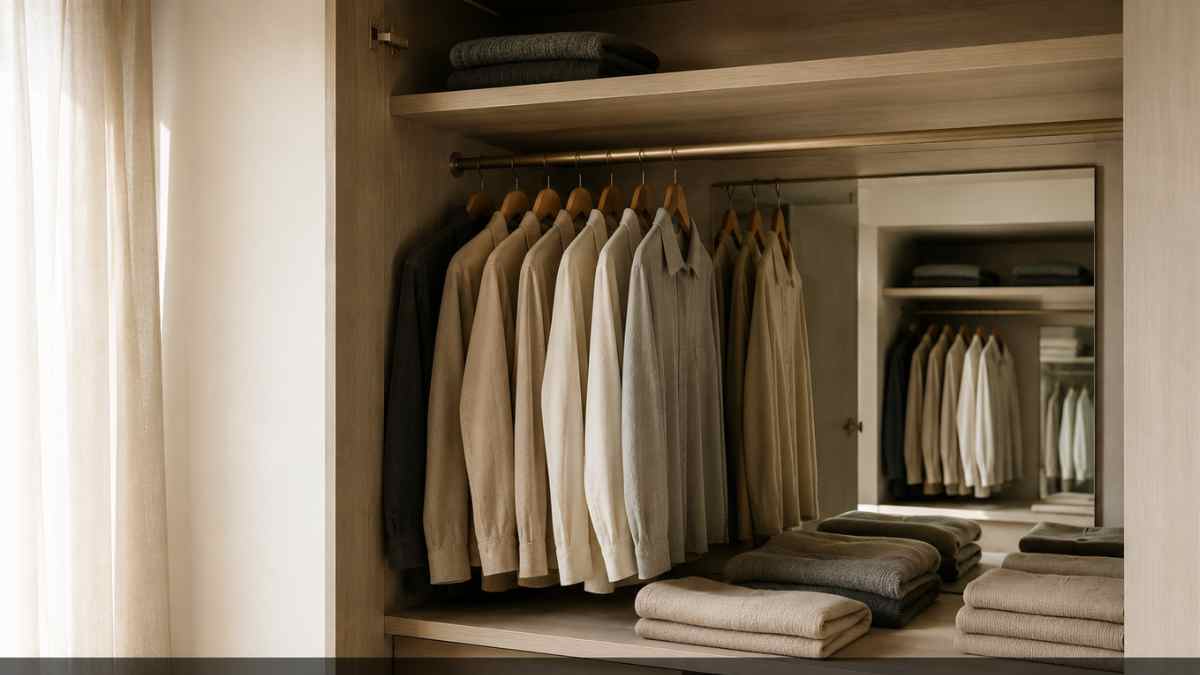
In service environments such as closets or laundry rooms, the internal mirror in a tall column cabinet may seem excessive, but it has an accurate function: to make the stock of products, containers and equipment visible without having to open everything. Ikea has incorporated this logic in some configurations of the Pax system with the Auli mirror panel, applied to the inside of the sliding doors at a cost of around 50 euros per panel. It’s not a complicated idea, but it works reliably.
Where the interior mirror loses its effectiveness is in furniture with widely separated compartments, such as sideboards with many narrow compartments and overlapping drawers. Reflection is fragmented and confused and visual gain is nullified.
The detail that few consider: the frame
The interior mirror of a piece of furniture is never simply glued to the panel. The question of frame or stop is decisive for both duration and appearance. Frameless mirrors, fixed with neutral silicone directly to chipboard or MDF panel, tend to show moisture infiltrations along the edges over time, especially in environments such as bathrooms or kitchens. The most correct solution includes one groove milled into panel which houses the mirror or a perimeter frame of aluminum or brass that protects the edge of the glass.
Designer Piero Lissoni worked this detail into the Living Divani storage systems, where the internal mirror panels are integrated with satin brass profiles that also act as a decorative element of the interior of the furniture. The price of this product line is obviously different from an Ikea piece of furniture, but the construction principle is exportable: even in a budget solution, protecting the edge of the mirror costs a little and makes a difference over time.
Internal mirror and perception of internal order
There is a fairly direct mechanism that links the interior mirror to maintaining order and has nothing to do with aesthetics. When the interior of a piece of furniture is an opaque space, the chaos that accumulates remains invisible until the next opening, and this invisibility makes it psychologically tolerable. The mirrored reflection, however, enhances the disorder as much as that of the classroom. A poorly placed shelf multiplies in the reflected image and becomes harder to ignore. It’s the same principle why professional restaurants use glossy surfaces in open kitchens: reflection creates a form of passive control that doesn’t require a conscious decision.
This does not mean that an interior mirror automatically transforms the habits of those who inhabit a space. But it lowers the tolerance for disruption and increases the frequency with which it’s noticed, which tends to result in more frequent small tidying up jobs rather than occasional big cleaning jobs. For those who work from home and have developed a complicated relationship with space management, it’s not a marginal detail.
How to integrate it into an existing piece of furniture
It is not necessary to buy new furniture. A mirror cut to order by the local glassworks costs from 30 to 70 euros depending on the size and thickness of the glass (4mm is the standard for interior use, 6mm for large panels). Installation with neutral silicone can be done independently, but requires a clean, flat and dry internal surface. On raw MDF or matte laminate panels, silicone adheres well. On glossy painted surfaces, it is wiser to use double-sided mirror tape, available in specialist hardware stores for around €8-12 per metre.
If the furniture has a door with a vent or visible hinges that interfere with placement, the mirror can be sized to occupy only the central part of the table, leaving the edges free. The result is less radical but still functional. Mirror tiles 20×20 cm, used in series, are an alternative solution for irregular or very narrow spaces: they cost less than a custom-made mirror and can be cut with a glass cutter.
A built-in wardrobe lined inside with a mirror at the bottom, door-to-door, in an apartment with 2.70m ceilings becomes a space that looks taller and neater than it is. It is not an optical illusion from a photographed living room: it is a more accurate reading of the available space, without objects hidden behind other objects, without shelves that look full when they are not. The furniture remains the same. What changes is how you use it.



