


Every interior designer knows it, but rarely says it out loud: half of the sustainability problems in a home don’t depend on furniture, colors or square footage. They depend on where the electrical outlets are placed. A couch that you can’t place where you want because the outlet is on the other side of the room. A reading lamp with the cord running across the floor. The right bedside table, in the right place, but without electricity. They are invisible constraints that affect every furniture choice, often more than load-bearing walls.
Moving an outlet doesn’t necessarily mean calling an electrician and opening up the wall. Smart solutions easily found in Italy, including Amazon, Leroy Merlin and specialized stores, have made this operation much more accessible. It’s not about technological gadgets as an end in themselves: it’s about reclaiming design freedom in every room.
The living room: free yourself from the wrong wall
The classic living room problem is the pulled behind the sofa. The TV is on one wall, the sofa is on the other and in the middle is a carpet that no one wants to see wires. The most elegant solution, before you think about any renovation, are the floor slippers with cap: models such as the Legrand Pop-Up Floor Outlet, available on Amazon Italy for around 60-80 euros, are placed in a recess in the wooden or laminate floor and are opened only when needed. They are not invisible, but they are subtle and mostly eliminate the problem at its root.
For those who rent or don’t want structural interventions, Allocacoc’s multiple sockets with a flat wall cable (the DesignNest PowerCube Extended USB can be found on Amazon for about 25 euros) allow you to carry power along the skirting board without pipes or traces. The cable is three millimeters thick, fixed with double-sided adhesive and painted. It’s not a permanent solution, but it works for those who want to change the layout of their living room without commitment.
Bedroom: the bedside table that has no electricity
The bedroom is the room where the placement of sockets has the greatest impact on the quality of daily life. Charging a phone, powering a reading lamp, connecting an alarm clock: everything converges on the bedside table, which, however, is rarely next to the right socket. When you change beds, add a bigger nightstand, or just try to rearrange, the electrical restriction gets in the way of everything.
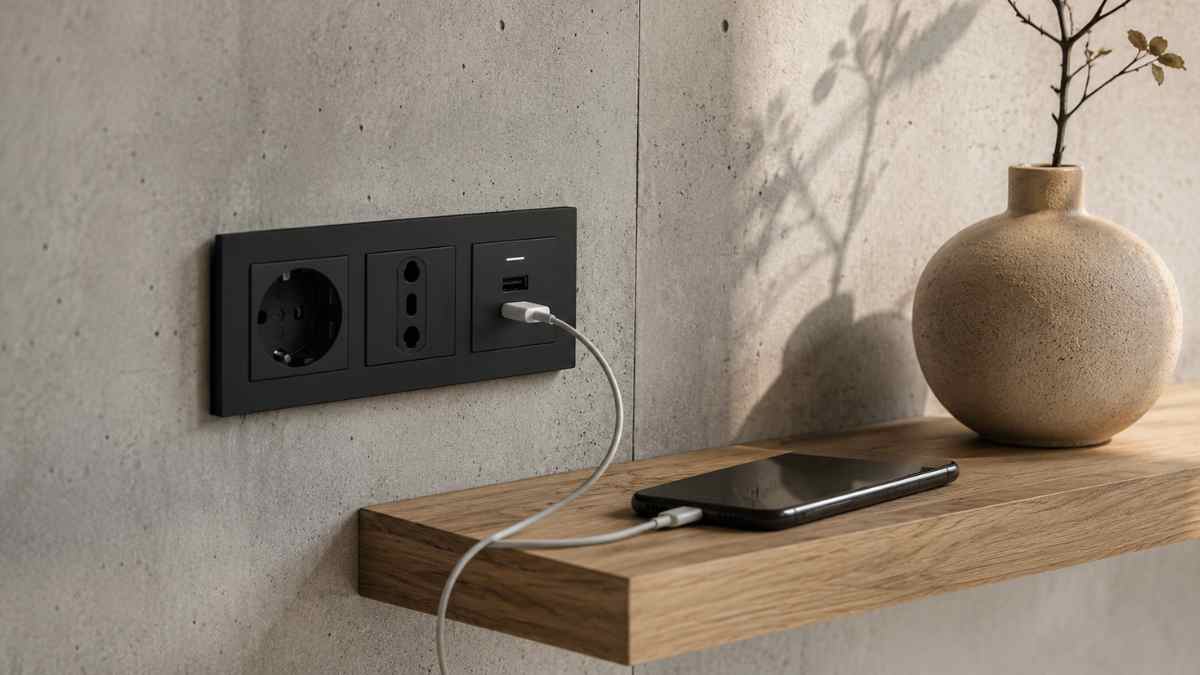
One of the most used solutions in this context is the USB+schuko flat wall socketswhich are installed in place of a standard Italian socket without modifying the system. Brands such as Legrand with the Céliane series or BTicino with the Living Now offer versions with built-in USB (type A and type C) that eliminate the need for bedside chargers. You will find them in large stores such as Leroy Merlin or on Amazon, with prices starting at 15 euros for the mechanism alone.
For those who don’t want to touch the system, e.g Mini wall extension hub like that of Allocacoc or Hama, they fit directly into the existing socket, protruding a few centimeters, carrying up to four connections in minimal space. They cost between 10 and 20 euros and can be found almost everywhere, even at Unieuro or MediaWorld.
Kitchen and study area: where the electricity never reaches where it is needed
In the kitchen the problem is the opposite: sockets abound on the worktop, but are missing exactly where an island, a mobile trolley or a small breakfast nook was added after the initial work was installed. And in the study area, especially if it is created in a non-special space, such as a corner of the living room or a niche, the socket is always wrong half a meter away.
For the kitchen, i electrified pieces from the work surface is the professional solution made accessible. Ikea offers the Sektion system with built-in sockets, but the most popular product on the Italian market is the Thorsman track or the modular Abb-Electrification system, which can be assembled by anyone who knows how to use a screwdriver. The advantage is that the sockets slide on the track and are placed where they are needed at the time. Prices start at €40 for the basic track on Amazon.
For the office in the living room or the position, the product that has changed the habits of the Italian home office is the table turret with integrated cable gland. Models like those from D-Line or Brennenstuhl screw or recess into the workbench and bring Schuko, USB-A and USB-C directly to the work surface. They can be found on Amazon for between 30 and 70 euros depending on ports and power.
Bathroom and corridor: the rooms forgotten by the system
The bathroom is the room where sockets are generally rare (the minimum safe distance from water always relegates them to inconvenient positions) and the hallway is the one where they are almost never present. However, both have become inhabited areas: the backlit mirror, the perfume diffuser, the hair straightener, the charging panel for household appliances.
For the bathroom, smart safe solutions for wet environments are IP44 socketscertified for use in zones 2 and 3. Brands such as Schneider Electric with the Unica series or Vimar with Arké offer aesthetically refined versions, in white or anthracite, that integrate without clashing. You cannot install them yourself if you are not familiar with systems, but the cost of hiring an electrician to add an outlet in the bathroom is often lower than you think: between 80 and 150 euros all inclusive, depending on the distance from the panel.
For the corridor, the fastest solution is multi-socket with single switch and flat cable be plugged into a nearby existing outlet. Hama and Trust produce compact models that protrude no more than six centimeters from the wall and carry three or four components. It costs less than 15 euros and can be found in any electronics store.
Smart home: when the socket becomes smart
The next step, the one that turns a practical solution into an active sustainability option, is the smart plugs with app control. This is not mind-blowing home automation: products like the TP-Link Tapo P115 (about 15 euros on Amazon) or the Meross MSS210 can be plugged into any standard Italian outlet and allow you to control the power supply remotely, turn the schedule on and off, and monitor consumption in real time.
Practical utility in the home is concrete: the living room lamp that turns on at a set time, the bedroom fan that turns off after an hour, the phone charger that stops supplying power at night. They integrate with Amazon Alexa, Google Home and Apple HomeKit without complicated configurations. For those who want a more structured ecosystem, the Philips Hue series integrates smart plugs into the lighting system, while Shelly with Plug S offers a more technical version, with open APIs for those who want to customize the behavior of the devices.
All this stuff can be found at Amazon Italia, Unieuro, Leroy Merlin and traditional electronics stores. You don’t need subscriptions, you don’t need a technician, and you don’t need to open a wall. We just need to understand, once and for all, that the socket in the wrong place is a project problem and that projects change.
A house is always inhabited differently than it was intended. The sockets remain where someone placed them twenty years ago, but the furniture is moved, the habits change, the objects to be charged multiply. Starting there, right where the current arrives, is probably the most specific form of light renovation there is.



