


Setting a summer table without slipping into the list of tourist villages requires only one thing: stop looking for perfect coordination. White goods, shells, ultramarine are there, they work, but only if used with a certain indifference that cannot be improvised by buying a full set of twelve. THE casual chic a tavola born from the idea that each item has its own story, not that it was bought together with the others in the same afternoon.
Hosting in summer means accepting that the framework works for you: light lasts longer, air carries smells and sounds, guests are more relaxed. You can do less and achieve more, as long as you do it well. An unironed linen tablecloth, three colors at most, some unexpected object in the center of the table. The difficulty is not in adding, but in taking away at the right time.
The unpaired dish is not an alternative
There is a subtle difference between a table that looks like it was put together at the last minute and a table that conveys an exact flavor despite the use of different elements. This difference is called consistency of tonenot of logic. You can mix opaque white plates with slightly ivory, a rough stone bowl with blown glass glasses, without the result looking like an empty warehouse.
The Portuguese brand Vista Alegre has built entire collections on this logic: pieces with different glossy, matte, partially enameled finishes designed to coexist. The collection Transatlanticfor example, it works in a palette that ranges from off-white to cobalt blue with touches of gold, and it works precisely because each piece stands on its own. Even Anthropologie, with its limited-edition, hand-painted stoneware plates, has normalized buying one plate at a time rather than the full set.
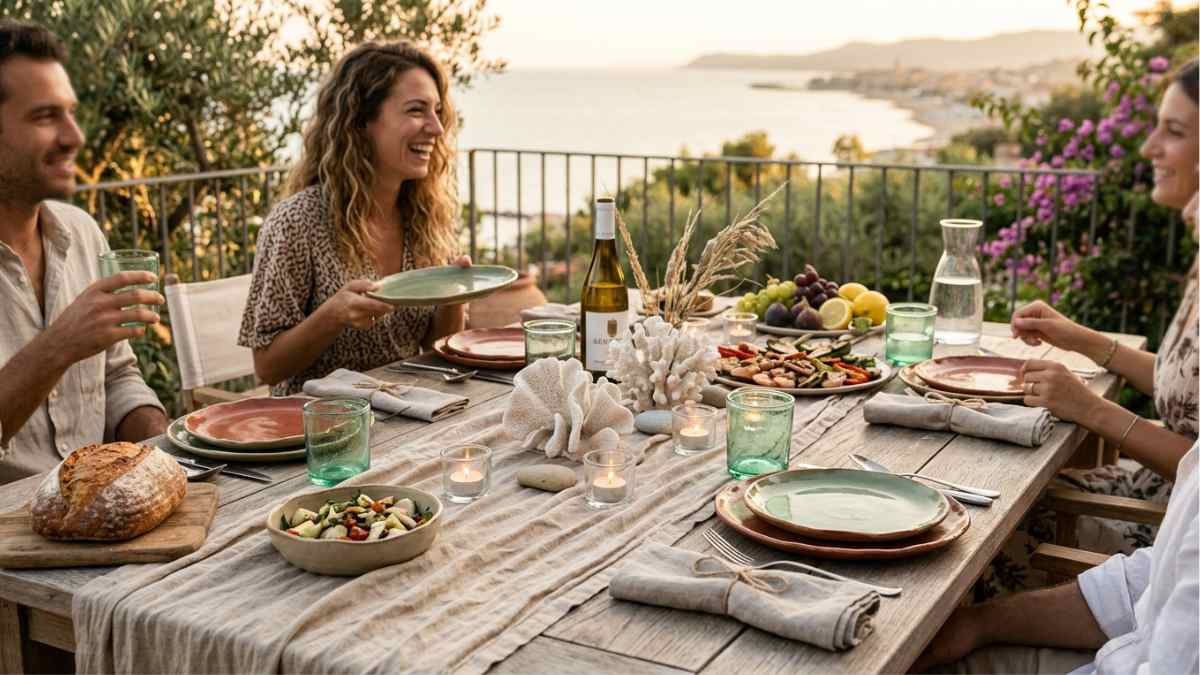
In practice: choose a basic form (all white dinner plates or all natural ceramics) and let the other variables, edge color, material texture and size say otherwise. Three terracotta glass soup plates paired with white dinner plates with a fine turquoise finish. Six plates all different in shape and color with no common thread, no.
Summer fabrics that are never out of place
Natural-colored raw linen has become almost a symbol of good minimalist summer taste, but for this very reason it should be used with care. The tablecloth, the napkins, the placements are repeated without variation, all the same lose all character and become an anonymous background.
A successful table could be this: washed linen tablecloth in the color of sandoptical white coarse weave cotton napkins, fine woven jute ramp in the center. The contrast between the warmth of the sand and the pure white is maintained without the need to add anything else. Or, for a more summery but not sunny tone, a light clay tablecloth with white and sage striped napkins with fine stripes, not the umbrella ones.
The French brand Garnier-Thiebauta historic textile manufacturer from Gérardmer, has been working for generations on jacquard linens with intricate textures that change appearance depending on the light. Their mercerized linen napkins have a rhythm that synthetic fabrics will never achieve. For those who prefer a more contemporary aesthetic, Ferm Living offers two-tone cotton napkins with exposed stitching and construction details that make an effortless statement piece.
The most effective trick with summer fabrics is to work textures and not prints. A tone-on-tone herringbone stitch fabric is worth more than a flamingo print.
The central table that does not take up all the space
The trend in recent years for summer centerpieces has led to arrangements so elaborate they look like installations: multiple vases, real fruit entwined with flowers, eucalyptus branches touching glasses. The result is a table where you don’t really know where to put your hands.
A centerpiece works when it leaves physical and visual space for the rest. Three small jars in blown glass Bitossi house at different heights, each with one or two stems of wild flowers or aromatic herbs (thyme, lavender, blooming rosemary), occupy less than forty linear centimeters and have an immediate impact. Or: a low natural ceramic tray with a few whole lemons, two or three medium-sized shells and a sprig of myrtle. Material, summery, recognizable without being didactic.

If the aesthetic of the table is more Scandinavian, gray linen, white earthenware, thin glasses, the centerpiece can be a single element: a minimal plant sculpture, a willow branch in a tall, narrow vase, or simply a series of cylindrical candles of different heights in natural unscented wax. The absence of color in the center balances the simplicity of the other elements without emptying the table.
Three tables, three different characters
To understand how these principles translate into specific practices, it’s worth imagining three summer launch scenarios, each with a defined personality.
Deconstructed Mediterranean table. Washed linen tablecloth in light terracotta, Vietri ceramic plates with raw unglazed edge, blown glass glasses with low turquoise, steel cutlery with olive wood handle. In the center, a lava stone cutting board with some olives and a sprig of oregano. No flowers, no candles. The heat of the materials does all the work.
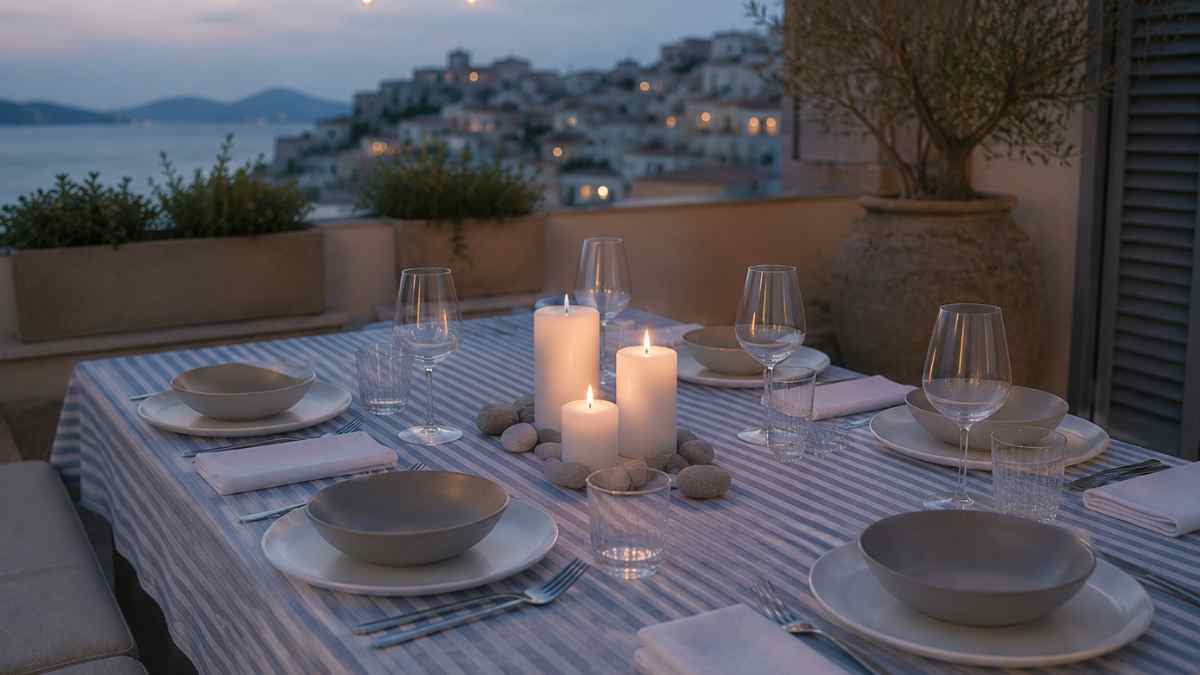
Scandinavian cuisine with a seaside touch. White and non-navy powder striped cotton tablecloth, powder blue optic white linen napkins, white dinner plates with gray matte soup plates, fine silver cutlery. Central: three white cylindrical candles of different heights and some smooth sea pebbles. Cool, clean, unexpectedly elegant for a terrace dinner.
Romantic summer table with no frills. Unironed butter-colored cotton tablecloth (the folding of the clothes is part of the look), mixed deep plates in white and blue majolica, smooth ivory blouses, stemmed glasses in clear glass, matte gold cutlery. In the center a low potted vase with white buttercups and one or two fig branches with leaves. Irresistible because it doesn’t try to be.
In each of these installations, the common thread is not style but coherence in dissonance: each element knows they are in company without having to wear the same uniform.



