


Anyone who has spent a summer in a house with terracotta or natural stone floors knows that there is a difference that cannot be measured with just a thermometer. Bare feet, early in the morning, on a surface that still retains the coolness of the night: it is one of the few sensations that the body immediately perceives a benefit before the mind processes it. We are not talking about hidden air conditioners, nor about expensive technological solutions.
We are talking about materials that work according to very ancient natural principles and cleaning practices that, if done in the right way, enhance what the floor already does on its own. Flooring choice is perhaps the most underrated variable in a home’s summer comfort. It affects perceived temperature, relative humidity and how heat accumulates or dissipates.
The physics of coolness underfoot
Natural materials such as marble, travertine, limestone and high-density porcelain have one property in common: thermal inertia. They accumulate the cold of the night hours and release it slowly during the day, acting as a kind of passive thermal battery. Calacatta marble, for example, has a thermal conductivity of around 2.5 W/m·K, almost three times that of a solid wood parquet. This means that at the same ambient temperature, the marble surface is noticeably cooler to the touch.
Handmade terracotta follows a slightly different logic: it is porous, breathable and in the presence of natural ventilation promotes slight evaporation that lowers the surface temperature. Tuscan or Apulian farmhouses built before the building boom systematically exploited this principle: raw terracotta floorswindows that were opened only at dawn and dusk, shutters closed in the central hours. A complete passive system that operated without any mechanical intervention.
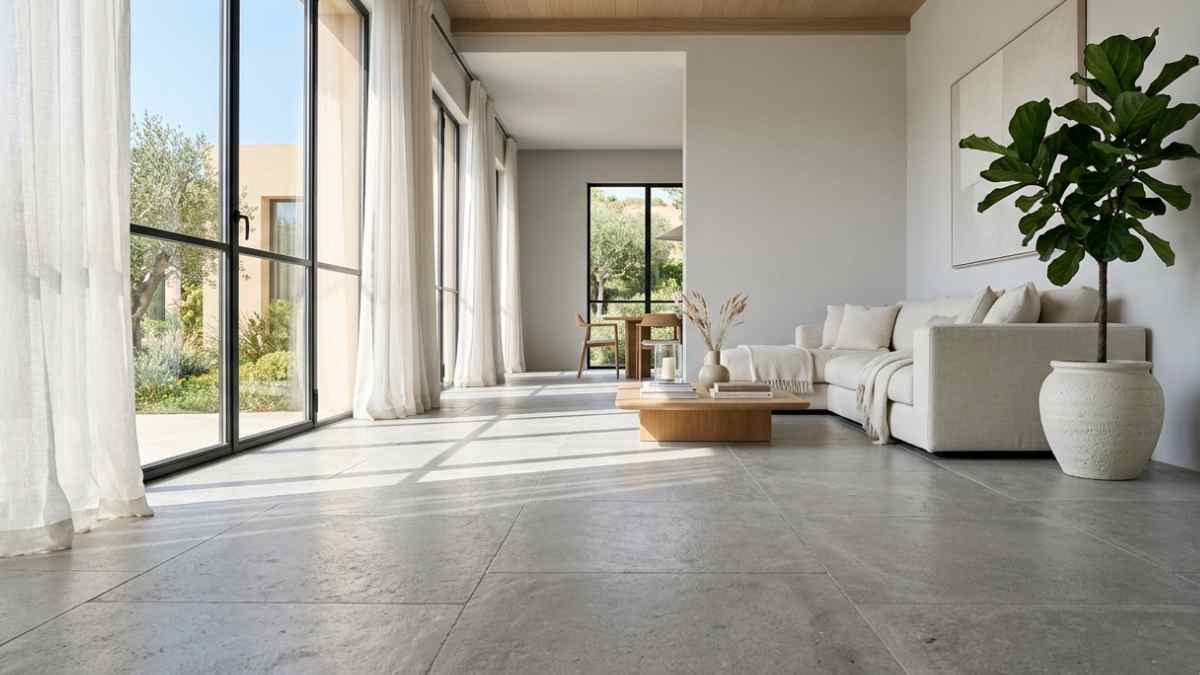
Technical porcelain, In versions with low water absorption (less than 0.5%), they are similar in behavior to natural stone. Brand like Flourishwith the Pietre di Fossena series or Rex with the Etoile de Rex series, they offer slabs imitating limestone with a thin thickness (6 mm) and reduced mass, at a cost significantly lower than natural stone. The thermal performance is not identical, but the difference compared to a laminate or vinyl is clear and measurable.
What happens when you clean the wrong way
A stone floor or cooked neat works best. It is not an aesthetic issue: a thin layer of detergent residue, limestone dust or wax forms an insulating film that reduces the thermal conductivity of the surface. It is a minimal effect, but when added to the entire surface of a house it becomes noticeable.
The first mistake from Avoid using foam cleaners on natural stone floors. As the foam dries, it leaves a film that bleeds the surface and changes its thermal behavior. For marble, travertine, and limestone, the correct product is a detergent with neutral pH especially for stone surfaces, such as those from the Fila Surface Care series or the German brand HG, diluted in cold or lukewarm water, never hot. Hot water opens the pores of the stone and favors the deposition of mineral salts.
For untreated terracotta or with a natural wax finish, frequent washing with plenty of water is not recommended. Better is a well-wrung damp cloth, which is wiped early in the morning to take advantage of the evaporation in the following hours. Adding vinegar in washing water, popular in many homes, is contraindicated on any calcareous surface: acetic acid attacks calcium carbonate and over time corrodes the surface, dulling it irreversibly.
Materials to be re-evaluated: limestone and Venetian terrace
In addition to the narrative of the big brands, there are two materials that deserve attention for their thermal properties and relative affordability. The first is the local limestoneavailable in very different local versions (Pietra di Trani, Pietra Serena, Nembro), which has the advantage of reduced environmental impact compared to imported materials and a thermal conductivity comparable to marble. Supply and installation prices start from around 60-90 euros per square meter for standard versions, with significant variations based on surface treatment.
The second is the Venetian terrace, which has come back into fashion in recent years thanks to architectural firms such as the Spanish studio Francesc Rifé and the work of brands such as Concreteworks. It is a continuous blend of Portland cement, marbles and natural pigments, hand applied and polished. Its thermal characteristic comes from the mass: a 3-4 cm thick Venetian terrazzo floor effectively accumulates the cold at night and retains it for many hours. The continuous surface, without joints, is also easier to clean and does not retain dust in the rooms.
The maintenance of the Venetian terrace requires a specific natural wax, applied once or twice a year and daily cleaning with a damp cloth. No aggressive productsno steam, no abrasive brush. In return, a duration measured in decades.
The cleaning routine as a summer thermal strategy
There is a practical aspect that works regardless of the type of floor. In warm months, wiping the floor with a slightly damp cloth in the early morning hours, before the outside temperature rises, lowers the surface temperature by 1-2 degrees through evaporation. It is not a huge figure, but on a surface of 60-80 square meters it makes a real contribution to the interior microclimate.
The same logic applies to the choice of hours: airing the house at night and in the early hours of the morning allows the floor to lower its temperature. Closing everything during the central hours preserves the accumulated coolness. With a quality natural stone or engineered stone floor, this cycle is sufficient to keep the house at a perceived temperature 3-4 degrees lower than outside, without any mechanical support.
Good cleaning, with the right products and at the right times, is not just domestic hygiene. It is the maintenance of a passive thermal system that, if it works, makes much of the artificial air conditioning unnecessary. The floor works even when you can’t see it working. Just don’t get in his way.



