


A three square meter balcony in Milan, Turin or Rome is not a size problem. It’s a matter of intention. Most small urban terraces are furnished as if they were a shelf: something to place things that don’t fit inside. A few plastic chairs, an ashtray, maybe a forgotten vase. The result is a space that belongs neither inside nor outside, a gray area rarely used and treated with a sense of missed opportunity.
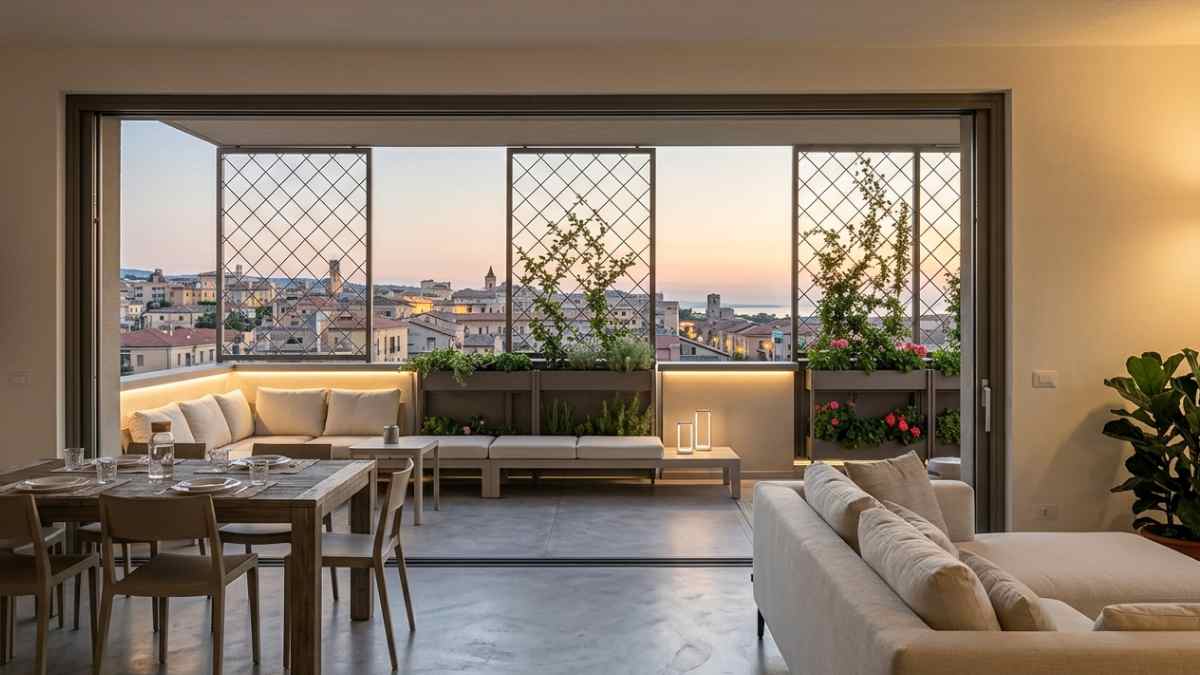
It only takes one change of perspective: the balcony is not an annex of the living room, but its outer edge. If designed with this logic, even the two and a half meters deep becomes an easy-to-read, usable environment, capable of visually multiplying the surface of the apartment. The tools to do this exist, are accurate, and cost less than you might think.
The floor as a signature of the environment
The first visual signal that the eye registers when looking out is the horizontal plane. If the The floor of the balcony is made of raw concrete80s tiles or metal grill, whatever you put in it will look like it’s gone. The most effective way to create visual continuity between the interior and exterior is to align the tone of the exterior flooring with the interior, or at least make it consistent with the living room palette.
THE composite wood platforms interlockings, which can be installed without glue or labor, have achieved a remarkable aesthetic quality. Brands such as Ubbink or Blooma (Castorama) offer versions in WPC with reliable wood grain, in shades ranging from light oak to dark teak. Cost: between 15 and 35 euros per square meter. If the interior parquet is light, a bleached oak platform eliminates the boundary between the window and the balcony, especially in the months when the French window remains open.
Those who prefer stone, h porcelain concrete tiles in 60×60 or 60×120 form they create a surface almost identical to modern interior floors. Marazzi and Ragno have outdoor lines that are color-coded to their indoor tiles, designed for just this kind of continuity.
Vegetation as vertical architecture
On small balconies, vegetation should be treated as a structural element and not as a decoration. A table, two chairs and ten scattered vases create chaos. The same amount of greenery, concentrated vertically on one side or on the perimeter, frees up the horizontal plane and creates a scenographic backdrop.
THE hinged plant walls The pocket, like those of Lechuza or Vibia Outdoor, are fixed to the railings or the perimeter walls and can accommodate roots, ivy, herbs or aromatic herbs. They take up zero centimeters of floor space. Planters with railings work on the same principle: very long, narrow, placed on the outer edge, they create a green line that frames the balcony without stealing its surface.
If you want a single item that affects, a dwarf olive in a tall, narrow pot (not the low round vase, which has a heavy presence) does it all by itself. Representative of Mediterranean minimalism, it resists urban exposure well. The shape of the vase matters as much as the plant: Serralunga’s 60-80cm cement tube vases give vertical proportions that work better on a small balcony than any wide, low vase.
Furniture that does not block the eye
On a small balcony, the full chair is a proportional error. Any seat with a solid back, thick upholstery or opaque structure reduces the visual space far beyond its natural size. The solution is not to give up comfort, but to choose pieces with optically light structure.
Fermob Bistro, in perforated metal, is the most cited example for a specific reason: it weighs 3.6 kg, is stackable, and its mesh structure does not interrupt the view. Alternatively, Hay’s Slatted range, in teak or aluminium, has a slim profile that doesn’t weigh down even the narrowest of balconies. For those who want soft seating, woven rope armchairs in thin frames, such as those from Kettal or the more affordable Sklum, maintain visual lightness while adding comfort.
The table, if necessary, must be able to disappear. Folding wall tables, such as Ikea’s Norberg or String Furniture’s more sophisticated versions, lower and raise in thirty seconds and return the space when not in use. It’s not a compromise: it’s smart design applied to a small surface area.
Light, fabric text and the border issue
The balcony that acts as an extension of the living room is not only recognizable during the day. At night, the difference between a space that is left in the dark and one that invites you to sit down is almost entirely lighting. Not the headlights, which give a cold and directional light that is not suitable for relaxation. THE Warm light LED string lights (2700K), wrapped around the railing, pergola structure or planter posts, create an evening atmosphere without electrical installations. Philips Hue has an external version controlled by apps. for a more economical solution, Govee’s IP65 tapes perform well and resist moisture.
The textile is the last element and one of the most underrated. An outdoor rug under the chairs, made of washable synthetic fiber, marks the perimeter of the outdoor living area just as it would in the living room. Sklum offers more modern versions with geometric patterns. Cushions covered with Olefin or Sunbrella fabric withstand the sun and rain without losing color after the first summer.
An outdoor cushion in the same color as those on the sofa in the living room is not an insignificant detail. When the French window is open, the eye perceives the color continuity as a sign of belonging: that the space outside is the same room.
When borders become invisible
Continuity between inside and outside is not achieved by taking the living room outside. This is achieved by ensuring that the two environments recognize each other. Same color palette, same sense of height, same attention to materials. You don’t need much: a cohesive floor, a light seat, something green vertically and a warm light source in the evening.
The three square meter balcony overlooking a courtyard in Milan can become the place where you have breakfast, where you have a drink at seven in the evening, where you sit for ten minutes in silence before starting the day. Not by magic or because of an off-scale budget, but because someone decided to treat it like an environment rather than an open-air closet.



