


There is a subtle difference between a working room and a working room convince. It is not a matter of new furniture or painted walls. Sometimes it’s just a matter of where you place a light source and what you decide to leave in shadow. Interiors photographed in design magazines almost all have one thing in common: they’re not perfect, but nobody cares. Because the viewer’s eye is occupied elsewhere, guided to a precise angle, to a texture, to an ambient heat that is elegantly distracting.
This is neither magic nor trickery: it’s the logic that lighting designers have worked with for decades, finally applied on a domestic scale. And the living room, which in most Italian homes still bears the marks of the choices made years ago, the not very high ceilings, the slightly irregular walls, is the place where this logic can make the most visible difference.
The light coming down from the ceiling is located
The starting point, almost always, is to stop relying on the central ceiling light. Not because it’s completely wrong, but because top-down lighting with a single source casts vertical shadows on everything: the walls, people’s faces, the imperfections in the plaster. It is the most democratic light there is, in the worst sense of the term: it treats all corners of the living room equally, without favoring anyone.
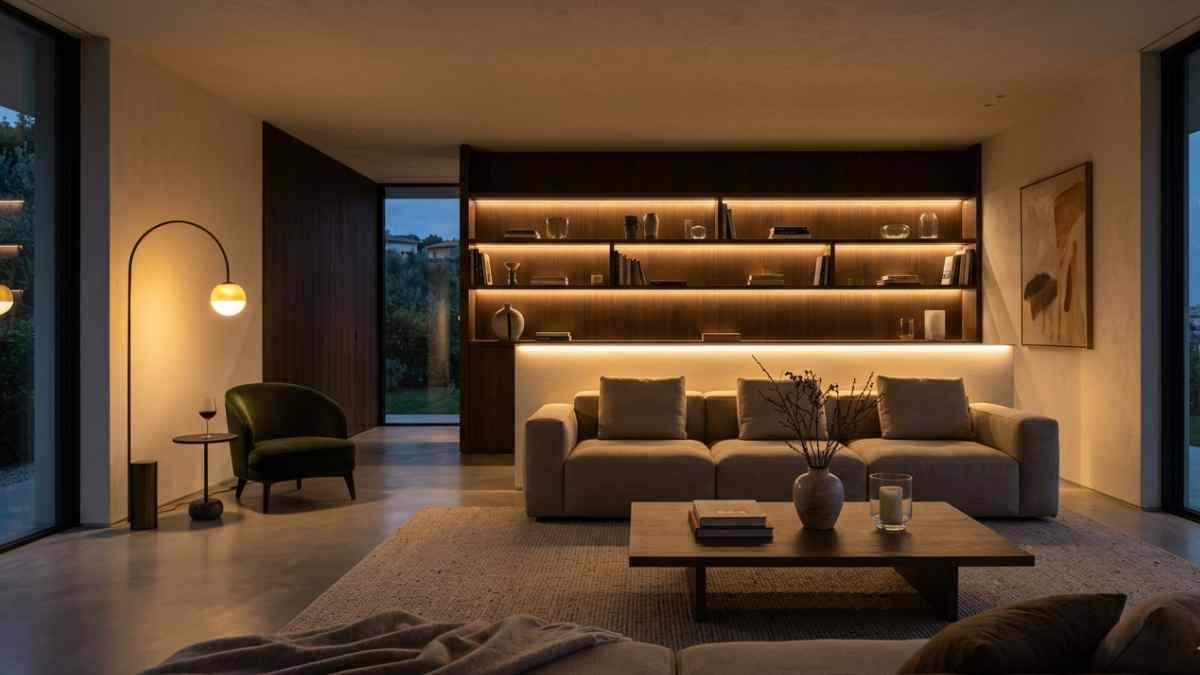
The opposite of this uniformity is called multi-level lighting. It means building the living room light on different levels, with the sources working independently and at different heights. A floor lamp next to the sofa, a sconce projecting light towards the ceiling in a corner, a table lamp on a sideboard. Together they produce an environment in which the gaze moves horizontally, does not descend from top to bottom, and architectural imperfections cease to be protagonists.
Porro, the Brianza brand known for furniture with built-in light, has made this principle part of its design language since the late 90s: backlit sideboards do not only serve to display objects, but serve to create a lateral light source that softens the entire room.
Corners that work, walls that disappear
In homes with limited heights or walls that are not perfectly regular, the most effective way to distract is to use vertical grazing light. It involves placing a light source near a wall, oriented upwards, so that the light flows along the surface. The visual effect elongates the room upwards and at the same time creates a level of warmth that distracts from any structural irregularities.
Adjustable wall lights from Flos, such as the Bon Jour series or the latest Bellhop Wall in the battery version, lend themselves to this type of installation because they do not require fixed wiring and can be moved until the right angle is found. Not everyone wants to drill a hole in the wall only to discover that the location wasn’t ideal.
Another technique that works in living rooms with tall furniture is to include indirect light above bookcases or wall unitsoriented towards the ceiling. It creates a warm halo that makes the ceiling appear higher than it is and transforms this often dusty and neglected space between furniture and ceiling into something purposeful. IKEA sells warm light self-adhesive LED strips for less than fifteen euros, which, used in this way, produce an effect that many confuse with personalized solutions.
The role of floor lighting in quiet luxury
Of all the lighting elements in the home, the floor lamp is perhaps the most underrated. It is relegated to the corners as a magazine, picked to fill an empty slot and rarely activated. However, it is the most powerful tool for redefining the atmosphere of a living room without touching anything structural.
A floor lamp with a natural fabric diffuser, placed laterally in relation to the sofa, creates a source of warm light that surrounds without dominating. The eye perceives it as a secondary center of gravity of the room and stops looking for flaws elsewhere. The aesthetic reference here is his quiet luxury applied to lighting: nothing fancy, nothing unnecessary, just good materials and a light that doesn’t rush to be noticed.
Santa & Cole, a Spanish brand with a solid history in lighting design, has for years produced floor lamps with cotton or linen shades that diffuse a light so even and soft that it seems natural. The Tripod model, designed by Guayabero and Oi! in 2006, it remains one of the most copied references in the industry precisely because of this ability to adapt without imposing. Price around 350 euros, which in terms of visual impact is easily equivalent to a small renovation.
Dimmer: the variable that changes everything
If there is a low-cost investment that radically changes the perception of a living room, it is the faintest. Not in the usual sense of dimming the light at night, but in the more subtle sense of being able to calibrate the intensity of the light based on the time, the season, the mood of the room.
A living room with full light at noon and the same light at dinner seem like two different environments, and not in a good way. Even with a simple adjustment system, any imperfection that would make direct light visible can be simple faded out of the perceptual field. It does not disappear: it ceases to be interesting.
Lutron’s smart systems, used by high-end hotels and restaurants for thirty years, have reached the home sector with wireless solutions that do not require replacing the systems. For those who don’t want to deal with the complexity of a home automation system, even a simple built-in electrician’s dimmer, placed in one or two strategic outlets, makes a noticeable difference within days of installation.
The light that never changes describes the room in a fixed, rigid way. What fits becomes part of the room itself, and the room begins to look alive, inhabited, chosen, regardless of what is on the walls or underfoot.



