


Buying a dining room rug is, in most cases, an aesthetic decision. You look at the color, the texture, if it’s washable, if it holds dogs. Then the carpet arrives, is placed under the table and for a few days everything seems to work. The problem comes later, in the routine: someone moves the chair to sit down and that chair sticks to the edge. The same thing happens when you stand up.
Each meal becomes a small silent battle with the floor, a small effort that no one expected and which, added up over hundreds of uses, begins to weigh disproportionately compared to the object that causes it.
The carpet under a dining table is not a neutral decorative element: it is an object that interacts with the behavior of those who eat, with the weight of the chairs, with the type of floor below. Its incorrect dimensioning means that the daily use of the space and not only the aesthetics is at stake. And the difference between a right and wrong measurement is often a few centimeters, those centimeters that no picture on Pinterest shows when a chair is pulled back.
The engineering that no one examines before they buy
A dining chair, when someone sits down or stands up, travels on average between 40 and 50 centimeters away from the edge of the table. This is the data that determines everything. If the mat does not cover this distance on all sides, the back legs of the chair will end up off the mat at the very moment when the body’s weight is bearing down on them the most. The result is a warped edge, a wobbly chair, a wood or stone floor that suffers avoidable scratches.
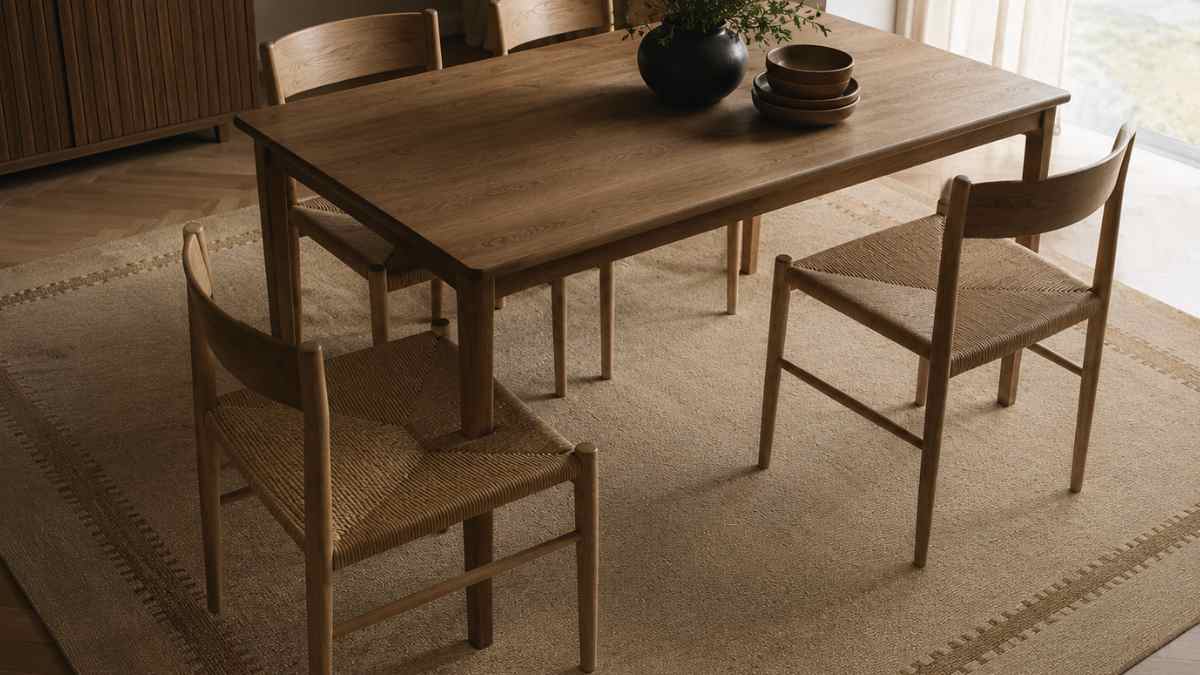
THE 60-70 cm rule per side is what was adopted by interior designers to guarantee complete freedom of movement. It means that by taking the surface of the table, you add this measurement to each side to get the minimum size of the rug. Therefore, a rectangular table 160×90 cm requires a carpet of at least 280×210 cm, preferably 300×240 cm. These formats exist, but are less common in general distribution: Ikea almost always stops at 230×160 or 250×350, while brands like Nanimarquina o Kvadrat produce to measure with costs starting from 800-900 euros for contract plans.
The floor directly contributes to the difficulty. On a smooth parquet, a chair with plastic legs slides almost without friction. on a medium pile rug, the same feet meet resistance. If the carpet is too short, the transition between the two surfaces creates a mechanical jolt that over time loosens the joints of the chairs themselves. This is no exaggeration: contract chair manufacturers such as Kartell for the Masters series or Vitra for HAL explicitly test the compatibility of the legs with soft surfaces for this very reason.
Size, not shape: where you’re really going wrong
The temptation of the round rug under a round table is strong and visually it makes sense. But a 200 cm diameter circle placed under a 120 cm round table leaves about 40 cm per side, just insufficient to contain the movement of the chairs. You need at least 240 cm in diameter, a form that exists in few collections on the Italian market: Hay offers it in the short-pile pea range, with prices around €350-500, while Gan Rugs reaches 240cm with woven jute rugs, more suitable for informal settings.
The problem with rectangular rugs is different and more subtle: many are placed in the wrong orientation relative to the table. A 200×140 cm rectangle placed under an extendable table can work with the table closed and prevent any movement of the chairs with the table open. Expandable tables, a category that represents a significant share of sales in the mid-range, according to Csil Milano 2022 data, require carpets that take into account the extended configuration rather than the basic one.
Another common mistake is with kilim or flat-weave rugs: the low pile reduces friction but doesn’t eliminate it, and the edges of these rugs tend to be stiffer. The chairs bend over them instead of sliding over them, creating a visible and functional difference in height. The edge finish Size is just as important: a cotton taped edge performs better than a machine-stitched edge on a synthetic fabric.
The floor decides how much leeway you have
There are material combinations that make the edge problem worse and others that make it almost irrelevant. A carpet with a pile greater than 15 mm on floating parquet creates instability because the floor itself has a certain softness and the carpet reinforces it. In these cases, the anti-slip underlay is necessary, but must be chosen according to the type of installation: perforated PVC underlays work well on porcelain tiles, much less on parquet because they prevent the wood from breathing.
On resin or polished concrete floors, the dynamic is reversed: the carpet tends to slide along with the chairs, dragging itself along. A natural rubber underlay recommended for example by Bolia in the 140×200 and 170×240 cm version around 60-80 euros is the most effective solution, with the caveat that some types of natural rubber leave permanent marks on the resin if left still for months.
Terracotta or natural stone floors with strong joints present a further technical detail: chair legs, even with felt legs, tend to slide on surface irregularities. A properly sized rug protects both the floor and the chair, eliminating the type of localized wear that otherwise silently accumulates.
When the carpet is there but the problem remains
Some combinations are structurally difficult to solve with size alone. A table with a central base widely used in contemporary projects, such as Saarinen’s Tulip reproduced by Knoll or the cheaper versions by Calligaris, frees the perimeter from the table legs, but this does not eliminate the problem of the edge of the carpet: the chairs still move outwards, and even more freely like the table.
In these cases, the solution is to make the rug larger than usual by at least 70-80 cm per side in relation to the surface, or accept that the rug acts as a purely decorative perimeter element and deal with the movement of the chairs with sliding legs in PTFE (Teflon), which almost completely reduce friction on any hard surface.
A table with sled chairs, like the version of the Eames Plastic Chair series DSS by Vitra, requires even more space because the sled base slides with a wider track than traditional legs. No manufacturer explicitly writes this in their technical data sheets, but it is a detail that those who design environments with these chairs know from direct experience.
The right carpet for a dining room is not the most beautiful on the list, nor is it the most common form. It remains silent for years if chosen correctly. It speaks differently to every meal, with that curling edge and that chair resisting a little, everyday, totally avoidable resistance.



