


Japan has a long history of finding aesthetic solutions to specific problems. THE armament it was born this way: not as a living room decoration for those who want to look minimalistic on Instagram, but as a cultivation technique developed during the Edo period, when land was scarce and gardens were a luxury reserved for the few. The idea is as simple as it is effective: the roots of the plant are wrapped in a mixture of akadama (granular Japanese clay) and moss, are tied with hemp or cotton thread, and the resulting ball is hung or placed without the need for a vase. A plant that brings its own soil with it, like a little bubble of a self-sufficient ecosystem.
What was an exercise in necessity design has become, in recent years, one of the most interesting approaches to home greening. Not because it is “modern” in the empty sense of the term, but because it responds to a real problem: houses have become smaller, shelves are already occupied, and putting one more terracotta vase on a KALLAX shelf adds nothing to anyone. The kokedama occupies the air space, that which is almost always left unused between the floor and the ceiling.
From Kyoto to your living room ceiling: what’s behind a moss ball
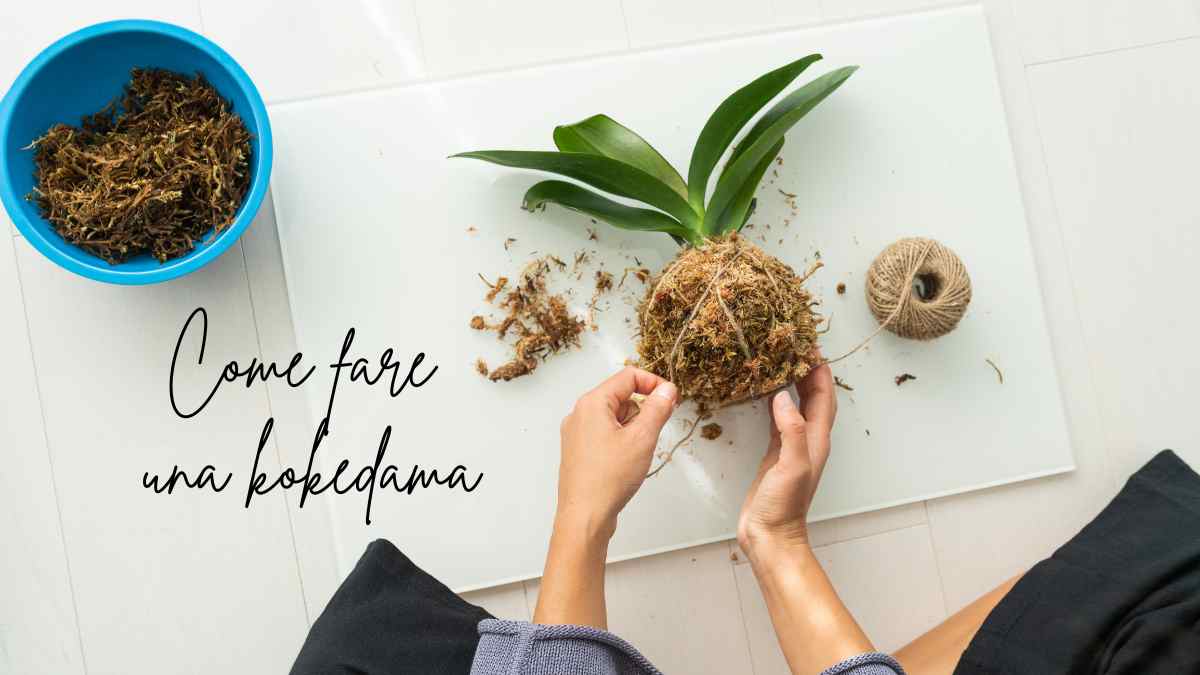
The traditional technique involves a specific mixture of substrates. The classic analogy is 7 party in akadama for 3 parts of it torba a terra da bonsaimixed with water until it has a pliable consistency. The ball of substrate is first formed around the roots and then rolled sphagnum moss or flat moss, and finally fixed with wire. No glue needed, no artificial support needed: the compression of the moss holds everything together.
The result is an object that changes over time. Live moss darkens when well hydrated and tends to straw yellow when thirsty. This makes kokedama a natural indicator of plant water status, much more intuitive than any app or soil probe. To water it, you dip the ball in the water to 10-15 minutes every 7-10 days in summer, every two weeks in winter. It is then allowed to drain and re-hung.
For beginners, the most suitable plants are those that tolerate humidity fluctuations without collapsing: Asparagus setaceusferns like the Raised kidney stone, Ficus linelust, but also some talents for bright environments. Phalaenopsis orchids do well but require more attention to the substrate. Succulents, on the other hand, do not tolerate wet moss around their roots and tend to rot.
Hang green without drilling into ceilings and without losing your mind
The practical problem that holds many back is proofreading. No one wants to drill holes in the ceiling for three moss balls. The cleanest solution is to use vertical voltage systems: telescopic rods hanging between the floor and the ceiling, to which the cables are anchored. There are very sophisticated versions on the market, such as those in the series Stretched Material by Danish designer Nichlas Hojgaard, designed specifically for floating greenery in contemporary interiors.
A less structured but equally effective alternative is the macrame support: nets or straps of raw cotton or jute rope that support the ball and are anchored to a single wall hook, much less invasive than a multi-point system. Normann Copenhagen offered support to matt brass that work well with Medium-sized Kokedamai, tra i 10 and 20 cm in diameter. Brass ages well, oxidizes in interesting ways and lasts for approx 2 kilos in weight, adequate for most household bullets.
For those who rent and cannot touch walls or ceilings, the most honest solution remains to mount them: on an elevated surface, on a Japanese ceramic support (the suibanthe flat trays used in bonsai), or in small concrete bowls. It’s not the aerial version, but it’s still a way to bring the logic of kokedama home without structural compromise.
In which rooms it works and in which it is just a failed experiment
The environment makes the difference. A cockade with a Boston fern in a bathroom with a window and natural humidity it will grow almost autonomously, with minimal interventions. The same kokedama in a dark, dry hallway will last a few weeks before becoming a throwaway ball of yellow moss.
The rooms where the system works best are those with constant indirect light and some degree of environmental humidity: bathrooms with windows, kitchens with east or west exposure, living rooms not exposed directly to the afternoon sun. The minimum light threshold is approx 300-500 lux for most kokedama plants, a value corresponding to being at no more than 2 meters from a window on a cloudy day.
In business areas, the trend has taken another direction. Many branded restaurants and hotels they use multiple kokedama compositions at different heights to create what is called interior decoration green ceiling: vegetated roof without permanent structures. The most cited reference in this context is the work of the studio Wild plants of Amsterdam, which has developed installations for retail spaces that use spheres up to 40 cm in diameter with Monstera deliciosa and Philodendron gloriosum, anchored in hinged metal grids.
The Italian market and where you will find materials that stand up to the comparison with the original technique
In Italy kokedama has a network of specialist artisans and nurseries that is still underrated. The industry markets like Gardening in Milan every year they host dedicated booths with ready-made koketama, but also kits for those who want to make them at home. Prices range from 12-15 euros for small spheres with resistant plants up to 60-80 euros for compositions with rarer or larger plants.
For loose materials, akadama is easily found in bonsai stores and on Amazon: a package 14 liters of fine akadama (grain size 1-6 mm) costs approx 18-22 euros and is sufficient for about ten medium-sized balls. From which you can find quality dry Sphagnum moss, the ones that are then rehydrated Baker and from many specialist garden centres.
Those looking for a more refined and already assembled version, without wanting to improvise with earth and wire in the kitchen, can look at the catalogs of Westwingwhich offers periodicals of Italian and European craft production, or Homes of the Worldwhere the prices are more affordable but the quality of the plants varies and it is worth checking the condition of the mosses before buying.
A well made hard ball of moss two or three years before the substrate wears out and needs replacement. In the meantime, the roots grow, come out of the sphere, create new shapes that no vase would have created. It is one of the few house decorations that gets better as it grows, assuming you give it enough water and a decent window.



