


There’s a precise time limit at which entering a tiny house stops working: it’s when the beach bag enters the scene. It’s not about size, it’s about shape. The beach bag does not fit on any shoe rack, does not hang on standard hooks, does not stack. It sits on the floor, takes up half a square meter of passage, and stays there for the whole summer along with the straw hat, spare sunglasses and an unknown number of flip-flops that seem to multiply independently.
The problem isn’t the quantity of stuff: it’s that the winter entry system, designed for jackets and closed-toe shoes, isn’t equipped to handle the seasonality of summer. Buying a bigger shoe rack doesn’t solve anything: it adds a piece of furniture that reduces the passage in a small entryway and doesn’t solve the problem of wide-brimmed hats, bulky bags or rolled towels.
The peg is not a laboratory accessory: it is a wall that thinks
The perforated panel, universally known as pegit comes from the tradition of craft workshops and machine shops, where the need to have tools available in variable configurations has created the most flexible system in existence. Inserted into the domestic entrance, it completely changes the logic of the space: instead of having fixed containers that force objects into predetermined categories, you have an infinitely reconfigurable grid that adapts to seasonal objects without requiring any structural intervention.
One panel inside 12mm birch plywoodpainted or left natural, mounted on the wall behind the entrance door with spacers 3-4 cm from the wall, it takes up zero floor space and offers an organizational surface that can accommodate wide-brimmed hat hooks, horizontal bars for vertically hanging bags, small wire baskets for sunglasses and keys, and shelves for sunscreen. In summer the hooks go up for hats, in autumn they are reconfigured for jackets. Same table, no other purchase.
Ikea sells the system It is seen in wood and metal versions with modular accessories starting from 15 euros for the base panel, with a range of accessories including containers, shelves and hooks in various sizes. For a more aesthetically refined version, In the army has the system They stack up which applies the same modular logic with a finish closer to designer furniture. The price difference is significant, but the principle is the same.
The free floor as a priority: rails, profiles and retractable solutions for shoes
Summer footwear is the first element that colonizes the entrance floor. Sandals don’t stack, flip flops slip, espadrilles warp when pressed. A closed shoe rack in the summer accumulates residual moisture and odors that no air freshener can really compensate for.
The most effective solution for open shoes is to keep them visible and ventilated, but not on the floor. THE horizontal wall profilesplaced a few centimeters off the ground, they allow you to secure the sandals by the sole or strap, keeping them parallel to the wall and completely elevated. It is not a very common commercial system in Italy, but it is easily made with a stainless steel rod 16 mm in diameter, attached with wall brackets approx 15 cm from the floor. The cost of materials is approx 20-25 euros for a linear measure.
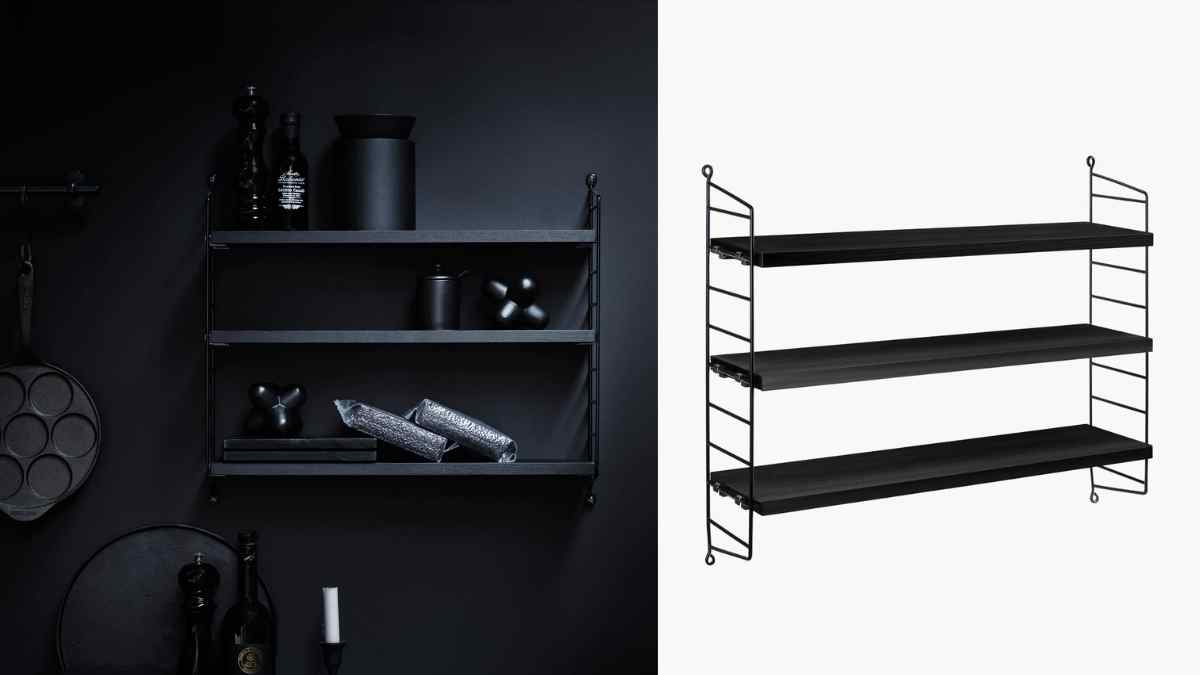
For those who prefer a solution that can be purchased without intervention, the inclined wall shelves like those in the series di String shoe rack they work on the same principle: the shoes are placed at an angle, with the nose down, in a structure that takes up less than 15 cm depth from the wall. Three shelves high 60 cm they hold up to nine pairs of open shoes while keeping the floor completely clean underneath.
The Shaker hook and the logic of the single line
The Shaker system, that of the horizontal wall bar with regularly placed turned wooden hooks, is one of the longest standing systems of vertical organization in existence: American Shaker communities were already using it in the eighteenth century to keep the furniture itself hanging on the walls when not needed. At the modern entrance, a Single Row Shaker Bar placed in approx 170-175 cm from the floor elegantly solves the problem of hats, shoulder bags and light summer jackets.
The advantage over single hooks is the continuous modularity: you can move any object to the side without having to remove and reattach any hooks. The standard distance between the hooks is 20 cmenough to hang a wide-brimmed hat without touching the one next to it. Wire industry produces brass and steel Shaker rods with high quality finishes. For more accessible versions, Zara Home in recent years he has suggested bars made of natural ash wood with matching hooks underneath 35 euros for a meter length.
The space-saving seat that does three things at once
In small entryways, every piece of furniture must justify its presence by doing at least two things. A low seat with built-in storage is the element that solves three problems at once: it offers a support surface to sit on to put on sandals, it hides beach towels and bulky beach accessories in the inner compartment, and it visually defines the entrance area without requiring more than 40-50 cm of depth.
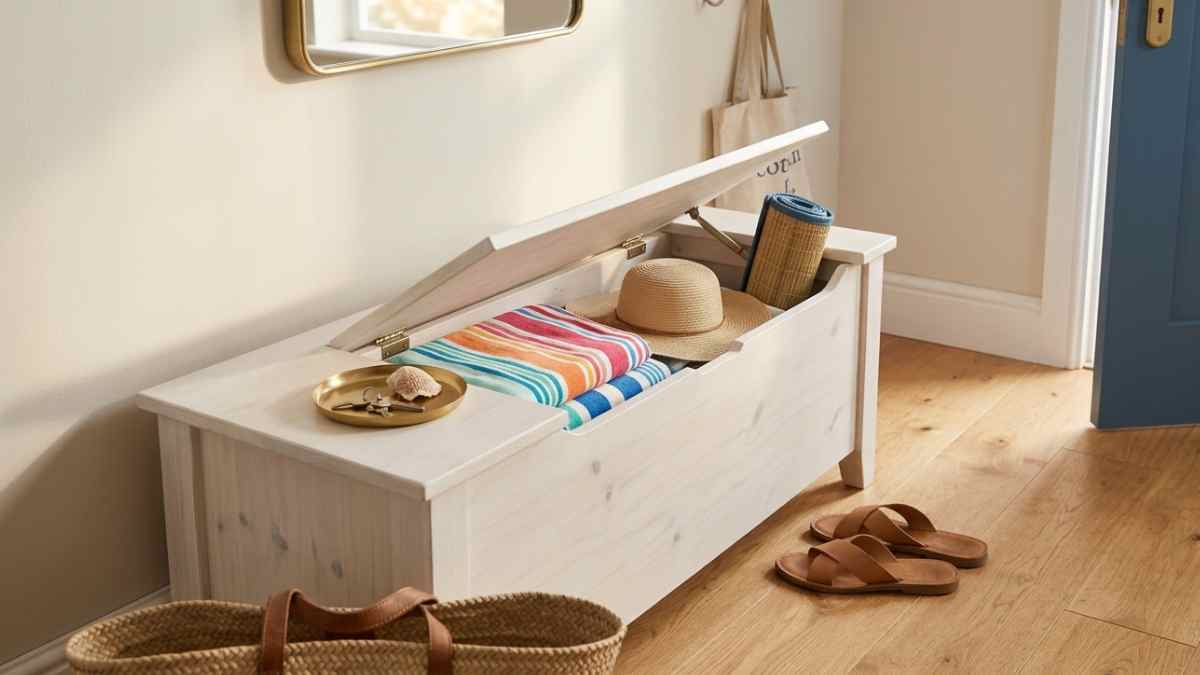
The most effective storage counters for small entryways are those with a folding top surface opening and at least a high interior compartment 25 cmenough to fit roll towels or flat bags. Hay with it Loop Stand Storage offers a lacquered steel version with a wooden lid that works well visually even in small rooms, because the metal structure does not create a complete visual mass. For those looking for something lower in price, the panca Nice di Ikea with open front compartment in painted pine costs less than 50 euros and easily integrates with a pegboard above to create a coordinated system.
The rug that organizes without touching the walls
A small, washable rug placed directly in front of the entry door does something no piece of furniture can: it defines the perimeter of the transition area without taking up vertical space. In the summer, a carpet inside quick drying synthetic fibers o inside Machine washable plain cotton handles sand, residual water from sandals and summer dirt that wool or pile carpets cannot tolerate.
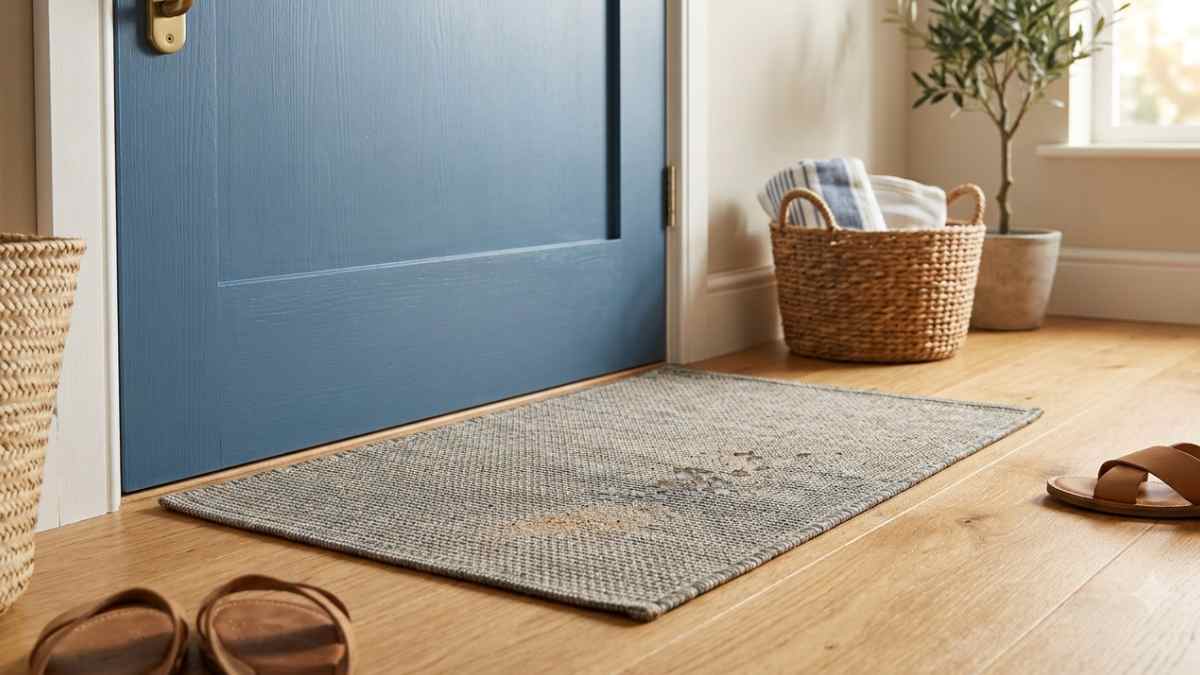
The carpets inside woven coconut fibers They dry in less than an hour, are easy to shake off and have a rough enough texture to clean the soles before the dirt gets into your home. The ideal dimensions for a small entrance are 50×80 cm the 60×90 cm: large enough to cover the immediate walking area in front of the door, small enough not to reduce the perceived passage. Dixie m Terrified they produce natural fiber versions with finished edges that hold up well over time even with frequent washing.
A small entrance does not become functional by adding containers: it becomes functional when every summer object has a vertical position, the floor remains free and the system can be reconfigured in five minutes when the season changes. The square meter saved on the floor is worth more than any specially purchased piece of furniture.



