


Those who leave the air conditioner on all night in twenty-two degrees almost always do so for the same reason: the fear of waking up in a bath of sweat outweighs the fear of the September bill. Then comes September and the calculation changes. Every degree less adjustment on the remote control increases consumption between 6 and 8 percent according to ENEA estimates, and those who keep the room at twenty-two degrees for eight hours straight pay for this margin in full, often without even sleeping better: dry throat, heavy head, feeling like you’ve woken up in a cold room instead of your own.
The problem is never the air conditioner itself. It is the way it is used between eleven at night and seven in the morning, and it is a question that is solved before you even press the power button: in choosing the right machine and in a series of gestures that almost no one fully follows.
Two letters worth more than energy class
The acronym A+++ printed on the box says a little. The number that separates a truly efficient air conditioner from one with a good label is PROPHETthe coefficient that measures how many kWh of cooling the device produces for each kWh of electricity absorbed over an entire season. An acceptable value starts at 6.5, a good one exceeds 8.5. THE Daikin Perfera All Seasons FTXM35A claims SEER up to 9.25, the highest value among monosplits on the market today in Italy, with a Swing Inverter compressor designed to remain below 19 decibels in minimum operation, practically imperceptible by the bed. THE Mitsubishi Electric MSZ LN Kirigamine Style it even reaches 10.5, with a Plasma Quad Plus filtration system that not only treats air but also fine particles and bacteria.
Translated into the bill: a 12,000 BTU monosplit with a SEER of about 8.5 consumes about 140 kWh per year in cooling, just over 40 euros at current prices. A lower-end model can exceed 200 kWh in the same period. It’s no different than spec fans, it’s the reason two air conditioners with the same list price can cost different amounts over ten years of use.
Because the inverter modulates instead of jerking
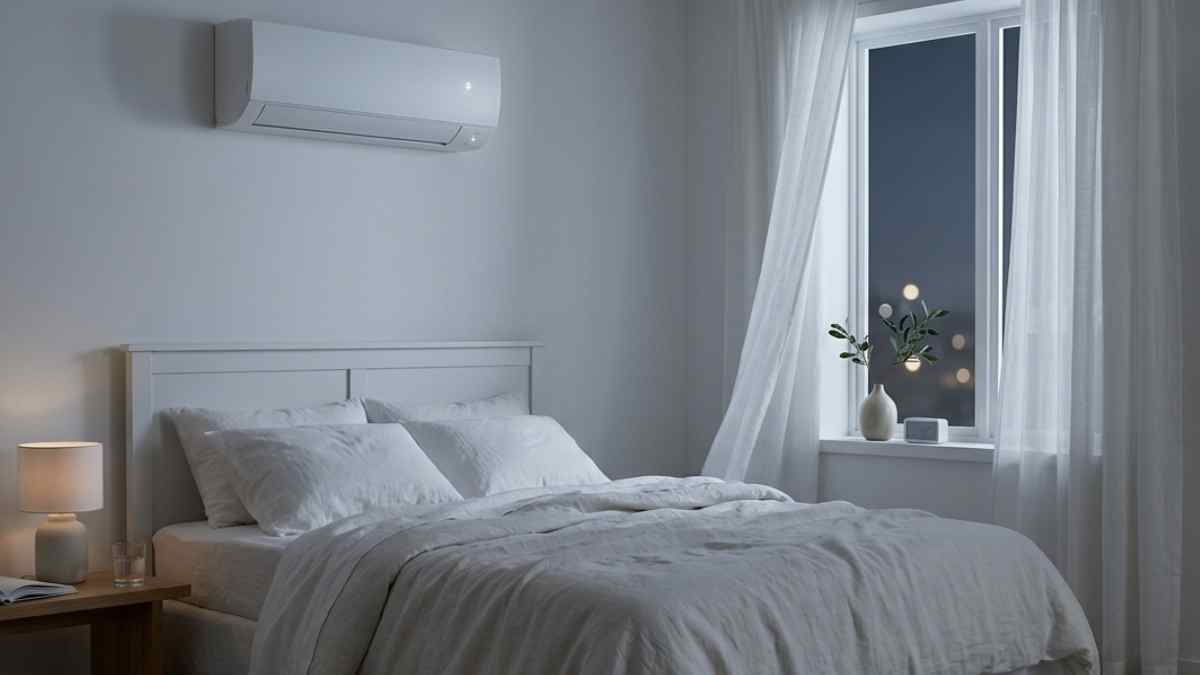
An on-off air conditioner always runs at maximum power and turns off suddenly once the set temperature is reached and then starts again from zero. A model Inverter it adjusts the compressor continuously, staying at low speed as the room stabilizes. The difference is noticeable in consumptionup to 30 percent lower in an eight-hour cycle according to field tests, but also in comfort: no temperature change, no compressor that restarts with a click just when you’re about to fall asleep.
Il Panasonic Etherea works in the same logic as a thin profile designed not to dominate the wall, while the Samsung WindFree Elite it distributes the air through twenty-three thousand micro-holes that spread the flow without the classic direct jet, the one that often ends up in those who sleep at night and causes the feeling of dry throat when waking up.
Cool the walls, not just the air in the room
Here is the gesture that really makes the difference between an air conditioner that is on for eight hours and one that is turned off at midnight with the same effect. The air cools in minutes, but walls, floors and furniture accumulate heat during the day and release it slowly over hours. The order that works is to turn on the air conditioner a few hours before you go to sleep, with sealed windows and shutters, to also reduce the temperature of the surfaces as well as that of the air. Then just set the function Sleep with a one-hour switch-off timer or switch it off completely: the already cold walls stay cool for a large part of the night.
One detail that weighs more than it seems is the installation of the outdoor unit: if it remains exposed to direct sunlight or is connected to long and poorly insulated pipes, the actual performance falls below the values indicated on the label, no matter how good the SEER is on paper.
The ceiling fan runs while the air conditioner rests
After shutdown, the dew that accumulates on surfaces is not always enough to cover a full eight hours, especially on nights above thirty degrees. A ceiling fan on minimum speed uses between 15 and 30 watts, an infinitesimal fraction compared to an air conditioner, but keeps the air moving and prevents residual heat from building up, leaving your head warm and your feet cool. Engine models DCtoday the majority among mid- and high-end brands, consume up to 60 percent less than the old AC motors and remain silent even at high speeds.
Bed linens also matter more than you think. Leaves inside clean linen the cotton percale they do not retain body heat like synthetics and promote sweating. Zara Home offers ranges in washed linens designed just for this, while those wanting something more technical for outdoor furniture can look to the fabrics Sunbrellawhich do not absorb heat during the day.
The dirty potion worth 15 percent of the bill
There’s one last variable that almost everyone forgets about until the end of the season bill. Dirty filters reduce efficiency by up to 15 percent according to ENEA, a figure equivalent to buying a top-of-the-range air conditioner and treating it like one from ten years ago. Cleaning them every two or three weeks during heavy use and checking the cooling gas once a year costs a few euros and brings the machine back close to the values listed on the technical sheet.
In the end, the cool night without waking up with a dry throat does not depend on a purchase, but on a precise line: a machine chosen by looking at the SEER and not just the letter on the label, a careful installation, an evening pre-cooling, sheets that let the skin breathe and a fan that runs quietly while the air conditioner rests. You can feel it from the first morning you wake up without feeling like you slept in a cold room.



