


There are balconies that start as small outdoor lounges and end up, in a few summers, as storage for brooms, dirt bags and drying racks that have never been closed. It does not happen because of laziness, but because of an installation mistake that hardly anyone disputes: we continue to think of the balcony as a miniature room, to be filled with furniture as you would a living room. The problem is that some square meters do not forgive this approach, and every object placed on the ground takes away precious centimeters from the walkable surface, the only thing that really determines whether a space looks tidy or stuffy.
The most effective solution does not involve a bulky outdoor closet, which ends up adding problem to problem. It goes by a literal change of direction: from the floor to the walls.
The free floor counts more than any new furniture
The human eye reads a space as ordered when the floor line remains continuous, without interruption. It’s the same principle that interior designers use to make small apartments seem larger, and on the balcony it works even more directly because the surface area involved is minimal. Moving containers, tools and containers from the ground to the perimeter walls is not just an aesthetic issue: it naturally frees up the space in which you can move, sit, open a chair without tripping over a watering can.
When the wall becomes the shelf
The modular system Seriesborn in the 1940s and still imitating the world today, it lends itself perfectly to vertical use on balconies: lacquered metal panels with shelves that can be fixed at different heights, able to support vases, small gardening tools and even portable lights. Alternatively, treated wood grilled panels for outdoor areas, also offered by IKEA in the Sjalland line, they offer the same logic at a much lower cost: they are fixed to the railing or the perimeter wall and become the support point for everything that previously filled the floor.
The result is not only practical. A wall organized with objects placed in staggered heights creates a composition that the eye reads as purposeful, almost scenographic, a far cry from the casual accumulation that characterizes the balcony closet.
Tables and chairs that disappear when not needed
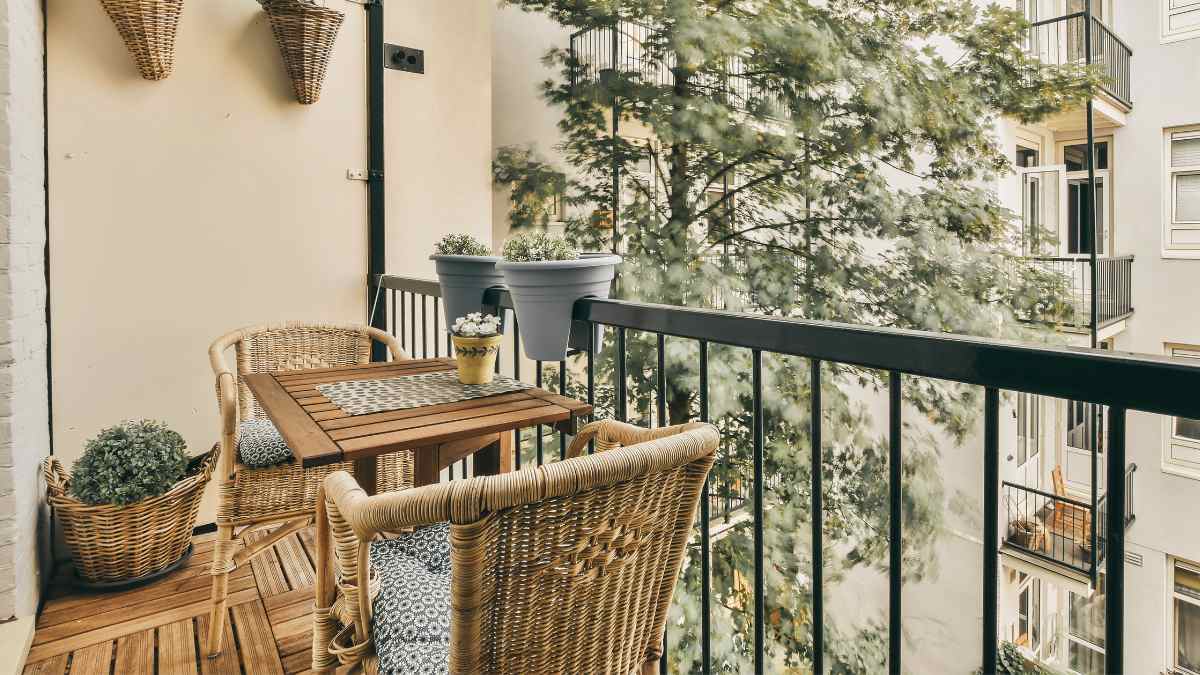
The second variable is furniture. A stationary table, no matter how small, occupies the same portion of space twenty-four hours a day, even when nobody is using it. Collapsible solutions, anchored to the railing or the wall, solve the problem at its root: On disk offers in the Vieques collection folding elements designed for compact outdoor spaces, with an aluminum structure that resists moisture without visually burdening the environment. Even a simple folding shelf made of solid wood, which can be closed in a few seconds, returns the balcony to its original function only when it is really needed, breakfast, reading, aperitif, and then returns to a clean wall for the rest of the day.
The color that holds the composition together
One of the most common mistakes, after the space is decided, is to forget the color consistency. Cushions, towels and chair covers chosen without a common thread transform even a well-organized balcony into an accumulation of clashing patterns. The fabrics Paola LentiUV resistant and designed specifically for exteriors, it allows you to work in a limited palette, two or three shades at most, that dialogues with the color of the facade instead of clashing with it. You don’t need a big budget to apply the same principle: just choose one dominant color and limit everything else to variations of the same color family.
What really changes when you lift the shutters
The most immediate benefit of this change in perspective is not measured in square centimeters gained, but in the reaction you get every morning when you open the shutters. A balcony with a free floor and organized walls communicates order even before you notice individual objects, and this feeling remains constant even on days when there is no time to rearrange everything perfectly. It’s the difference between a space that has to be managed from scratch every time and one that, once set up well, remains livable almost on its own.



