


Anyone who has bought a pothos convinced that it will clean the air of the house from the smog of the city, in all probability, is caring for a very beautiful and useless plant for this purpose. It’s not the plant’s fault, it’s a misunderstanding that was born nearly forty years ago in a NASA lab and has never really been corrected, despite the scientific denials that have piled up in the meantime.
The legend of cleansing plants still circulates today with the same certainty of established fact, in lists of ten recommended plants repeated identically in dozens of locations. The problem is that this list was born out of an experiment designed for a completely different context, and the numbers that support it, outside of their original scenario, tell a different story than what they promise.
The studio that created the legend
In 1989, scientist Bill Wolverton conducted the famous Clean Air Study on behalf of NASA, thinking not of any sitting room but of a much more specific problem: how to keep the air breathable in a sealed space station, with no windows to open and no exchange with the outside. In this hermetic chamber, filled with volatile organic compounds such as benzene and formaldehyde, some plants showed an amazing absorption capacityand from there was born the idea, which later became common sense, that a few plants were enough to purify the air of any room.
The detail left out by the media at the time is that this sealed chamber is nothing like a real apartment, with opening doors, windows, drafts, and a much larger volume of air than the small experimental box.
The number the media got wrong
The most commonly cited number, the famous 90 percent of pollutants removed, is often presented as a general average that applies to any plant and any substance. In fact this data refers to a very specific case: common ivy in its ability to absorb benzenenot the total of all plants tested against all measured volatile compounds. Recalculating the data on a more realistic basis, the average absorption capacity of houseplants falls below 10 percent, a far cry from the number that went viral.
This is not about false information, but about a particular result was incorrectly extended to an entire classjust the kind of simplification that makes a laboratory experiment an urban armchair legend.
How many plants do you really need for a living room?
Michael Waring, an engineer at Drexel University in Philadelphia, reviewed 195 studies on the cleaning ability of indoor plants, comparing the results to the actual dimensions and actual air exchange rates of an inhabited room. The final calculation is merciless: to obtain the same result a single hourly air exchange such as that guaranteed by a system of mechanical ventilation, would serve about a thousand plants crowded into the same space.
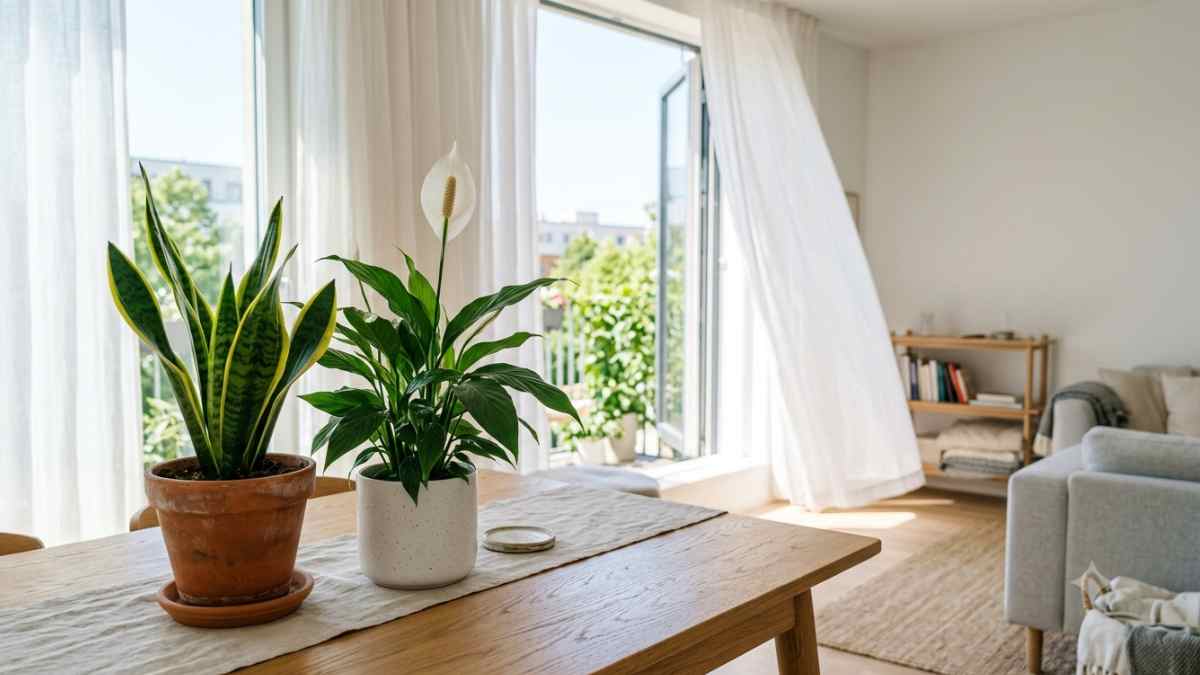
So here comes the old advice of keeping one plant every ten square meters, taken from various sources as a NASA recommendation largely optimistic compared to the latest figures: ten plants in a city apartment remain an aesthetic gesture and psychological well-being, not an air purification strategy that can be measured by an instrument.
Plants that defend themselves better than others
That said, not all plants were tested in the original study. In Wolverton’s classification of fifty indoor species, the areca, a tropical palm with thin and arching leaves, occupies the first place in relative efficiencyfollowed by sansevieria and dracaena, both able to survive even in poor lighting while maintaining a reasonable gas exchange capacity. At the other end of the list, the kalanchoe pIt is the least effective species among those tested, although it remains a pleasing ornamental plant.
However, those who want to choose based on scientific and not aesthetic criteria, would do well to orient themselves a mixture of two or three different species than in a single replicate plant, simply because different plants process different volatile compounds and variety, even on a small scale, remains more efficient than armchair monoculture.
What do plants really do in the living room, if not purify
The most consistent benefit, from a scientific point of view, does not concern the air but the perception of the space and the mood of those who live there: several environmental psychology studies confirm that the presence of greenery in the home reduces perceived stress and improves concentration. regardless of how many volatile compounds are actually removed from the environment. Plants also regulate, to a small extent, the humidity of the ambient air through leaf transpiration, an effect that is measurable but limited to the area immediately near the pot.
A neat space next to the sofa Therefore, it remains a right choice, but for the right reason: not because it cleans the air in the house by itself, but because every morning, watching it grow, it gives back something that no electric cleaner could do.



