

Cleaning outdoor tiles can become a frustrating routine. You wash it, rinse it, let it dry… and after a few hours, or at most the next day, they look dirty again. Opaque, marked, with that dull look that immediately gives the impression of being neglected, even when in fact they have just been cleaned.
The problem is that we often look at cleaning in the wrong way. It’s not a matter of “doing better” but of understanding what is really happening on the surface.
It’s not dirty: it’s a residue that remains even after washing
In most cases, what you see is not dirty in the classic sense. It is one residue.
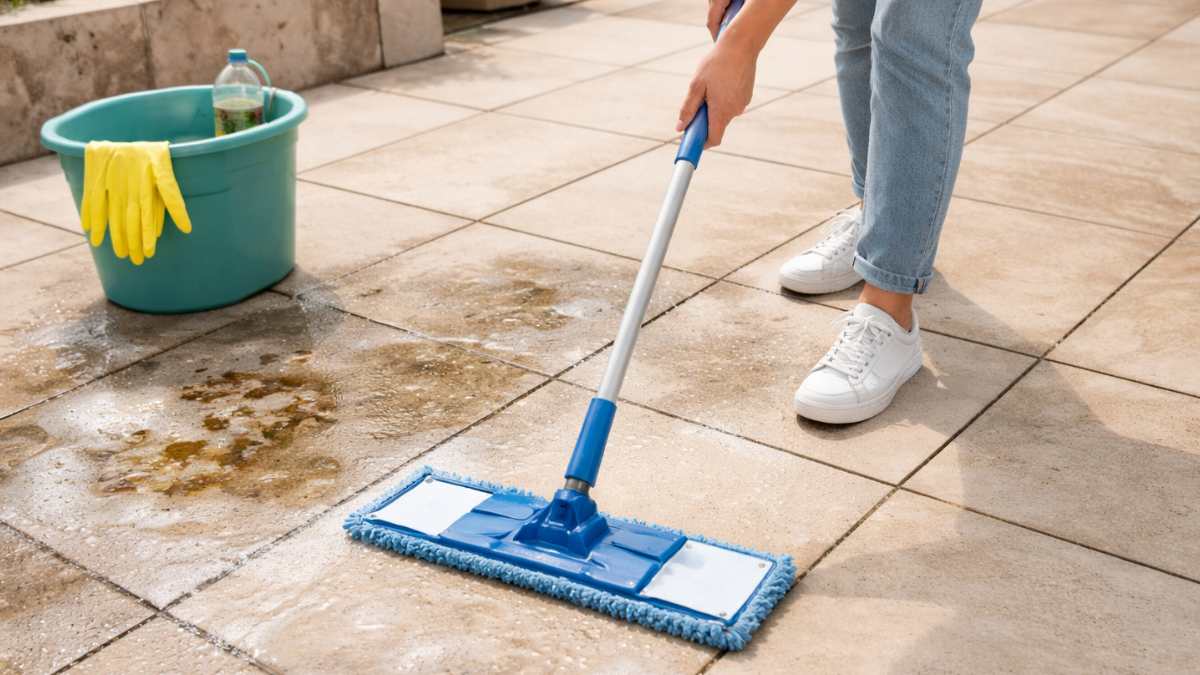
Water, detergents, dust and external agents leave a fine patina that is deposited on the tiles. When water evaporates, everything in it stays there. And it accumulates over time.
The result is a surface that it no longer reflects light evenly. It’s not dirty, but it looks dirty. And it’s exactly what creates that matte effect that’s hard to get rid of.
The role of water (and why it makes it worse)
One of the most underrated elements is water itself. Especially outdoors, water contains salts, impurities and particles that are deposited on surfaces.
When you wash the floor and let it dry without manual dryingthese substances remain on the tiles. It’s the same principle as halos in glass.
The more this process is repeated, the thicker the layer becomes. And at that point, simple cleaning is no longer enough.
Leaks: the critical point that ruins everything
Even when the tiles are clean, Leaks can completely compromise the end result.
Being porous, they retain dirt, moisture and debris. Over time they darken, creating a contrast which makes the whole floor look dirtier.
It is one of those details that you notice immediately, even if unconsciously. And this renders useless even the well-baked cleaning of the main surfaces.
The wrong detergents create more problems than they solve
Another common mistake is excessive or incorrect use of detergents.
Many products leave a invisible film which, instead of actually cleaning, traps the next dirt. This is why some surfaces seem to get dirty more quickly after washing.
Using too much product can also create build-up. The more you insist, the more it layers.
When the surface is the real problem
Not all tiles react the same way. Those that are more porous or have a matte finish tend to hold more dirt and debris.
Even slightly rough surfaces, meant to be anti-slipcan make it more difficult to achieve a clean result. Not because they are dirty, but because they “hold” longer.
In these cases, the visual perception is influenced by the texture of the material itself.
How to finally get a really clean result
The difference is not in power, but in method.
Reduce leftovers is more important than removing visible dirt. Using less detergent, better rinsing and, when possible, drying the surface helps prevent streaking.
Even periodic intervention in the joints completely changes the result. When they are clean, the entire floor looks more uniform.
When the appearance of the tiles really changes
The transformation is noticeable when the light is reflected evenly again. No more opaque areas, halos or noticeable differences.
At this point, the tiles don’t just look clean: I really ameven on a visual level.
And that’s exactly the difference you’re looking for every time you pick up the mop.



