

jr and fondazione bonotto unveil monumental care tapestry
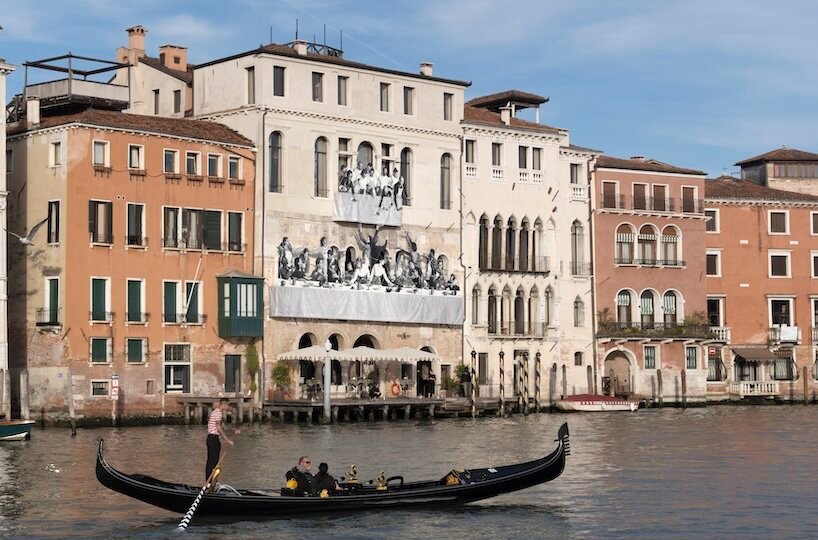
For the 61st Venice Biennaleartist JR presented “Il Gesto”, a multidisciplinary project that activates both the exterior and interior of Palazzo Ca’ da Mosto (The Venice Venice Hotel). The intervention begins at the facade of the building, where a large-scale temporary installation of ultra-light panels transforms the Venetian-Byzantine architecture into a public stage visible from the Grand Canal. While these exterior figures appear to lean out of the windows to interact with the city, the work finds its permanent and definitive form inside the palace: a monumental tapestry created in collaboration with master weaver Giovanni Bonotto. Reinterpreting Paolo Veronese’s 1563 painting The Wedding at Cana, the project shifts the focus from a biblical miracle to a modern model of social repair and community care.
JR’s connection to the site dates back to his repeated stays at the cloister of San Giorgio Maggiore, where the original Veronese painting hung for more than two centuries before its removal to the Louvre. Returning this image to Venice as a modern “fresco” in fabricthe artist addresses a historical shift while highlighting a contemporary initiative of mutual aid. ‘This is a very special project, because it’s the first time I’ve made a tapestry, but also because of the incredible story behind this piece‘. The line-up is based on Refettorio Paris, a community kitchen launched eight years ago that reclaims surplus ingredients – items rejected by supermarkets due to minor aesthetic flaws – and transforms them into sophisticated three-course meals served free of charge to refugees and the homeless.

on the facade of the building, a large-scale installation transforms the Venetian-Byzantine architecture | image courtesy of JR
community kitchen as inspiration for the Venice Biennale project
In the tapestry, 176 real participants from the Refettorio take the place of the figures in Veronese’s original work. JR describes the resulting scene as a documentation of a particular social choreography: “This is almost like a little theater of life… all the volunteers who come every night, we ask them to play a role that night, which is very important, they are actually at the key of these dinners‘.
The project flattens professional distinctions, placing world-renowned chefs like Alain Ducasse and Massimo Bottura in service roles alongside the people they cook for. JR notes that the dining experience, which includes music by artists such as U2, creates a unique sense of equality: “I like that, I think it puts everyone’s ego on the line…chefs, they really want to impress them with a meal that feels very special…they only see the love and respect that went into the plate‘.

176 real-world participants take the place of figures in Veronese’s original | image courtesy of JR
“the wedding at cana” was being reimagined as a high-tech textile artwork
The tapestry, which will remain on view until November 24, is 4.30 meters high and 7.80 meters wide. Its production by Fondazione Bonotto involved 600 hours of research and weaving to translate JR’s complex photographic digital archive into a woven medium. The materials chosen for the work emphasize an ecological sensibility, using blue threads for the sky and black shadows sourced from recycled plastic sourced from household chemical and soap containers. These are embedded with virgin wool, organic cotton and traditional Japanese Washi paper.
Giovanni Bonotto underlines the technical pressure it poses: “No textile computer is programmed to handle a file that big…our computer can’t handle a file that big because we weave on mechanical looms, industrial mechanical looms, and the looms keep crashing, crashing, crashing.”. For Bonotto, the last piece represents a victory for human intelligence:The work also symbolizes the battle between man and machine… we want to show that human intelligence has the sensitivity to find a way to win.”.

from left to right: Alessandro Gallo, JR and Giovanni Bonotto | image from Alessandro Lana courtesy of Venice Venice Hotel
The digital platform amplifies marginalized voices in the exhibition
As JR thinks about the project:In this work, the banquet becomes a necessary meeting place, where beauty ceases to be a privilege and becomes a shared human experience‘. Translating a social initiative into a permanent architectural element, JR and Bonotto move away from the spectacle of large-scale art toward an enduring record of service and mutual care.

behind the scenes of the making of the tapestry | image from Alessandro Lana courtesy of Venice Venice Hotel



