


When a room seems small or unbalanced, we almost always tend to intervene in the objects: we think of changing furniture, reducing the dimensions, eliminating something. In fact, in most cases, the problem is not connected with the amount of furniture, but with the way it is distributed in the space.
The sofa, being the most voluminous element in the living room, plays a decisive role in this perception. Its position affects the way we read the room, the depth we can perceive and even the size of the space that seems available to us. This is why moving it just one meter can produce a amazing resultwithout changing anything structurally.
Because the sofa against the wall reduces the space
Leaning the sofa against the wall is an extremely common choice, especially in small rooms, because it gives the impression of freeing up the center of the room. In fact, this arrangement creates a rather stiff visual effect.
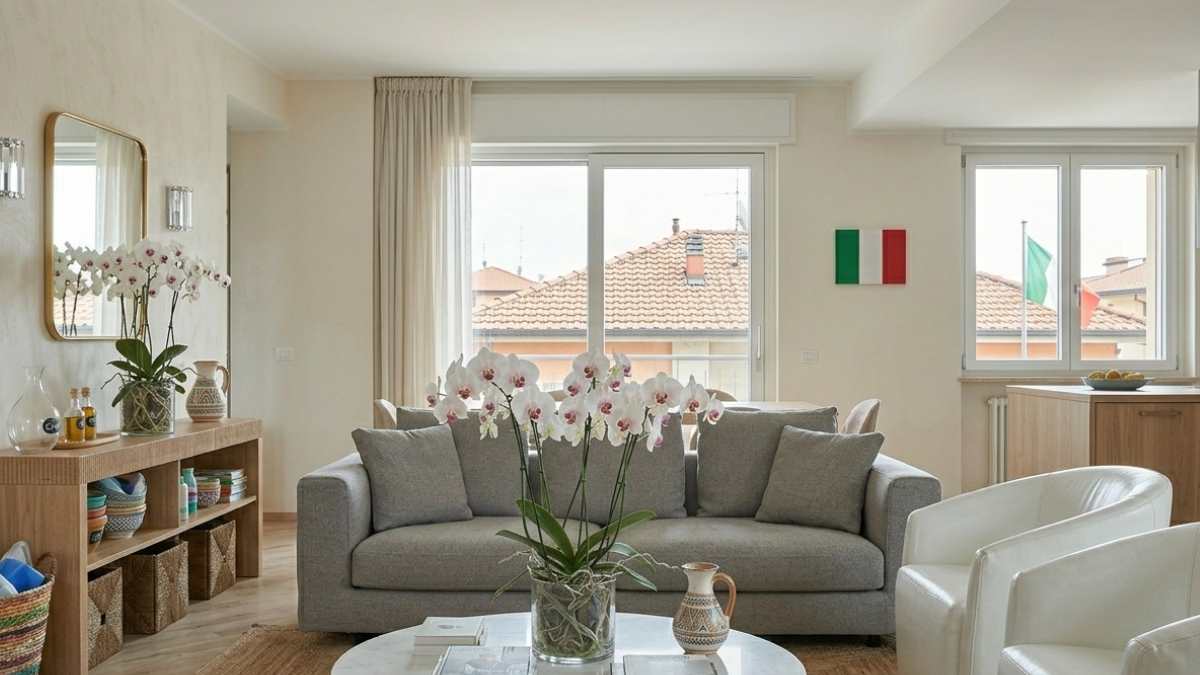
When all the main elements are aligned along the walls, the space is perceived as a closed perimeter. The eye runs quickly along the edge of the room and immediately stops, finding no intermediate levels. This reduces the sense of depth and makes the environment more flat.
In addition, the sofa against the wall creates a kind of visual “block”, a clear line that separates the furnished space from the rest of the space. Even if the center of the room is free, it is not perceived as an active part of the environment, but as residual space.
What happens when you move it?
By moving the sofa even just 60 or 100 cm from the wall, the visual structure of the room changes significantly. It’s not just a matter of “moving back” a piece of furniture, but introducing a new level in space.
The eye, instead of immediately stopping at the wall, begins to read a sequence: first the sofa, then the space behind it, finally the wall. This Layering creates depth and makes the environment more complex. It is the same principle used in photography or exhibition installations, where successive layers are constructed to expand the perception of space.
Light also plays an important role. When the sofa is detached from the wall, light can pass through and be better distributed, creating softer shadows and increasing the sense of airiness.
The role of the space behind the sofa
The space created behind the sofa is not “waste”, but a resource. It is precisely this part that determines the success or otherwise of the intervention.
If left completely empty, it can work very well in minimalist or particularly small environments, because it enhances the breathing effect. However, in many cases, it is useful to give it a light function.
A narrow console, for example, allows you to define the space without overwhelming it. It can be used to place a lamp, some books or decorative objects, while still maintaining a limited depth. Even a tall plant or floor lamp can help create verticality and make this area more interesting without overwhelming it.
The important thing is to avoid build-up. If the space behind the sofa fills up like any other wall, the benefit of separation is completely lost.
In which rooms does it work best?
This type of intervention is particularly effective in rectangular living rooms, where the sofa is often placed along the longest wall. In these cases, moving it to the center allows you to rebalance the proportions and to avoid the corridor effect.
It also works very well in open spaces, where the sofa can become a dividing element between the living room and the dining or kitchen area. In this way spaces are defined without the need for walls or partitions.
Even in the smallest of rooms, where you think you have no room, a little movement can be enough to achieve a perceptual improvement. It is not necessary to create long distances: even a few centimeters can make a difference if placed in a coherent context.
The most common mistakes
One of the most common mistakes is moving the sofa without reviewing the rest of the composition. The rug, for example, must accompany the new location, otherwise a visual disconnect is created. Likewise, the coffee table and other furniture should maintain adequate proportions and spacing.
Another mistake is to immediately fill the free space. It’s understandable to want to “use” every inch, but in this case the gap is an integral part of the result. It is precisely the presence of a free and legible space that creates the effect of width.
The impression that the room “doubles” is no accident. It depends on how our brain interprets space. When there are more levels, fewer interruptions and more visual continuity of the floor, the environment is perceived as larger.



