

A narrow corridor turns into a tunnel when it offers no handholds for the eye. It is a sequence of empty walls, poorly lit, where the eye never stops and slides along the bottom without finding a rhythm. To transform it into a gallery you don’t need to fill it, but to build it. The difference is all here: the transition from a space that is left as it is to a space that is considered a path.
The first step, the one that really changes everything, is to stop working on both walls. When you intervene from both sides, especially in a narrow corridor, the space closes even more. The sensation is that of being crushed between two advancing surfaces. The gallery effect, on the other hand, occurs when only one wall becomes the protagonist and the other remains more free. This immediately creates breathing space and allows the gaze to orientate clearly.
Tables must follow an exact line
At that point it is not enough to hang pictures. They have to be placed precisely, because that’s where everything is played. The height cannot vary, it cannot follow the taste of the moment or the shape of the wall. It must be stable. When elements are aligned along a centerlinemore or less at eye level, a continuity is created that accompanies the passage. If, however, they go up and down, even slightly, the effect breaks and the hallway goes back to looking cluttered and narrower.
The distance between the elements builds the rhythm
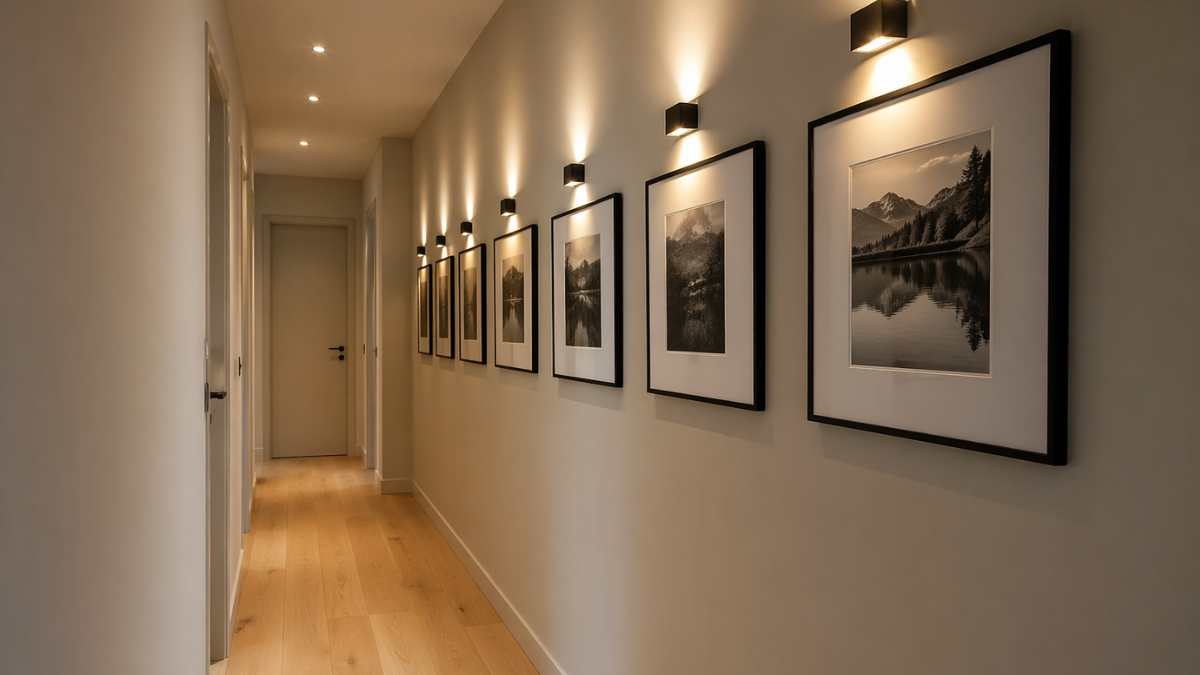
Even the distance between one element and another is not random. If it is very irregularthe gaze stops. If they are too close together, a single mass is created that weighs it down. When this the space between frames is consistentthe rhythm becomes natural. We no longer perceive individual objects, but a sequence. And it is precisely this series that transforms the wall into something more structured.
The format should be consistent
Form plays a fundamental role. In a living room you can work with free compositions, but in a corridor this approach does not work. Consistency is needed here. The frames the same, or different prints but in the same format, help create a clear visual line. If each element is different in size or proportion, the fragments of the wall and the gallery effect disappear completely.
The light must accompany the wall
Light is the second decisive point, which is often underestimated. A corridor with a single central light, perhaps powerful, creates shadows on the walls and emphasizes the sense of length. Instead, the light should accompany the wall, not fall over it. When lit from the side, even softly, it accentuates the surfaces and creates depth. The paintings are no longer hung on a flat wall, but emerge. Even a simple sequence of appliques or small points of light distributed along the path completely changes the perception. The wall comes alive and the space opens up.
The color must support the gallery effect
Color should support this work, not contradict it. If the wall is too dark or too different from the rest of the house, the hallway is closed. If instead of the color it is uniform, warm, slightly wrapped, everything becomes more continuous. The doors, if they remain similar to the wall, stop breaking the surface. The corridor seems longer, cleaner, more coherent.
The end of the corridor must not be left empty
Another element that is often overlooked is the background. If the corridor ends in a gap or a dimly lit area, the tunnel effect remains. However, when there is an optical closure point, even simple, space changes direction. It can be a light, a mirror, a more prominent eye-catcher. At that point the path has a beginning, progression and end. It is no longer a casual pass.
The mistakes that ruin the result
The mistakes, in this kind of intervention, are always the same. Placing elements without exact logic, different heights and distances, is the most common. To illumine them, to let the light come only from above, is the second. Trying to fill everything, thinking that more items mean more character, it is what definitively compromises the outcome. A gallery works because it leaves space between items, not because it piles them up.
When the corridor really becomes a path
When everything is aligned, when the light follows the wall and when the arrangement has a precise logic, the corridor ceases to be narrow in the way we perceive it. The dimensions don’t change, but the reading does. The space becomes continuous, accompanied, easy to read. And what was once a tunnel becomes a path.



