

A$AP Rocky is curating the exhibition with basic.space
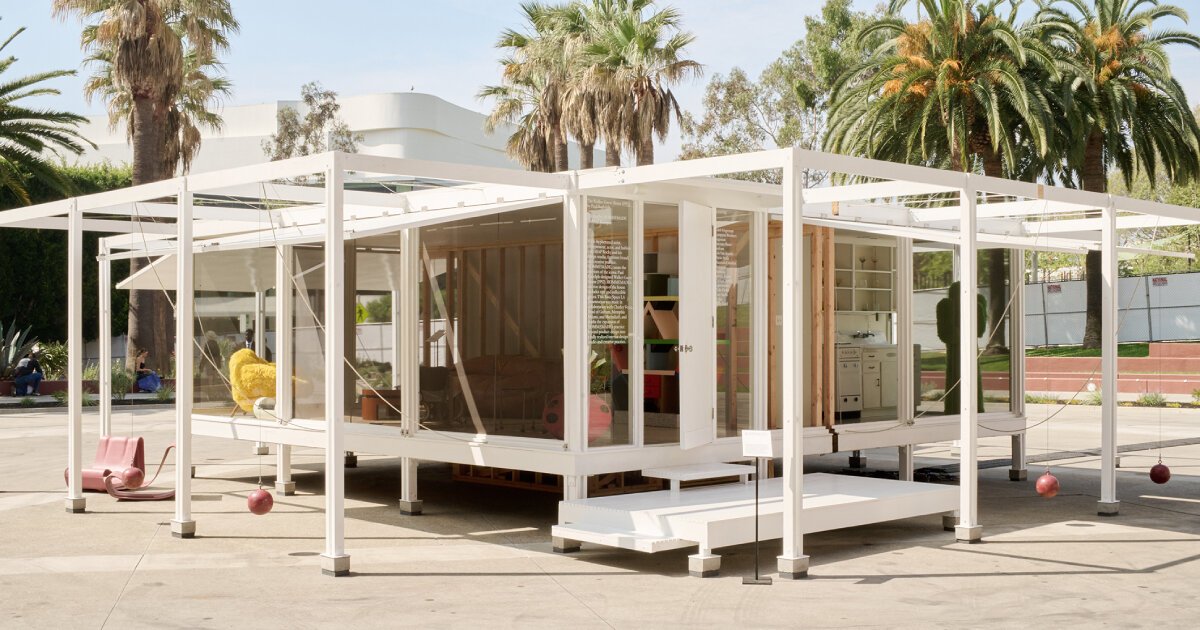
The Walker Guest House, designed in 1952 by Paul Rudolphreappears, away from its original location Florida and in one report curated by A$AP Rocky. Presented by Basic.Space as a structure reconstructed and installed in full scale, the house is presented in its original interior elements, with modern design pieces by Charlotte Perriand, Eileen Grey, Jean Prouvé, Pierre Jeanneret, Dieter Rams, Ettore Sottsass, Gaetano Pesce, Sabine Marcelis and many others. The house was first built on Sanibel Island, Florida, on a square plan, slightly raised from the ground.
Its structure uses a clean grid and wooden frames define the walls and ceiling. It is built to move, hence the ‘basic’ and readily available materials used, such as timber, panels, glass and metal hardware. The presentation in Los Angeles, which took place between March 27 and 29, 2026, adds another layer because Paul Rudolph’s The Guest Walker House was no longer on a quiet island, but in an urban design complex, surrounded by exhibition spaces and galleries. Visitors were able to see how it works and how it fits into a history of design and architecture.

all images courtesy of Basic.Space | photo © Ezra Stoller/Esto
The changing design of the Walker guesthouse by Paul Rudolph
When Paul Rudolph designed the Walker Guest House, he had just started his independent practice after working with Ralph Twitchell. He was 33 years old and the house became his first major statement. In 1957, Architectural Record readers placed it among the most important houses of the century, alongside Ludwig Mies van der Rohe’s Farnsworth House and Philip Johnson’s Glass House. This places the Walker Guest House at a key moment in American modernism, a movement where architects tested how simple forms, open plans and new materials could change the way people lived. One of the best-known features of the structure is the wooden panels on the exterior, as each of them can be raised or lowered using a counterweight system.
The weights are red-painted steel balls, each about 77 pounds, hanging from ropes. When a panel is closed, it acts like a shutter and blocks the sun and wind. When opened, it lifts outwards and becomes a canopy, creating shade. This moving facade reflects Paul Rudolph’s idea that a house should respond to the climate, so instead of having fixed walls, the building adapts and can be open like a pavilion or closed like a shelter. The architect described this idea as the need for a “cave” and a “goldfish glass”, where the user can also control how much light, air and privacy enters the space. At the Pacific Design Center, where the model was edited knocker A$AP Rocky aired, Paul Rudolph’s Guest Walker House made visible again with his help retail Basic.Space and Charley Vezza, the head of Gufram, Memphis Milano and Meritalia. What came out was not a copy or an image, but a functional structure: a house that opens, closes and adapts, still active in the present.

photo © Ezra Stoller/Esto

A$AP Rocky curates the reimagined version of Walker Guest House, presented by Basic.Space

the house is presented with its original interior elements, with modern design pieces

the house was first built on Sanibel Island, Florida, on a square plan, slightly raised from the ground

view inside the structure curated by A$AP Rocky



