


The hallway is the first space you cross and the last you think about when furnishing your home. However, there the perceived quality of the whole apartment is decided, in a matter of seconds. When it is narrow under 120 cm in width, it becomes almost an unsolvable architectural problem: no furniture, little breathing space, walls that seem to advance. The structural solution costs money.
The decoration, the catalog with the mirrors in a herringbone pattern, is tiring. However, there is a third way that works on perception in a more refined way and which in recent years has unexpected design dignity: hanging a painting with a natural theme on the back wall with a studied perspective, able to simulate an opening to the outside. This isn’t some 90s magazine gimmick. It involves the application of the same principle of architectural trompe-l’œil used for centuries in European palaces in false windows and loggias to an affordable, modular and replaceable support at any time.
The mechanism works because the human brain reads depth through precise visual cues: the overlap of layers, the color tint towards distance, the progressive reduction in dimensions of elements. A painting containing all these signals—a tree-lined path, a dense forest, a high-canopy rainforest—literally tricks the visual cortex, which interprets the painted space as real space. The corridor does not widen. But it stops feeling like a trap.
Because layered green works better than any other theme
Not all nature paintings have the same effect. A seascape, for example, often has a low, flat horizon that can further flatten the wall rather than break through the surface. A field of lavender seen from the front does not create depth: it creates a pattern, as beautiful as you like, but two-dimensional. The strength of a forestry or forestry subject lies in its own vertical layering: there’s the foreground of the big leaves and clear fires, an intermediate floor of logs and more animated vegetation, and then the backdrop, that light filtering through the foliage, that faded glow that marks the distance. Three levels of visual reading, in a single frame.
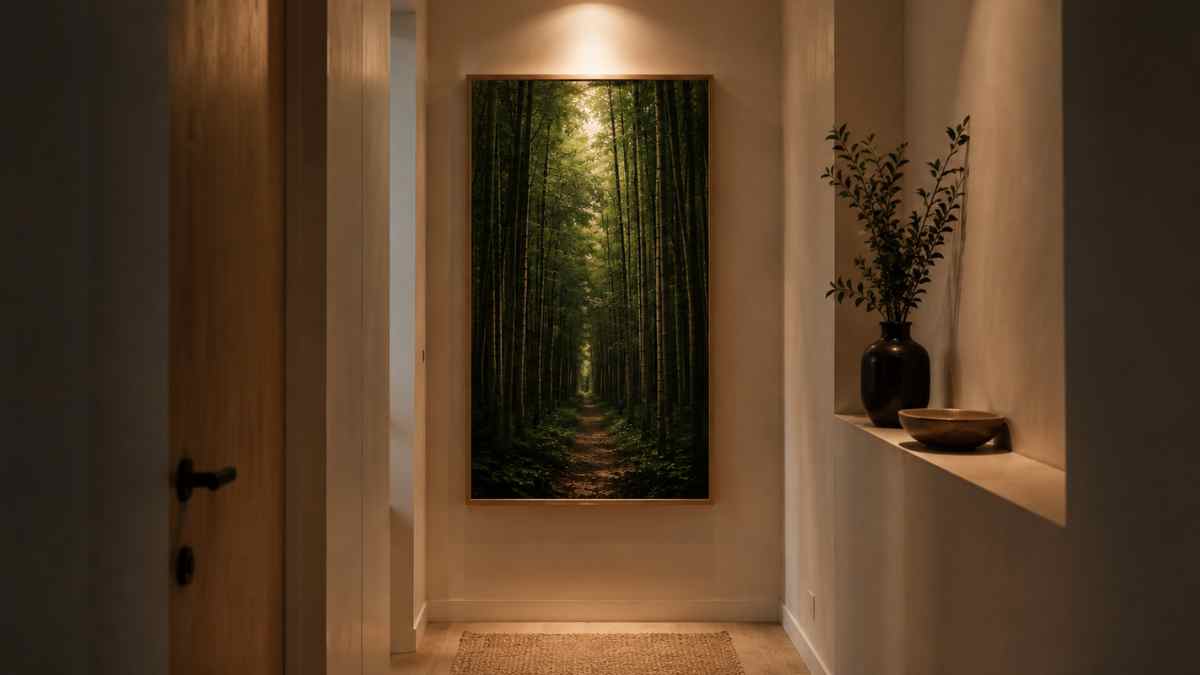
The tonal variety of green enhances this effect. The saturated and dark green of the foreground gradually gives way to cooler and desaturated shades towards the background, replicating exactly what is actually happening due to atmospheric diffusion. A narrow corridor with a photographic print of a rainforest, say a high-resolution image of the Arashiyama bamboo forest in Kyoto, with the aligned peaks converging towards a central vanishing point acquires a sense of depth that no low mirror can convey. The central vanishing point is critical: it should be approximately at the height of the eyes of the person walking on the corridor, at a distance of between 160 and 170 cm from the floor.
Where are these paintings and how much do they really cost?
The market for perspective prints and nature-themed paintings has fragmented quite clearly in recent years, with price ranges catering to different needs.
In the complex cheap, between 20 and 60 eurosyou can find digital canvas prints or photo posters in large formats from 60×90 cm and above on platforms such as Society6, Redbubble or Posterstore. Print quality varies, but by looking for images with a declared resolution greater than 150 dpi in print format, you can achieve acceptable results. In particular, Posterstore offers format customization options and matching frames. The most effective subjects in this range: photos of beech forests in autumn, bamboo tunnels, cypress paths.
In the complex average, between 80 and 250 euroswe are entering the territory of fine art prints on cotton or forex paper with a professional setup. IKEA, with its BILD series and periodic collaborations with photographers, offers some interesting options around 50-80 euros for 100×140 format. But it can be found on sites like Desenio, a Swedish brand with European distribution, or on Art.com that you can find high-quality photo prints with forest subjects selected for depth of composition. This series also includes prints by photographers such as Kai Ziehl or Michael Busselle, available on platforms dedicated to nature photography.
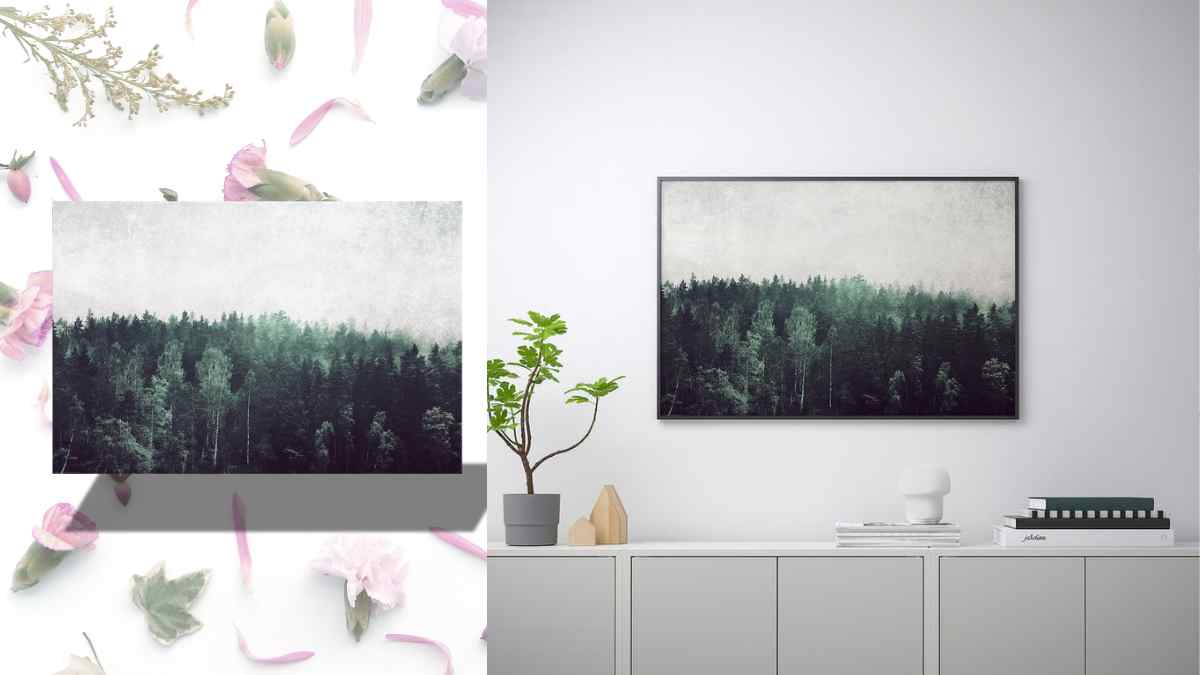
In the complex high, from 300 euros and abovewe work with online galleries like Saatchi Art or with photographers who sell limited editions. The difference is not only aesthetic: a Dibond aluminum print, for example, with a very high resolution forest theme, returns an almost tactile depth approaching architectural trompe-l’œil. Scandinavian interior design studios like Note Design Studio have used this technique in documentary residential projects, applying photographic wall impressions of boreal forests to narrow corridors of urban apartments.
The correct format and how to insert it without errors
Form is not a detail. Very small picture on the wall of the corridor produces the opposite effect: it draws the eye to a limited surface, making all the empty space around it even more prominent. Correct proportion wants the image to occupy at least 60-70% of the width of the back wall. In a 90 cm wide corridor, this means a base frame of at least 55-60 cm ideally more if the wall allows.
In height, the subject should develop vertically or in an almost square form. An elongated horizontal panorama tends to shift perception sideways, not in depth. A forest photographed verticallywith tall trees extending beyond the upper end, it instead suggests a space that extends beyond what is seen and this is precisely the mechanism to exploit.
Context has an impact. A thin black metal or dark wood frame creates a window effect that enhances the illusion of openness. A large frame in white or color does not help: it draws attention to the edge, explicitly stating that it is a hanging object. Unframed, mounted directly on canvas or on panel, the print acts as a scenic backdrop and is often the most effective choice.
Image lighting changes everything
A perspective painting in a poorly lit hallway loses much of its effectiveness. Directional light, preferably warm and coming from overhead or from an adjustable track spotlight, serves two things: it increases the perceived contrast between subject levels, making depth easier to read, and it creates a bright opening effect that the brain associates with environments that receive natural light. A light source of 2700-3000 Kelvin enhances the warm greens and browns of the wood. 4000 Kelvin gives a colder and more Nordic atmosphere, suitable for themes of birch or snowy beech forests. Even a simple adjustable 8-10 watt floodlightplaced on the ceiling 60-70 cm from the wall, it transforms the painting from a decorative print into an architectural element.
Some choose LED backlighting with diffused light, placed behind a backlit canvas. It is a more expensive solution that starts at around 150 euros for medium-large formats but transforms the corridor into something completely different in the evening hours. Brands like Lumidecor or Lumipix deal with just that, with catalogs dedicated to natural subjects photographed in high resolution and designed for backlighting.
A narrow corridor with a forest on the back wall and a spotlight pointed overhead has, at the right evening hours, something vaguely absurd. As if there really was something beyond that wall. It does not solve the problem of actual square footage. But it makes them stop weighing.



