


There is a domestic paradox that manifests itself precisely every June: the same house that seemed cozy in winter becomes heavy, almost suffocating. Nothing has changed, yet something is not working. That wrought iron candlestick on the windowsill, the stacks of books covered in dark covers, the centerpiece with the decorative dry branches. The objects that performed their work perfectly in January now occupy visual space in an imposing manner, as if the season had transformed them without touching them. The problem is not the decoration. It’s layering.
Summer visual absorption isn’t a belated spring cleaning, nor is it a minimalist gesture for those who can’t match their stuff. It is a practice of seasonal adaptation that few consciously apply, but which radically transforms the perception of a space. The basic idea is simple: certain classes of objects have a visual weight calibrated for the cold months. Removing them temporarily does not mean getting rid of them. It means making room for the season.
The visual weight that is not measured in kilograms
There are three categories of objects that weigh down interiors in the warm months more than anything else: candles in dark or opaque containers, decorative fabrics on horizontal surfaces, and so-called stuffing itemsthat is, those items that progressively colonized shelves, trays and shelves without anyone deliberately deciding to put them there.
Visual weight is a concrete concept, not a metaphorical one. It is derived from the ratio between the perceived mass of an object and the amount of free surface surrounding it. A shiny brass candlestick on a white shelf occupies not only its physical space, but also the psychological space around it. In summer, with more hours of direct light and a more exposed general atmosphere, this effect is amplified. Interior designers call it visual noisevisual noise and treat it as an integral design parameter.
Marimekko has built part of its summer aesthetic precisely in the elimination of layers: free surfaces, breathable designs, without intermediate decorations between the fabric and the shape. It is not a stylistic coincidence, it is an exact position for the relationship between the era and the perception of the spaces.
What leaves home (temporarily) and why
Summer Clearance works for categories, not individual items. Piece-by-piece work leads to the opposite effect: one candle is removed, another is moved, the disc is replaced. In the end, the shelf is still full. The most effective method includes free entire horizontal planes before deciding what to put back.
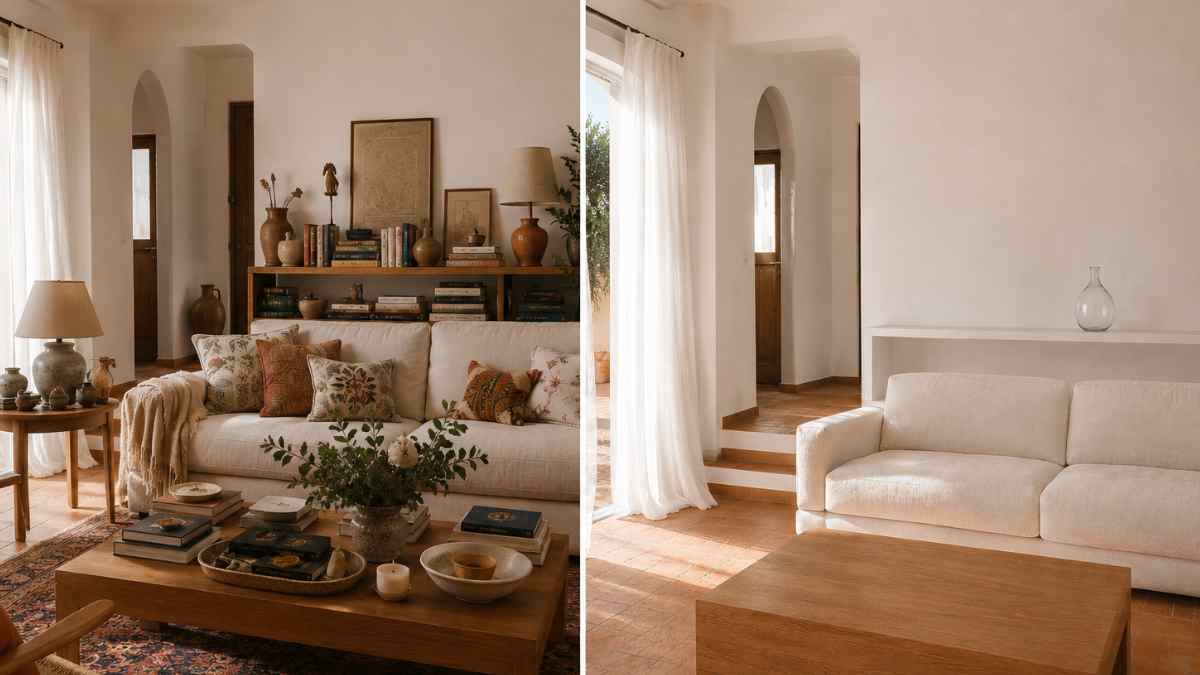
Large candles in containers made of concrete, raw ceramic or smoked glass are prime candidates for a temporary outlet. Not because they are bad, but because they are designed to absorb light, not reflect it. The same applies to the opaque clay vases, the dark wooden bowls, the iron lanterns. All the items that work wonderfully between October and March and which in July become visual ballast.
Storage of many decorative items should also be reduced. A centerpiece consisting of three candles, two decorative pine cones, a wooden tray and a bouquet of dried flowers is a winter ensemble. The same logic applied in summer creates free surfaces with at most one element, preferably in a material that interacts with light: transparent glass, light terracotta, opaque white ceramic.
Ikea has a summer line, the HAPPY SUMMERbuilt exactly on these principles: individual objects, bright volumes, no ensembles. It costs little, lasts a season, and forces those who buy it to think subtraction instead of addition.
Horizontal surfaces as a starting point
Shelves, tables, sideboards, windowsills: Horizontal surfaces are where visual disturbance is most easily stratified and where intervention has immediate effect. The operating rule of seasonal drainage is that any horizontal surface should be able to be completely cleaned in less than three minutes. If it takes ten minutes and three difficult decisions to empty a floor, that surface is already beyond the threshold.
The process involves removing everything, cleaning the surface and putting back at most a third of what was there. Not two thirds. A third. The visual result is almost always better than expected, because the rest of the items make sense in proportion to the space that surrounds them.
Tom Dixon, in his line of home accessoriesworks with this principle systematically: each piece is meant to stand alone, not in the composition. THE candelabra Bash, for example, it is designed to occupy a space by itself without needing anything next to it. It is the opposite of the logic of the coordinated whole, which instead invites addition.
Caching as part of the method
Seasonal emptying only works if items don’t disappear into a general cauldron. Labeled boxes, a special cupboard or even a few cloth bags closed with a ribbon: the point is that every item being removed knows where it is waiting. Those who find their winter items well preserved in September tend to put them back more selectively compared to those who left them in an anonymous box.
It is this aspect that distinguishes seasonal decluttering from the shift to permanent minimalism. It is not a matter of deciding that this cup of stone no longer has a right to be in the house. It’s about recognizing that it has time and context, and that respecting it makes both the cup and the house more functional in themselves.
Many interior stylists who work for photo shoots, such as those who work with magazines such as A.D. Italy the Elle Decorthey work exactly like this: for summer shots they systematically remove any object with a cool or intense visual temperatureregardless of its aesthetic value. It’s not style. It’s a technique.
What remains becomes more visible
There is a side effect of decluttering that few foresee: the objects that remain become the protagonists. A transparent blown glass vase that previously disappeared among five other objects suddenly becomes present. A handmade ceramic plate on an empty shelf says something specific about whoever chose to keep it there.
This is the moment when the real character of the spaces emerges, without the softening of the decorative disorder. Some rooms hold up well. Others reveal problems of proportion or color that were previously obscured by the objects. Both findings are useful.
A terrazzo floor he hadn’t seen in years because it was covered by carpets and tables. The shape of a bookcase that alone structures the entire wall. The color of a sofa that, after being freed from many decorative cushions, turns out to be just right for the space. Emptying does not simply restore lightness. Returns information.



