
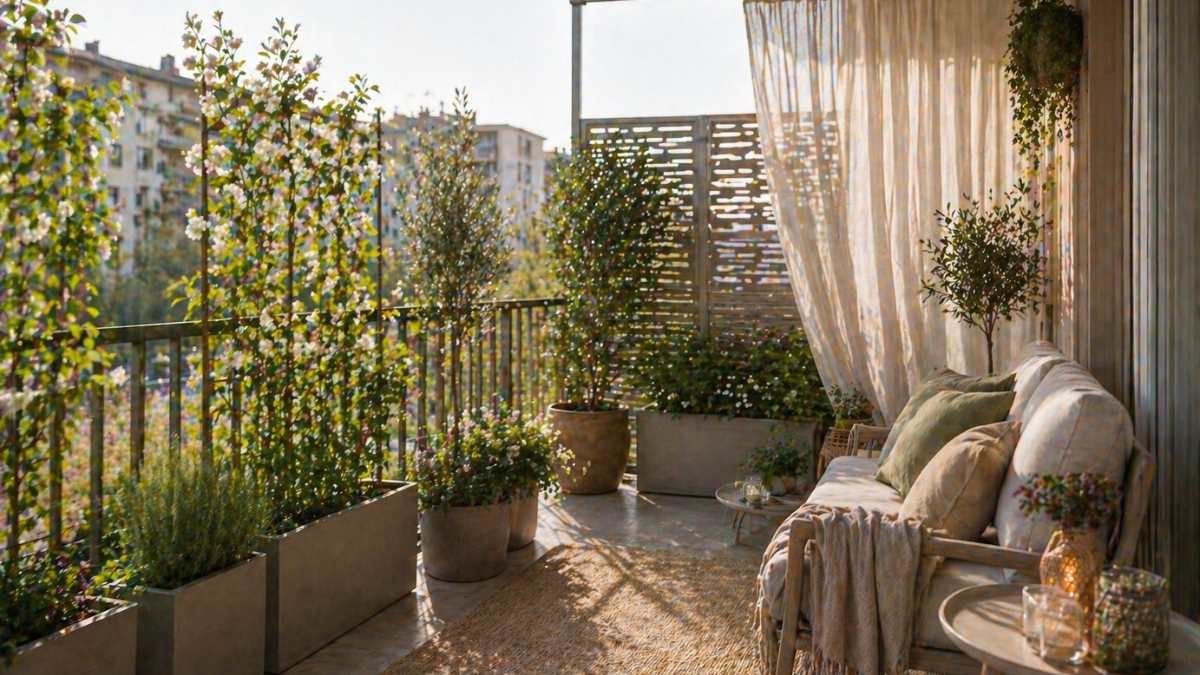

The balcony is one of the most exposed areas of the house. A direct view, a building in front or even a busy street is enough to completely lose the sense of familiarity. The most common reaction is to shut it down, heavily shield it, cover it with heavy sheets or solid panels. The result, however, is almost always the same: privacy is gained, but light, air and lightness are lost.
The point is that privacy doesn’t have to be a total visual block. It works much better when it comes filteredwas not eliminated. And this is exactly the trick that changes everything.
Privacy works best when it is not complete
A completely enclosed balcony is protected, but ceases to be an open space. Air circulates less, light enters worse and the environment also becomes visually heavier. When you work for shield without coverperception changes. It’s not about blocking the view completely, it’s about making it less direct.
It’s a subtle but very specific difference: those on the outside don’t have a clear vision, while those on the inside continue to they perceive the opening. It is this balance that allows you to have privacy without sacrificing space.
The trick: create a filter, not a barrier
The most effective solution is never a complete element, but something that it interrupts the gaze without obstructing it at all. An optical filter, actually. Plants are one of the most obvious examples. They should not be used as a solid wall, but distributed to create a irregular shielding. Vases placed along the parapet, elements of different heights, foliage that lets light through but does not allow direct vision. This way you get natural protection without closing the space.
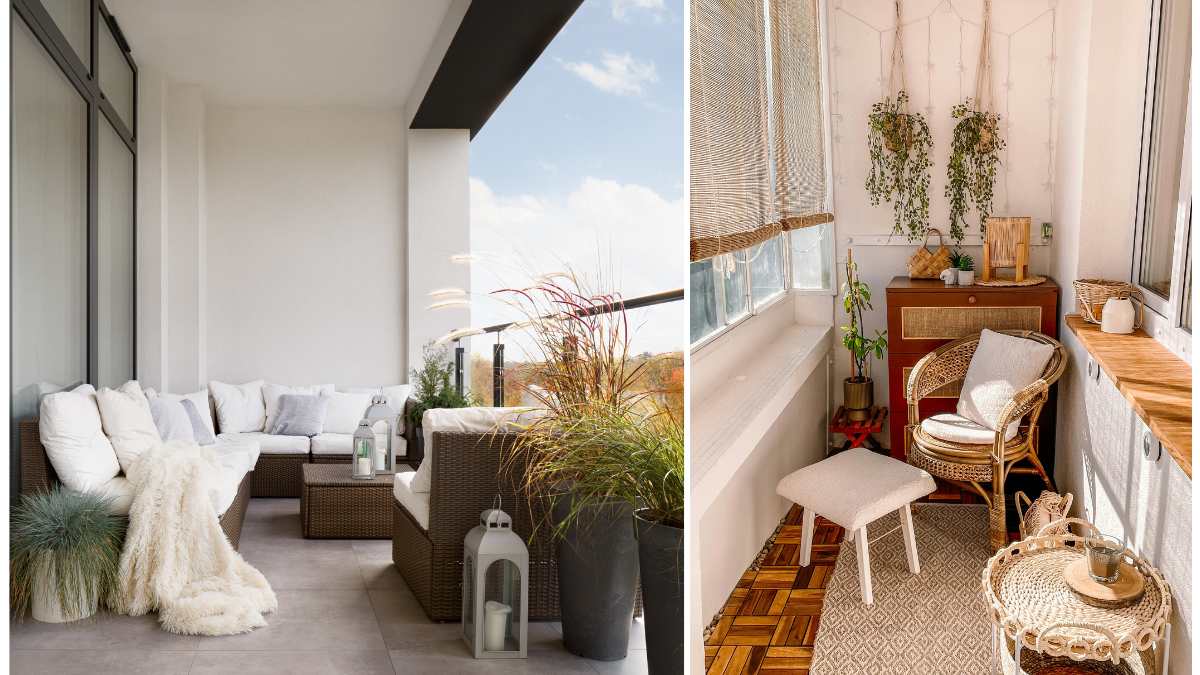
Fabrics also work very well, but only if they are light. A very heavy awning turns the balcony into a closed space. A softer fabricperhaps clear or translucent, it lets light through and, moving with the air, creates a dynamic separation. It is not a fixed barrier, but an element that changes during the day. Another effective solution is his perforated panels or light grills. Unlike full screens, they allow you to maintain visual depth. The gaze stops, but does not freeze. And here the result is lighter, both from a practical and an aesthetic point of view.
The most common mistake: closing everything together
When looking for privacy, we tend to cover each side of the balcony. It is the most frequent mistake and the one that destroys the result the most. The complete closure of the perimeter eliminates the problem of the outside gaze, but it is created static spacenot very airy and visually smaller. Even a large balcony loses quality this way.
It works much better to intervene only where it is really necessary. If the problem is a side view, it makes sense to show only that side. If it’s frontal, just work on the parapet. By leaving at least one part more open, balance and lightness are maintained.
The layout is more important than the elements
It is not so much what is used, but how it is positioned. Even the same objects can perform well or poorly depending on how they are distributed. A row of jars all the same and at the same height creates a rigid barrier. The same vases, staggered, with different heights and perhaps alternating with lighter elements, create a completely different effect. Space remains open, but less exposed.
The same goes for curtains. Placed straight and stretched they become a wall. Left softer, slightly tousled or wavy, they work like a filter.
The result you really have
When privacy is built in this way, the balcony does not lose its nature. It remains open, bright, livable. It doesn’t look protected, but it is. The difference is immediately noticeable: there is no longer that feeling of observation, but not even that of exclusion. It is one space that continues to breathe. And often very little is enough. You don’t need to transform the balcony, but only change the way you manage your gaze between the inside and the outside.



