
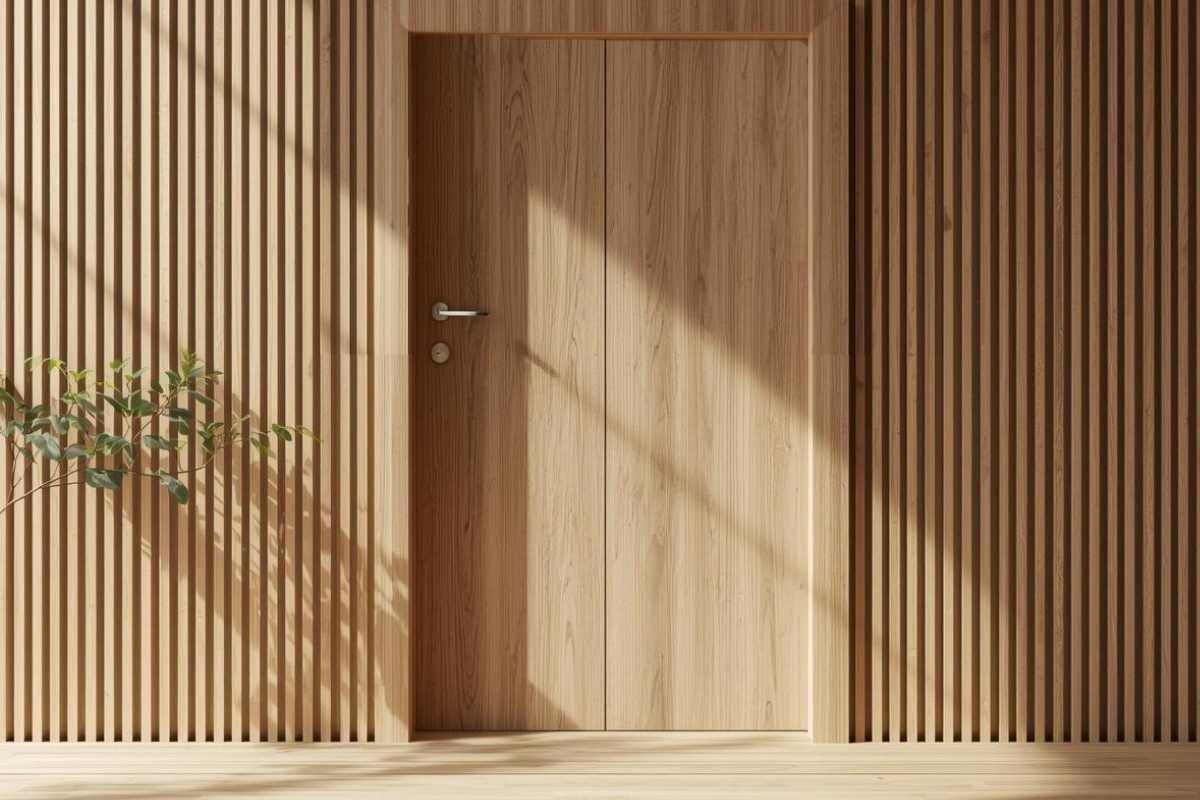

Imagine a door that has never been cut from any tree, that has never known a woodshop or the strong smell of synthetic glue.
A door that simply grew. It’s not science fiction or a design fair idea: it’s already a reality and it comes from Denmark, a country that has always paid attention to sustainable innovation.
Startup Rebound has developed a production process that uses mycelium, the root network of fungi, to grow rigid panels inside industrial molds. The result, ready in just two weeks, is a sound-absorbing, fire-resistant door made without waste. An object that challenges our very idea of production.
The mushroom that becomes a panel: how it really works
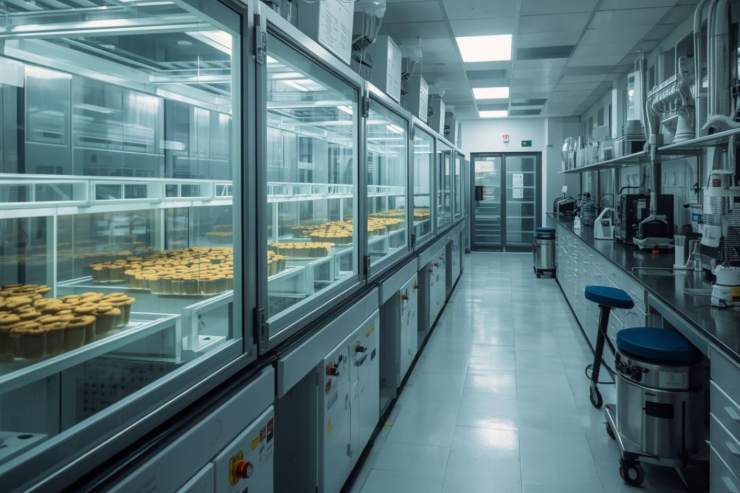
The heart of the process is biological, not mechanical. The mycelium is inserted into a mold where its root structures progressively colonize an organic substrate, branch out and compress to form a solid, lightweight panel with natural acoustic insulation properties. Two weeks versus the decades it takes a tree to mature: the comparison says everything about the sustainability of this technology.
The frame that wraps the panel is made entirely of scrap wood supplied by Dinesen, a historic Danish flooring company, turning production waste into a noble structural element.
The finished surface does not require paint or chemical finishes: the color and texture are formed during the growth of the fungus itself and can be further customized with a layer of natural clay. Even the structural strength is guaranteed with a “bio-gluing” technique integrated into the biological process, without synthetic adhesives. A door that is born already finished, like a ripe fruit detached from the branch.
From the lab to real homes: the first mycelium construction site
The acid test in the literal sense will come in 2026 with the housing project Kaerhytten, in Ramløse, Denmark: the first house in the world to be equipped with mass-produced mycelium doors. A result that marks the fundamental transition from the unique prototype to the replicable and scalable component, the most difficult challenge for any material innovation.
The architect Jens Martin Suzuki-Højrup, designer of the complex, chose to start with the doors because they are the elements we pass by every day without paying attention to them and exactly there, in the invisible everyday, the greatest opportunity was hidden. It is not an isolated case: the mycelium is already colonizing other construction sectors, from acoustic panels to suspended ceilings, and its versatility has also been demonstrated in areas away from construction, such as biodegradable food packaging.
Of course, open questions remain: the cost of large-scale production is not yet known, and the durability over time in real domestic contexts has yet to be verified. But the principle is established: we can build by inhabiting biology rather than fighting it.



