
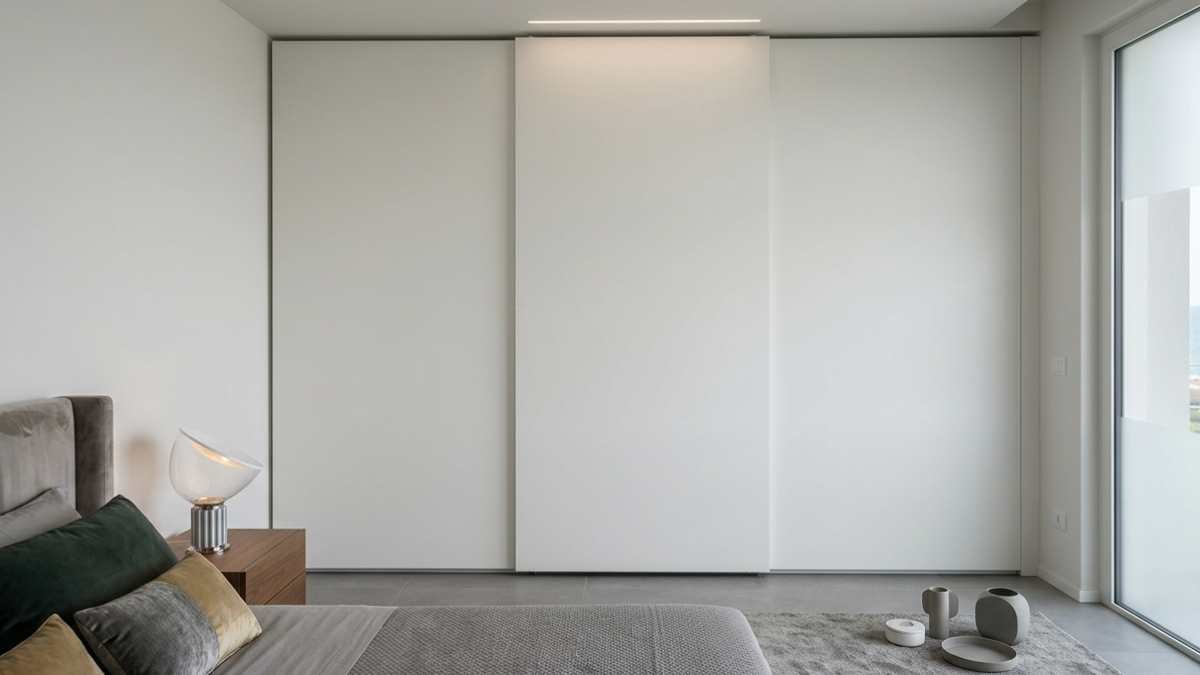

The volumetric effect of a wardrobe within a room does not depend solely on its planar size, but on the management of proportions and lines of escape. A wardrobe that occupies a regular surface can be perceived as a massive monolith or as a natural extension of the interior architecture. The key lies in the furniture’s ability to integrate into the perimeter of the wallor, conversion from an object of furniture to a structural surface.
The essential difference lies in the configuration of the facades and the management of color contrasts in relation to the building envelope, elements that determine whether the eye will read the furniture as an interruption of the space or as a coherent unit.
When the wardrobe becomes a wall: the continuity of surfaces
A 3-door wardrobe reaches its maximum aesthetic performance when configured to appear as a single block. To achieve this result it is necessary that the doors be a full height and have smooth surfaces, without deep grooves or protruding decorative frames. Visual interruptions, such as exposed frames, fragment light and create shadows that reduce the perception of spaciousness.
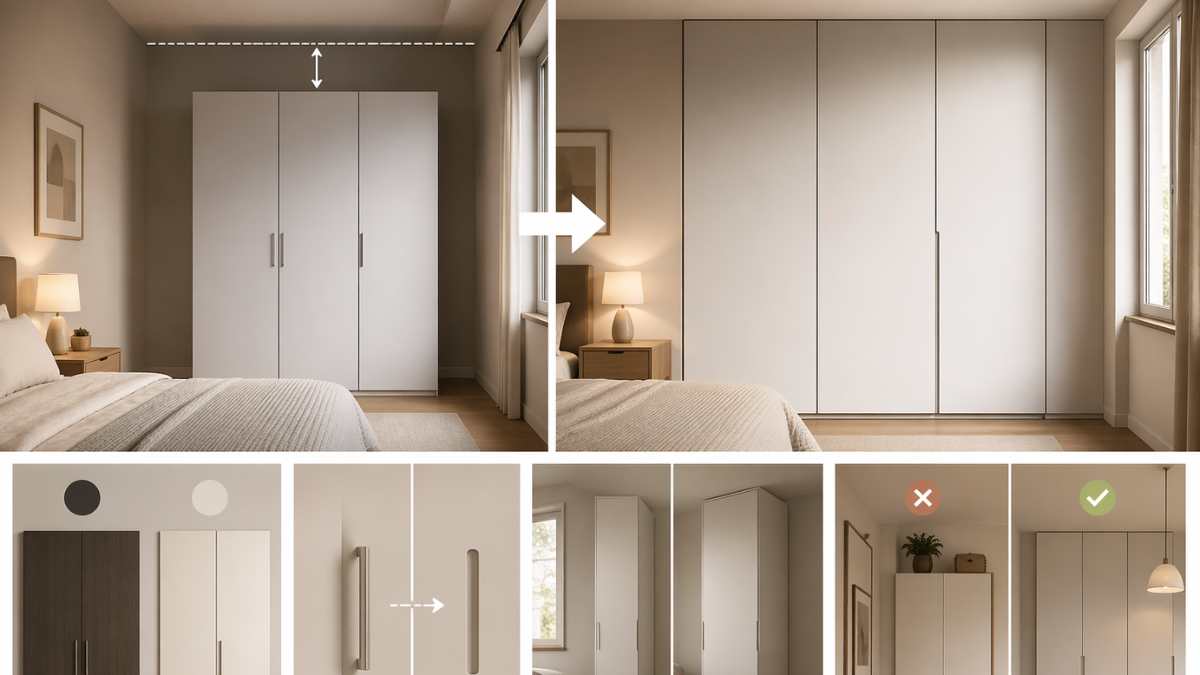
A technical reference example it’s the system PAX at IKEA equipped with doors BE WARNED the CLIMBER (in the smooth version). If it is chosen in a white matte finish and placed next to a wall of the same shade, the wardrobe ceases to exist as an independent volume. Practically, the absence of reflections guaranteed by the matte finish prevents the eye from recognizing precisely where the wooden panel ends and where the plaster begins, visually expanding the equipped wall.
The strategic height: eliminating the upper gap
Height is the parameter that most affects the visual stability of a wardrobe. A unit that stops 20 or 30 cm from the ceiling creates an upper shadow area that “presses” the piece of furniture down, making it appear like a foreign body. To optimize integration, it is preferable to choose structures that reach close to the ceiling, leaving only the technical space necessary for assembly (usually 1-2 cm for suspended systems).
If you use a standard model like PAX 236 cm in a room with 270 cm ceilings, the remaining space can technically be filled with plasterboard veil or a coordinated MDF filler panel. This function turns an inexpensive piece of furniture into a custom built-in wardrobe, eliminating dust deposits on top and stabilizing the vertical lines of the room.
Color and thermal management of light
The color contrast between furniture and wall defines the physical boundaries of the object. A dark gray or wood-effect wardrobe placed against a white wall creates a visual saturation that focuses attention on the mass of the object, making it paradoxically appear more compact. Instead, its use request su request (for example a beige finish on a sand wall) allows the edges to blend.
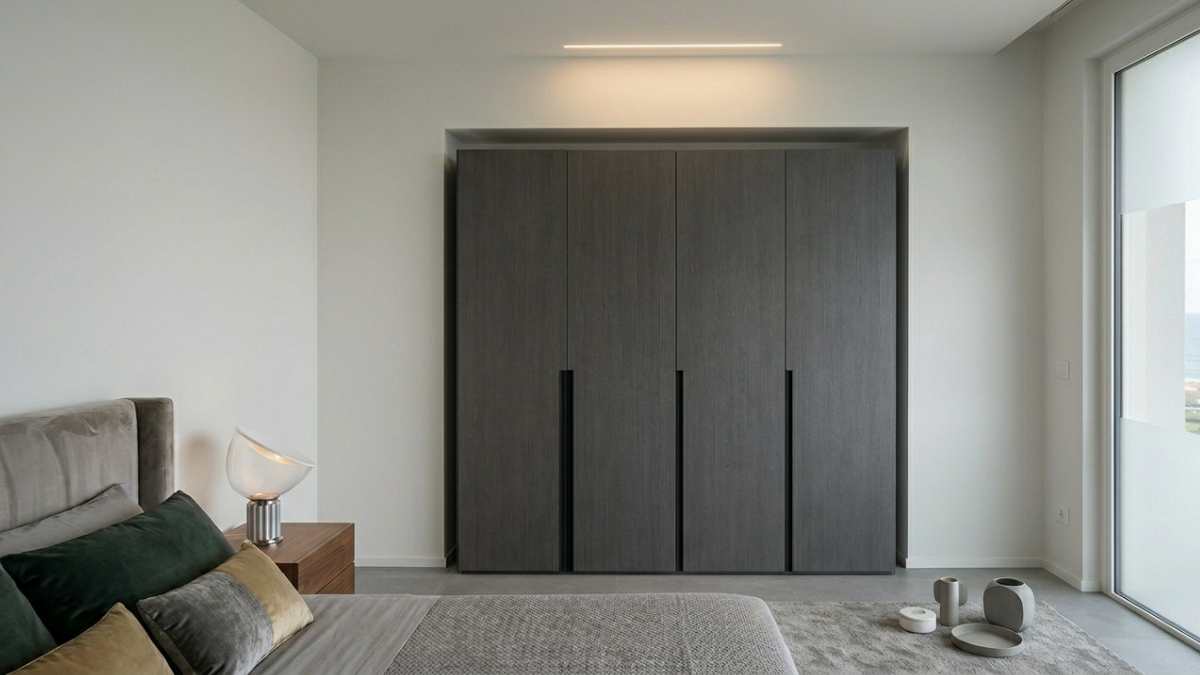
From an analytical point of view, light finishes reflect a greater amount of courtyards, increasing the brightness of the environment and reducing the shadow of the furniture. This measure is fundamental in 3-door wardrobes, where the front surface is large enough to influence the color temperature of the entire room.
The handles: eliminate mechanical interruptions
Traditional handles act as visual anchor points that interrupt the linearity of the table. If bridge handles or protruding knobs are chosen, the surface is fragmented into three distinct sectors, emphasizing the modular nature of the furniture.
To maximize the aesthetic compactness, the optimal technical solution is to use it push-to-open systems or doors with built-in groove handles (like the doors BILLSBROUGH). By eliminating protruding metal elements, the cabinet face remains clean, promoting fluid reading that doesn’t stop at hardware details. This approach turns three separate doors into a single architectural background.
The useful depth and the passage space
A typical 3-door wardrobe is usually 60 cm deep, which is necessary to contain outerwear without folding up the sleeves. However, including the thickness of the door, the final size reaches 62-63 cm. In bedrooms with a width of less than 320 cm, every extra centimeter takes away living space from the corridor between the bed and the furniture.
If space is critical, it is possible to evaluate constructions with reduced depth (such as PAX 35 cm units), provided that removable clothes rails transverse. This configuration reduces the occupied volume by almost 50%, maintaining the width of the 3-door front and ensuring a significant aesthetic without saturating the floor space.
Technical mistakes to avoid
Designing a wardrobe often fails due to small errors in systematic assessment:
- Hardware fragmentation: The use of doors with central mirrors or inserts of different materials breaks the continuity, making the piece of furniture look smaller and dated.
- Saturation of adjacent spaces: Placing tables or shelves near the sides of the wardrobe prevents the furniture from “breathing”, creating a visual crowding that conveys a feeling of suffocation.
- Glossy finishes in small rooms: Although the mirror is believed to expand the space, a finish shiny it creates multiple reflections of the surrounding objects (bed, chairs, clutter), visually doubling the chaos instead of simplifying the line.
- Visible legs: A wardrobe resting on visible legs communicates instability and “temporality”. A piece of furniture that rests on a closed base or that appears suspended at floor level looks much more compact and built-in.
In conclusion, the 3-door format represents a golden unit in furnishing: it is large enough to offer functional internal division (shelves, drawers, hangers), but manageable through minimalistic surfaces that hide its mechanical complexity.



