
Architecture, when reframed, is about the space and not the walls. it does not enclose, but reveals. THE Apartment in the Garden with Aranda/Laschit repeats the domestic interior as a calibrated aperture: a sequence of frames, thresholds and volumes that coordinate everyday life with light, landscape and time.


At the center of this Lower East Side (LES) project is an almost mythical condition for New York living—a double-wide private garden. Rather than treating this as an amenity to be accessed, the architects position it as a conceptual and spatial anchor of the project. The block of flats becomes, in their words, “a framework for the oasis outside”, a device through which the changing external atmosphere is constantly recorded from within.


This context is not only metaphorical. A new double-height volume acts as the main projection device, drawing daylight deep into what was once a compact, compartmentalized plan. And the vertical expansion increases the perceived space by reorganizing daily rituals around the very void of daylight. Dining, gathering and relaxation unfold in a tall, bright chamber where the presence of the garden is constant, even when it is not immediately visible.


Crucially, the aperture here is not a single aperture but a sequence of calibrated thresholds. The existing rear facade opens to accommodate extensive glass, dissolving the boundaries between interior and exterior. However, the project resists the overall transparency often associated with contemporary residential design. Instead, the openings are composed as ‘dramatic frames’, leading the eye outwards while maintaining a sense of interior depth and enclosure.


The material becomes decisive in enhancing this permeability in layers. Thatched white oak volumes frame the central space, their vertical ridges subtly echoing the texture of the outer fence. This dialogue between inside and outside leans toward visual resonance—soft alignments of surfaces, allowing the two realms to bleed into each other without collapsing their distinction. The result is atmospheric rather than literal, a silent synchronization of levels that enhances spatial awareness.

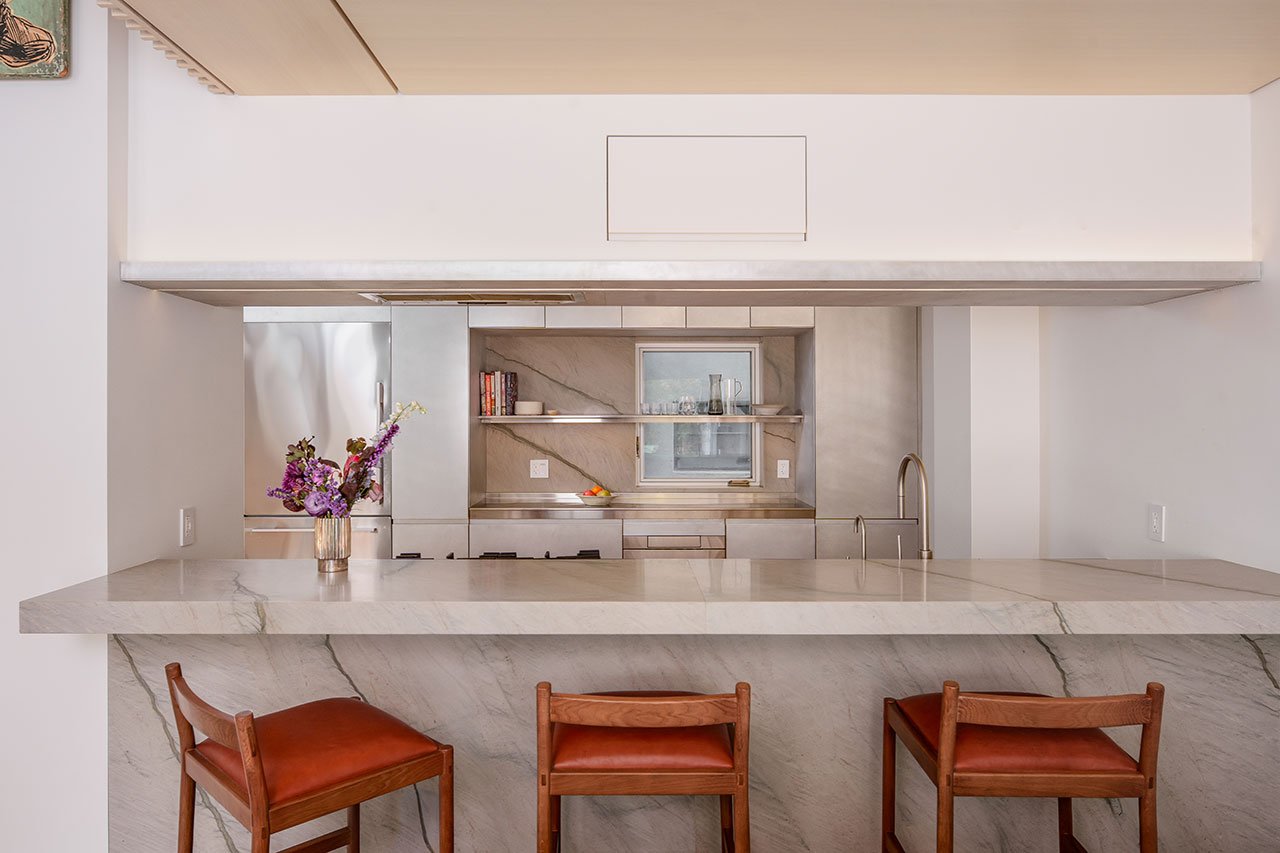
The restraint of the material palette further sharpens this perceptual clarity. Oak defines the main living zones with warmth and continuity, while terrazzo and terracotta ground the more functional spaces in durability and tactility. The kitchen, made entirely of brushed metal, introduces a counterpoint—cool, reflective, yet soft in finish. There is a noticeable absence of exaggeration. each material is read as both a surface and a mark, delimiting the use while maintaining coherence.


“There’s nothing over the top here, and that’s where the beauty lies,” says Aranda\Lasch co-founder and principal architect Ben Aranda. “Life itself can be excessive, but architecture can be the quiet, enduring backdrop that hosts it.”


Even the design participates in the logic of the aperture. The first floor is deliberately kept open, punctuated only by a monolithic staircase and a kitchen – two sculptural anchors that organize movement without restricting it. The ladder, in particular, functions as both an object and an interface. His handrail, described as the project’s only moment of exaggeration, becomes a point of contact between the body and the architecture. In a home defined by optical porosity, this detail underpins the tactile experience.


What results is a domestic environment that privileges continuity over separation but never abandons the need for gradation. Diaphragms evolve beyond “seeing” and become “felt along”—filtering light, aligning textures, expanding and contracting volumes, all in response to daily rhythms. Even from deep inside the apartment, the presence of the garden is felt.


Capitalizing on its unique advantages, the Garden Apartment proposes an alternative model of urban living that maximizes the spatial experience in the service of life, not square meters. It is not imposed as an object of admiration, nor does it function as a tool to garner attention for social currency. It constantly directs awareness to personal moments outward, inward, and everywhere in between.
To view this and other studio works, visit arandalasch.com.
Photo courtesy of Aranda\Lasch and RBM Laboratory.