

prewood: a solid timber in Tokyo
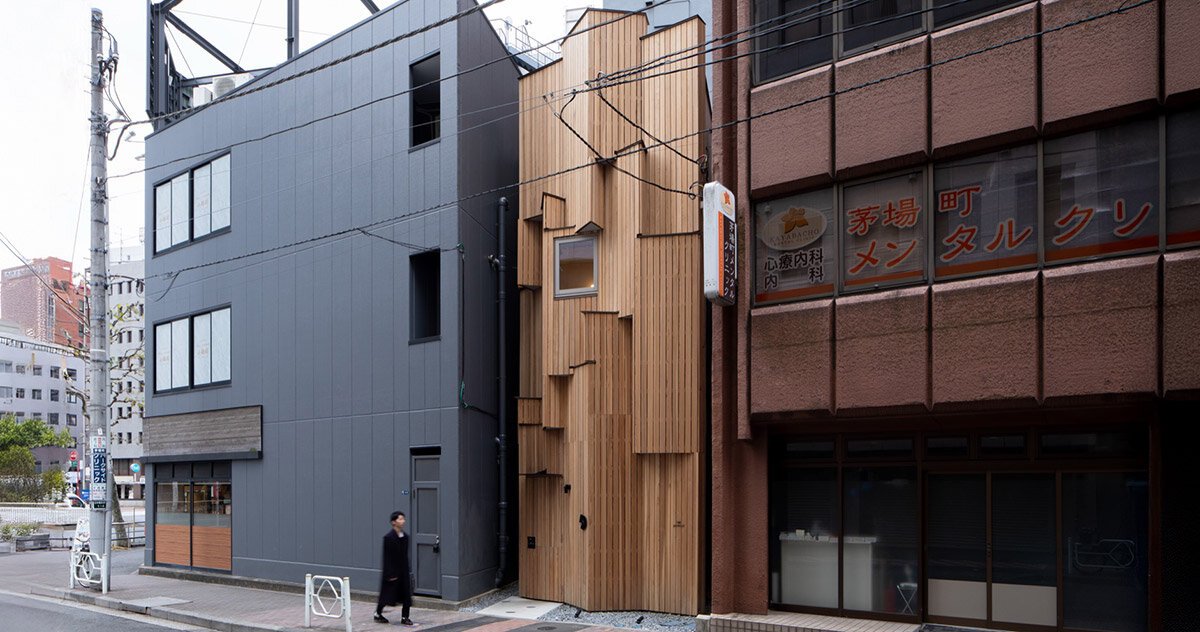
In Tokyo, VUILD completes the prewood, a compact timber building occupying a narrow urban void with precise, articulated approach. Within a dense landscape, the project fits among neighboring structures with a quiet confidence, its vertical cedar facade introducing a distinct texture while maintaining the rhythm of the street.
The exterior appears as a stacked composition of wooden panels, articulated through subtle depth changes and corner cuts. Openings are placed with restraint, offering glimpses of activity inside while maintaining privacy along the tight facade. The material remains raw, allowing the cedar to weather gradually, its surface expected to change in tone over time in response to the city’s climate.

Prewood, designed by VUILD, occupies a narrow site within a dense Tokyo landscape | image © Hayato Kurobe
vuild designs modules for reuse
At the core of prewood is a construction system developed by group in VUILD which treats the building as a set of discrete wooden units. Each unit is designed to be disassembled, allowing the structure to be broken down and transported into the future. This approach extends the life of the material beyond a single location, aligning the design with a broader view of resource cycles.
The units are stacked vertically, forming a compact volume that maximizes the usable floor area within the constraints of the plot. Digital modeling tools were used to define thousands of screw positions, translating directly into manufacturing data. On site, assembly proceeded with a high level of precision, supported by 3D printed guides that ensured consistent alignment at every joint.

the cedar facade introduces depth through subtle offsets and corner cuts | image © Hayato Kurobe
internal sequencing and spatial compression
Inside, prewood organizes its program through a series of split levels that expand the perception of space within a limited footprint. The service elements are clustered forward, freeing up the remaining areas for seating and circulation. The vertical movement between levels introduces variation in ceiling height and perspective, forming a sequence that appears continuous yet varied.
The interior palette is restrained, with plaster walls and exposed wooden surfaces setting the mood. Light enters through carefully placed openings, grazing the surfaces and accentuating the grain of the wood. On the upper levels, a semi-private zone supports small gatherings, while a rooftop terrace offers a moment of openness to the surrounding density.

Openings are positioned to balance access to light with privacy along the street | image © Hayato Kurobe
structural logic and application of urban timber
The structural system of the building responds directly to the limitations of its space. With limited scaffolding space, the modular components allowed quick assembly, completing the main structure in a short time. The process reduced the reliance on specialized carpentry, rather than relying on a coordinated system that could be performed with standard construction work.
Material choices also address regulatory and environmental factors. Located in a fire prevention area, prewood incorporates laminated wood ceilings designed to perform under fire exposure. The use of cedar panels, combined with ventilation gaps and protected end grains, supports durability while maintaining the material’s natural finish. Through this approach, VUILD positions prewood as an example of urban woodwork adapted to the dense conditions of the city.

the building consists of stacked wooden units designed to be dismantled | image © Hayato Kurobe

each module can be moved to extend the life of the structure | image © Tomoyuki Kusunose



