
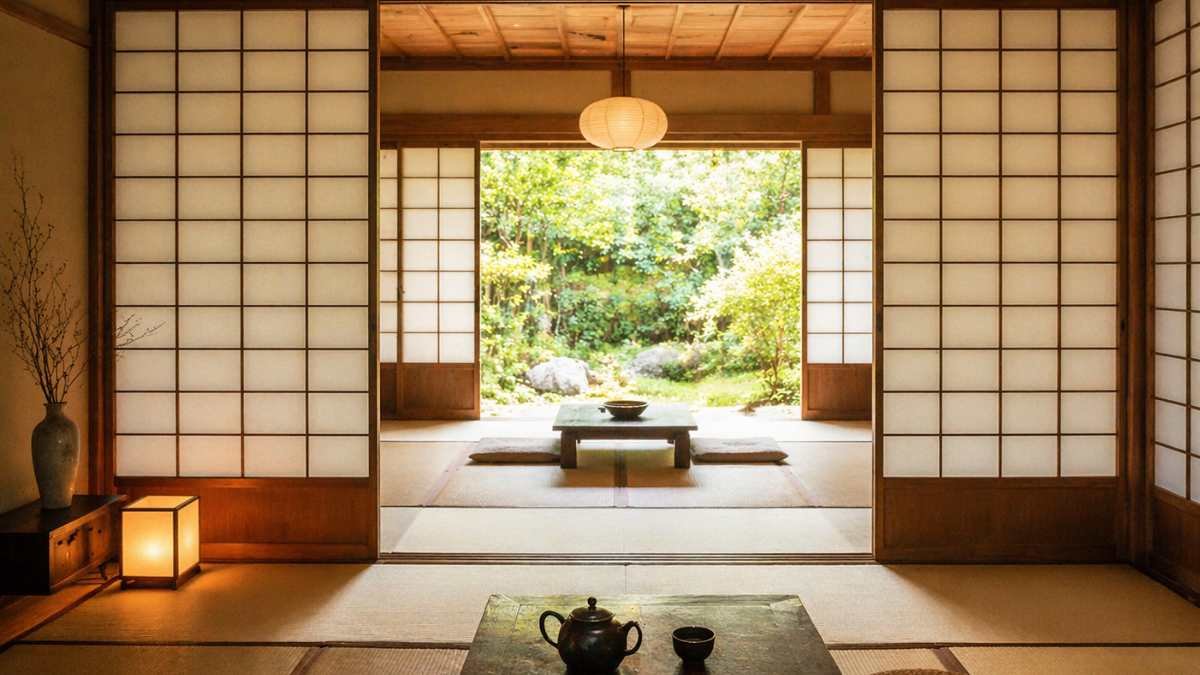

Entering a traditional Japanese house gives an immediate and very special feeling: the space seems to flow without interruption, the rooms are transformed, the light spreads gently. It is as if the walls, so central to Western homes, have suddenly disappeared.
Actually the walls are there, but it is not the heart of architecture. The secret lies in shoji, those sliding panels of wood and paper that completely redefine the way spaces are lived. They’re not just dividers: they’re a design tool that changes everything.
Not walls, but moving surfaces
In Western homes, walls serve as permanent separation. A room has an exact function and remains that. In traditional Japanese homes, however, space is meant to be flexible.
The shoji slides, opens, closes. This means that a room can be made bigger or smaller depending on the moment. There is no rigid separation between environments, but a dynamic structure that adapts to daily needs.
During the day, the spaces can be open and communicate. At night, however, more intimate spaces can be created. It is a completely different way of conceiving the house: not as something fixed, but as something that transforms.
The light changes completely
One of the most impressive effects of shoji is light. The washi paper from which they are made is not transparent, but filters natural light diffusely. This creates soft, even lighting without harsh contrasts. There are no hard shadows, no areas that are too dark. Light enters, but does not invade. It wraps around the space instead of hitting it.
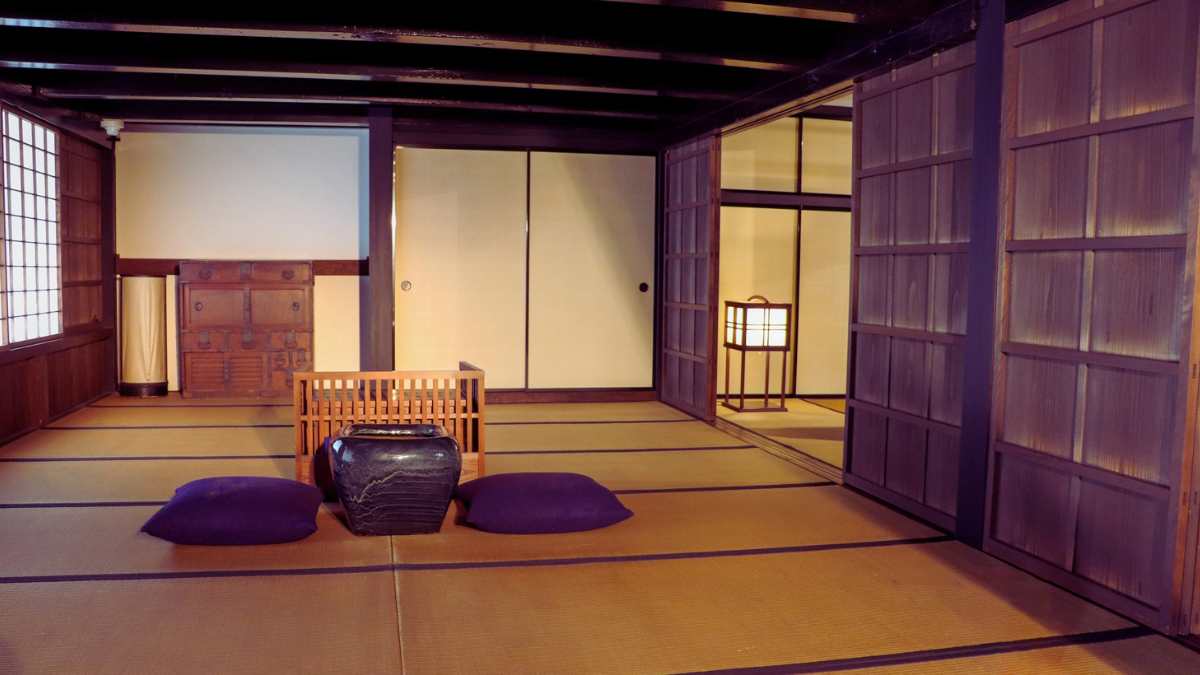
It is one of the reasons why Japanese houses look so calm and harmonious. Even with few elements, the environment is balanced, because light is an integral part of the work.
More space without having more space
Here’s the most impressive point: these houses look bigger than they really are. The absence of rigid walls allows the look to flow. There are no sharp visual interruptions and this makes the space perceived as continuous. Even small rooms feel larger, simply because they are not “closed”.
It’s the same principle we’re trying to apply today in open spaces, but here it’s taken to the extreme. It’s not just about eliminating walls, but replacing them with elements that they do not block the space, but suggest it.
Different privacy, not absent
At first glance it may seem that there is a lack of privacy, but this is not the case. It’s just designed differently. Shoji’s do not completely isolate acoustically or visually, but create a lighter separation.
This reflects a culture where space is shared more fluidly and where clear division is not always necessary. There are also other elements, such as fusuma (more opaque panels), which allow for greater separation when needed. But the basic idea remains: the house is not made of rigid boundaries, but of gradual transitions.
An architecture born from context
This choice is not only aesthetic. It is associated with very specific factors. Japan is an earthquake-prone country, and lighter, more flexible construction has historically been more appropriate. The load-bearing structures are independent of the internal partitions, which can be modified or replaced without compromising the building. In addition, the materials used – wood and paper – respond well to the climate and the needs of everyday life.
Because today it fascinates us so much
This way of designing the house is more and more relevant. At a time when we are looking for more open, bright and adaptable spaces, the Japanese model appears incredibly modern. It’s not about copying shoji, it’s about understanding the principle: reduce the unnecessary, make the space more fluid, let the light and materials do the rest.
That is why these houses appear without walls. Not because the walls do not exist, but because they cease to be protagonists. And when it does, it completely changes the way you experience space.



