


An empty balcony is not born of neglect. It was born out of a misjudgment probably made on day one, when anything still seemed possible. The owner had ideas, maybe some pictures saved on Pinterest, a vague intention to have breakfast outdoors on a Sunday morning. Then something didn’t work and the outdoor space became the place where the bike is temporarily placed or some box waiting to be placed.
This pattern is repeated in apartments of all types, regardless of the size of the balcony or the available budget. The problem is not laziness, or even lack of taste. The fact is that most people start from the aesthetic effect they want to achieve, completely skipping the phase in which they analyze what this balcony can support.
Plants die, chairs always move, going out on the terrace becomes a business to plan. At that point, keeping the shutters closed becomes the simplest option.
The sun that was not calculated
It all starts with orientation, which almost no one checks before buying something. A north-facing balcony receives very little direct light most of the year. A south balcony, on the contrary, can be done a shiny surface in the summer monthswith perceived temperatures far exceeding those of the interior. These two scenarios require completely different approaches, yet most purchases are made ignoring this variable.
Plants are the most obvious case. A lavender or geranium bought because it looks beautiful in the photo will wither in a few weeks on a northern balcony where direct sun does not reach. On the flip side, ferns and tropical plants do little to resist prolonged exposure to full summer sun. The result, in both cases, is a terracotta jar with something gray inside that no one has the courage to throw away. Dead or damaged plants communicate abandonment better than any other piece of furniture and the brain registers this signal before it is even consciously processed.
Wind further complicates the picture. Balconies on high floors or exposed to constant currents require sturdy items and heavy containers. Brands like Lechuza, a German manufacturer specializing in planters with self-watering systems, have built part of their catalog around this problem: their models balcony they are designed to withstand the wind thanks to the weight of the built-in substrate and the stability of the base. It is not a decorative detail, it is a technical choice that determines whether a plant survives or not.
Furniture that blocks rather than inhabits
The second error is dimensional and has direct implications for sustainability. A fixed table with four seats on a balcony of six square meters leaves no room to move freely, to open the French window without having to move a chair, to approach the railing without maneuvering. When every movement requires a small geometric calculation, the balcony ceases to be a space and becomes an obstacle.

Compact space designers have been working on this problem for years with solutions that have now been implemented by the mass market. Folding and hanging furniture they are not an alternative category: they are the right answer in a space with real constraints. Unopiu, an Italian company based in Thiene, has been producing outdoor furniture designed for small patios for decades, with stackable chairs and extendable tables that extend from 60 to 120cm with a single movement. The Danish brand Skagerak brought the same principle to the series with the chair Yours in folding ash that hangs on the railing or leans against the wall without touching the floor.
The fluidity of movement is the criterion that should guide any purchase for a small outdoor space. If the exit to the balcony requires you to move something, this exit will happen less. If the output is a natural gesture, the threshold is lowered and the space is used. Physical difficulty creates psychological distanceand this applies to both a four-square-meter balcony and an equipped terrace.
What you can’t see but weighs
There’s a third element that rarely comes into play in discussions of outdoor furniture: the floor. Italian balconies often emerge from buildings with raw concrete surfaces, anonymous non-slip tiles or dated tiles that no one has ever replaced. Adding plants and furniture to a surface that communicates coldness or decay never produces a satisfactory result. The eye continues to record the background, albeit unconsciously.
Composite wood or teak decks are the most popular solution, but execution makes all the difference. Ikea sells its platforms Run at an affordable price, but the light gray color gets dirty easily and requires maintenance. A step up are the products of Naterial, a brand of the Leroy Merlin chain, with WPC slats treated with UV resistance that retain their color for several years without special treatments. The choice of background changes the perception of the whole space: it is the same logic why restaurateurs take care of the floor of the room as well as the lighting.
Privacy also affects frequency of use. A balcony completely exposed to the view of neighbors or the street is less used, even by those who claim not to be shy. Windproof bamboo, specific outdoor blinds like those in the series Docril by Tententenda, or simply a strategically placed planter can redefine the perceived perimeter of the space without structural interventions.
Start again from the notebook, not the store
Before you buy anything for a balcony, it’s worth spending a few days looking at it. What time does the sun arrive, if it does? Where does the wind come from? How long does the afternoon shadow last? How many people will actually use it and to do what. A lonely breakfast balcony requires a completely different solution than one designed for two people dining outside in the summer.
This does not mean making a formal plan, but having at least a clear idea of the actual conditions before buying. Most balconies fail at the purchase stagenot in that of use. Everything else, wilted plants, obstructing chairs, neglected surfaces, are only the visible consequence of a decision made looking at aesthetics and ignoring context.
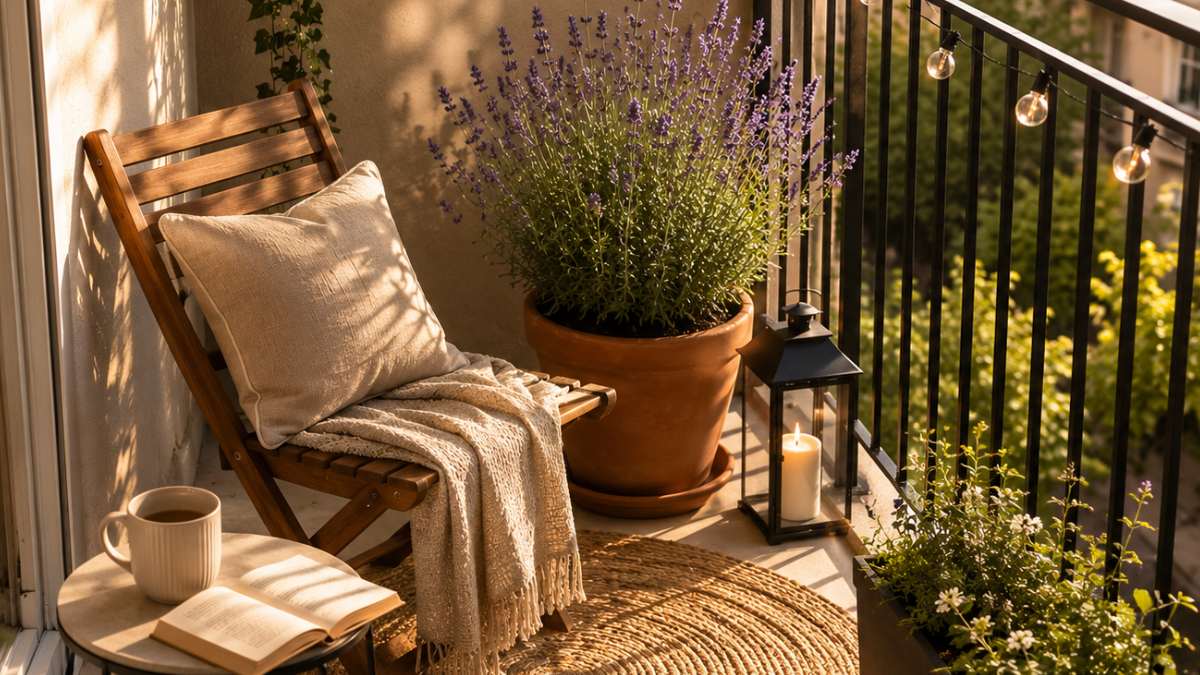
A pot with a plant just for this display, a chair that folds in thirty seconds, a floor that requires no constant maintenance: three well-chosen elements are worth more than a photo setup that lasts two seasons and then crumbles.



