
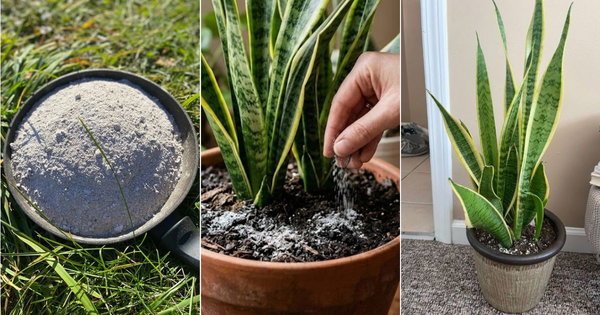

Did you know that a pinch of wood ash can improve the health of your snake plant? It seems quite unusual, but this simple balance can do a lot!
Yes, you read that right. Wood ash contains minerals such as potassium and calcium, as well as trace elements that plants can benefit from in small amounts. See exactly what it does and how to get the most out of it!
The amazing benefit of wood ash for snake plants

When it comes to these famously low-maintenance installations, you have to make sure the soil is correct! Snake plants prefer a slightly neutral to mildly alkaline range (about pH 6.5–7.5), and that’s where wood ash comes in handy.
Because it is naturally alkaline, a small amount can help correct acidic potting mixes, pushing the pH up into a healthier zone for root function. It matters most in containers, where peat mixes tend to become acidic over time.
Wood ash doesn’t just adjust pH. It also adds potassium and calcium, which support steady growth and stronger cell structure when the plant seems sluggish.
You should know: As ash is alkaline, overuse can raise soil pH or create salt build-up. This is especially important for potted plants because minerals accumulate in containers much faster than in garden soil. Also, if your soil is already clean or alkaline, avoid using it.
The key nutrients in wood ash that work

Wood ash contains calcium carbonate, which helps reduce soil acidity and bring the pH closer to neutral. ideal for snake plants growing in potting mixes that tend to become acidic over time.
It also provides small amounts of minerals such as potassium, magnesium and phosphorus. Potassium supports water regulation and stress resistance (hardwood ash has approx 5-7% potassium compounds), and magnesium helps produce chlorophyll for greener leaves.
The takeaway? For houseplants such as snake plants, these minerals act more like a soil conditioner than a strong fertilizer. When used properly, they can help maintain soil balance and provide small increments of nutrients over time.
How to add ash to snake plant
1. Soil spray method

The simplest way to use ash is by adding a small sprinkle to the surface of the soil. Take a pinch of clean wood ash and sprinkle it lightly on the top layer of soil around the plant. Then water the pot lightly so that the minerals slowly move into the soil.
For a tip: Use only a very small amount, about a pinch or half a teaspoon per pot, lightly dusting. Too much ash can make the soil too alkaline. And never scatter ash directly on or around the base of the leaves where they meet the ground.
2. Mixed ash-water solutions

If you want a gentler approach, make an ash-water solution by diluting the ash in clean water and using that as an alternative. For this, mix 1/2 teaspoon of wood ash in about 1 liter of water, mix well and let the mixture settle for a few minutes. Then, whenever it’s time, use the clean water to lightly water the soil.
Note: Make sure you The snake plant pot has adequate drainage holesor it may harm the good deed!
3. Mixing ash into potting soil
When transport your snake plantyou can mix a small amount of ash into the soil mixture. It helps in the even distribution of minerals! Just add a teaspoon of wood ash to the potting mix before planting if it’s a small pot, then you can go for 2-3 teaspoons if the pots range from medium to large.
4. Mixing ash with compost 
Instead of spreading ashes directly on the plant, you can also mix a small amount with compost before adding it to the pot. A ratio of about one tablespoon of ash per small bucket of compost you’re going to make is usually safe for houseplant soil mixes.
This will help the minerals gradually mix with the organic matter and release the nutrients more slowly.
Pro tip: Additionally, when transplanting a snake plant, a small pinch of ash in compost-amended soil can also provide a gentle mineral boost.
When should you avoid using wood ash?

Wood ash can be beneficial in small amounts, but problems arise when overused. So you might want to keep a close eye out for these signs:
- Appearance of white or crusty build-up on the ground
- Slow growth or yellowing leaves
- If the soil becomes too compact or dry.
Also, avoid using ash if your potting mix already contains lime or if you fertilize regularly with balanced houseplant fertilizers, as the soil may already have enough minerals. Simple, right?
Sometimes the simplest gardening tricks come from everyday scraps. You’ve heard of wood ash, but have you used it? milk on your snake plants?



