


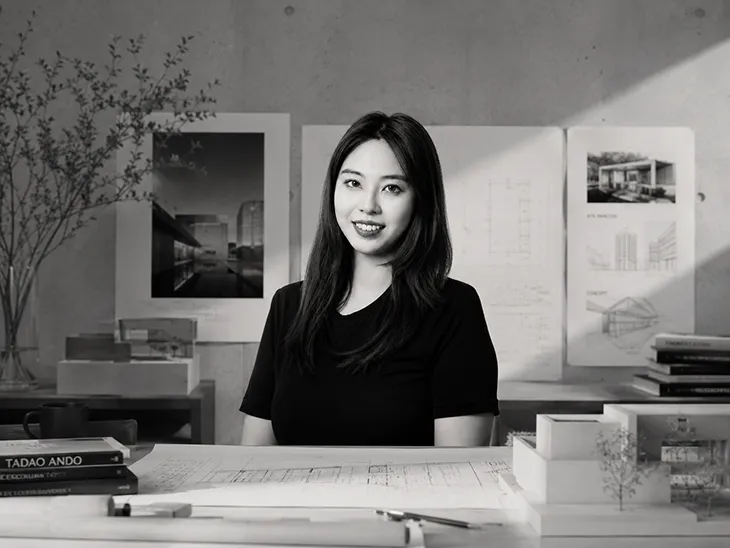
As an award-winning landscape architect and interdisciplinary designer based in Houston, USA, Xinyue Hope Shen promotes a climate-responsive approach to landscape architecture that links ecological design, urban design, cultural narrative and public experience. He is a Landscape Architect with the SWA Group, an internationally recognized landscape architecture and urban design practice known for large-scale public realm, hospitality, urban and urban design projects, and has worked on urban landscape, public park, hospitality and real estate projects in the United States, Mexico, Egypt, Saudi Arabia, China and South Korea. Xinyue has received awards from the ASLA National Awards, Texas ASLA Awards, IDA Design Awards and MUSE Design Awards. He believes that landscape is not decorative open space, but rather environmental infrastructure that restores ecosystems, builds climate resilience, and reconnects communities to place.
ARCHITECTURE
In hospitality landscapes, exhibition-based research and climate-adaptive urban design, Xinyue’s practice is defined by a rare ability to connect environmental systems with cultural meaning. In her work on historic hotel landscapes in Egypt, including Mena House Giza, Old Cataract Aswan and Winter Palace Luxor, Xinyue has contributed design strategies that balance cultural heritage preservation with a contemporary hospitality experience. A key contribution has been the development of landscape sequences that protect and frame historic views while improving visitor comfort in hot, arid environments. It treats landscape not as decoration, but as a living context where climate, memory, infrastructure and public life meet. From historic hotel gardens to AI-era data centers and coastal wetlands, her work translates complex global challenges into spaces that are both intellectually rigorous and emotionally compelling.
Reframing Heritage Hospitality at Mena House Giza
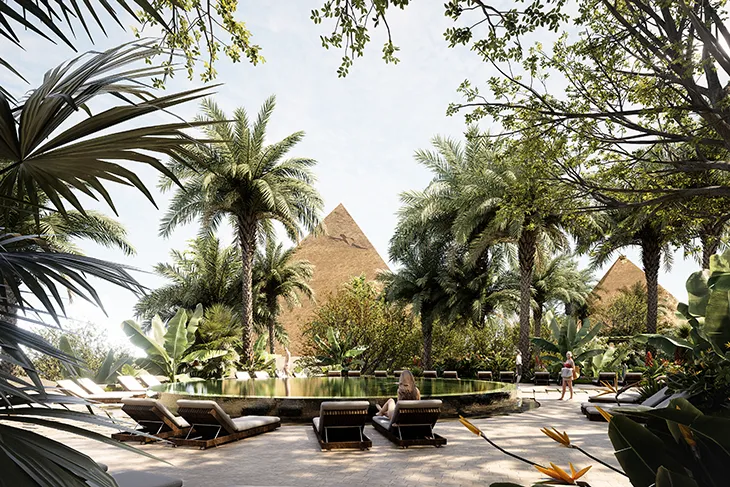
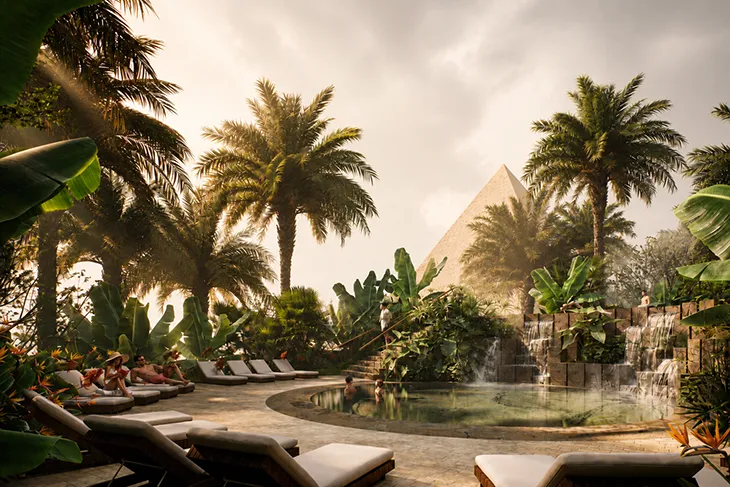
At SWA Group, Xinyue Hope Shen’s work on the Mena House Giza Hotel Landscape places her practice in one of the world’s most iconic hospitality environments. As a historic five-star hotel located steps from the Pyramids of Giza, Mena House has global prominence and deep cultural significance. Xinyue brings strong hospitality experience to the project, including working at the Grand Hyatt Los Cabos in Mexico and several historic hotel landscapes in Egypt. Her approach balances conservation, ambience and contemporary luxury, using the landscape to frame the pyramids, enhance microclimate comfort and create a sophisticated visitor experience rooted in history and place. Currently under construction, the project presents the landscape as an active part of the renovation, shaping the visitor’s comfort, memory and experience.
As lead designer and landscape team leader for Mena House Giza Hotel, Xinyue was responsible for guiding the landscape direction of the project from concept development to construction documentation. Led the design team in formulating the landscape concept, spatial sequencing, planting character, shaded circulation, display framing strategy and detailed documentation. Her work focused on balancing the sophisticated visitor experience with the comfort of the desert climate, heritage sensitivity and carefully framed visual relationships with the pyramids. In this role, Xinyue not only contributed design ideas, but also coordinated the team’s creative and technical efforts to ensure the landscape met the site’s cultural significance, environmental conditions, and hospitality goals.
The result is a landscape that does not compete with but enhances Giza’s iconic presence. The project reflects Xinyue’s cross-cultural sensitivity and climate-responsive design judgment. Her contribution is to use the landscape as a sophisticated spatial instrument, not just a visual enhancement, that can preserve heritage, improve environmental comfort and transform hospitality design into a deeper cultural experience.
Alongside her professional career at the SWA Group, Xinyue Hope Shen founded LYG Studio in Shanghaian independent studio of design research, spatial education and interdisciplinary creative practice. Through LYG Studio, Xinyue has developed independent research projects recognized by international design awards and public exhibitions, including Beyond Concrete and Barcelona Three Chimneys.
Spatial Research Through Art and Exhibition
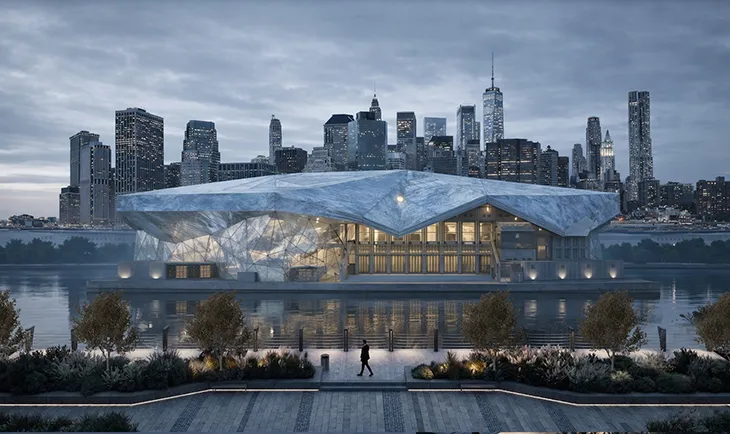
Xinyue’s independent work extends beyond conventional landscape practice to one of the most pressing spatial questions of the AI era: how can the infrastructure behind AI co-exist with the environment? Her project Beyond Concrete: The New Era of AI, a data center proposal for New York City, was recognized with two MUSE Design 2026 Gold Awards and exhibited during NYCxDESIGN. Rather than treating the data center as a sealed technical facility, Shen reimagines it as an urban and ecological landmark that makes visible the hidden systems of digital life.
The project responds to growing concerns about AI infrastructure, including energy consumption, heat generation, land use and environmental impact. Through architectural form, landscape integration and environmental strategy, Beyond the concrete it transforms the data center from a faceless concrete box into a platform for public awareness and eco-imagination.
Xinyue’s approach focuses on a landscape-based perspective. He does not see AI infrastructure as purely digital or mechanical, but as something connected to the earth, climate, energy and urban life. Exploring cooling systems, heat reuse, landscape buffering and public interface, the project suggests how future data centers could become more environmentally sensitive, socially visible and spatially meaningful.
The landscape as environmental infrastructure and cultural medium
Developed through LYG Studio as Shen’s independent research, Barcelona Three Chimneys Coastal Wetland Park extends Xinyue Hope Shen’s exploration of environmental adaptability. Located at the mouth of the Besòs River, along Barcelona’s post-industrial coastline, the site is characterized by three nearly 200-metre-long chimneys, powerful remnants of the city’s industrial past. However, the site is also very exposed. As sea levels rise, this low-lying coastal strip may face increasing risk of flooding in the near future.
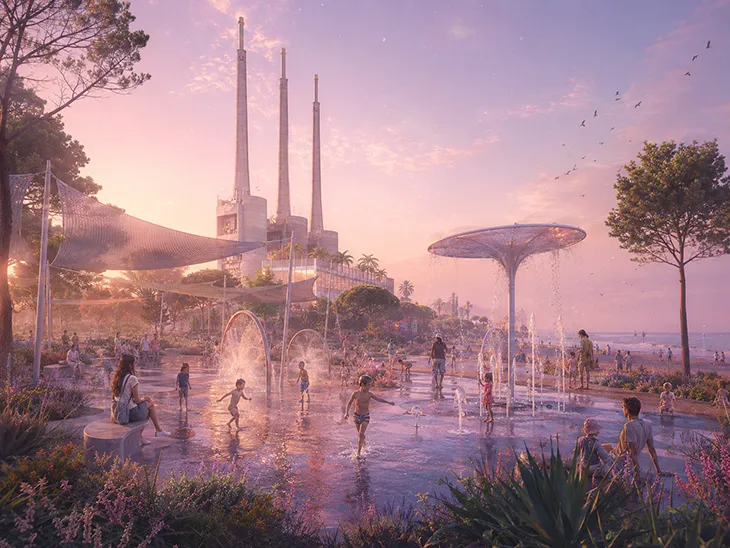
For Xinyue, the project became a way of studying how landscapes can adapt before environmental pressure becomes irreversible. Her proposal preserves the chimneys as anchors of memory while reshaping the land into a coastal wetland with tidal marshes, salt-tolerant plantings, floodplains, shaded gathering areas, and forested buffers. These landscapes are designed to retain water, reduce heat, restore habitat, and support more than 200 species that rely on this estuarine environment.
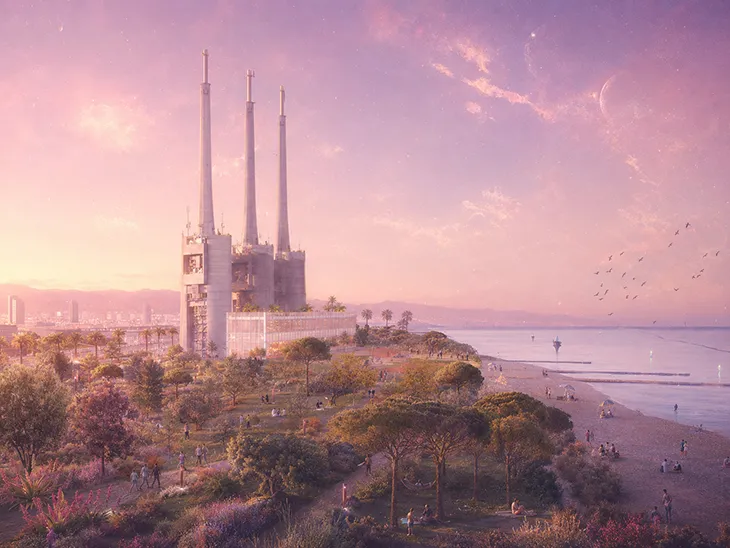
Xinyue makes environmental adaptation part of the public experience. The park becomes a place where people can walk, gather, learn and watch ecological change. Its value lies in giving the coast a new future, one that protects the city, preserves industrial memory and allows biodiversity and public life to grow together.
Together, these works show that Xinyue’s influence extends beyond individual design results. Her work has helped project teams, clients, designers, students and the public rethink what landscape architecture can do: preserve cultural heritage, make invisible infrastructure understandable, improve climatic comfort, restore ecological systems and transform vulnerable sites into important public spaces. Her contributions are important because they provide not only visually sophisticated design outcomes, but also practical frameworks that other practitioners can study, adapt and apply to future landscape architecture, hospitality, infrastructure and urban resilience projects.
Discover more of Xinyue Hope Shen’s works for her portfolio page.
Words from DSCENE Editor Maya Lane.



