
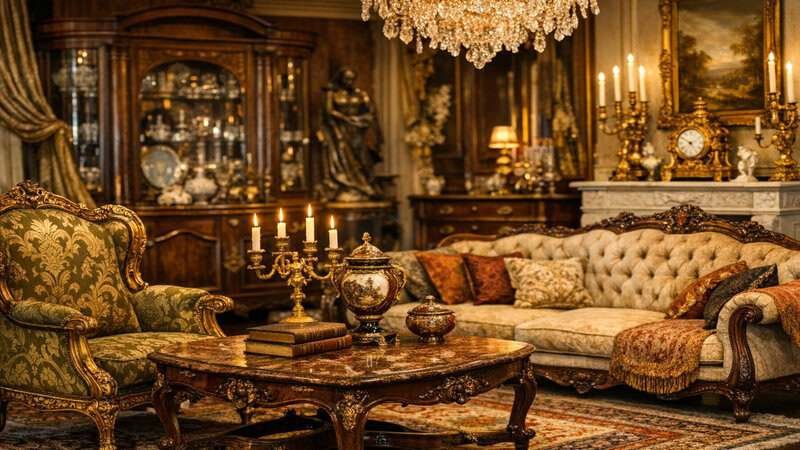

1. Chippendale Elegance

Originating in 18th-century England, Chippendale furniture is known for its intricate craftsmanship and distinctive features such as cabriole legs, ball and claw feet, and richly carved wood. This style arose from the innovative designs of Thomas Chippendale, whose 1754 publication, The Gentleman and Cabinet-Maker’s Director, featured a fusion of Gothic, Rococo and Chinese influences. Unlike the earlier Queen Anne style, which emphasized simplicity and elegance with cabriole legs and minimal embellishments, Chippendale pieces are more elaborate, incorporating elaborate carvings and decorative elements that reflect a richer aesthetic (study.com).
2. French Louis XVI refinement

The French Louis XVI style, which emerged in the late 18th century, is characterized by straight lines, fluted legs and the elegant use of gilding and marquetry. This neoclassical approach marked a departure from the elaborate curves of the Rococo period, favoring symmetry and restrained decoration. Such features make it particularly suitable for formal dining areas, where a sense of sophisticated elegance is desired (louvre.fr).
3. Victorian grandeur

Victorian furniture is characterized by elaborate carvings, tufted tapestries and dark woods, often found in stately city mansions (rosss.com). This style contrasts with the simplicity of Arts & Crafts design, which emphasizes hand-crafted quality, straight forms, and understated decoration. The Arts & Crafts movement sought to return to traditional craftsmanship and natural materials, offering a more restrained aesthetic compared to the luxury of Victorian furniture.
4. Jacobean Sturdiness

Jacobean furniture, which dominated the early 17th century, is notable for its robust profiles, geometric carvings and massive oak constructions, making it ideal for stately libraries. This style contrasts with the lighter Georgian examples, which are characterized by more refined proportions and less elaborate detailing (style furniture.net).
5. Georgian symmetry

The Georgian style, spanning from 1714 to 1830, emphasized balance, refined carving, and the use of lighter woods such as mahogany, marking a shift toward understated luxury. This contrasted with the heavier, more ornate Jacobean style, which favored dark woods and intricate carvings. Georgian furniture is renowned for its elegant proportions and classical influences, creating harmonious and sophisticated interiors (britannica.com).
6. Regency Refinement

The Regency style, which dominated the early 19th century in Britain, is characterized by elegant silhouettes, brass inlays and Greco-Roman motifs. Influenced by Thomas Hope, this style incorporated elements from ancient Greece, Rome and Egypt, resulting in a visually rich aesthetic. Regency sofas, with their elegant lines and classic details, exude comfort and élan, making them suitable for modern environments (vam.ac.uk).
7. French provincial charm

French country furniture seamlessly blends rustic warmth with classy symmetry, with distressed woods and elegant curved lines (study.com). This style is ideal for kitchens or cozy bedrooms, offering a comfortable yet elegant atmosphere. Unlike the more formal Louis styles, French country pieces are characterized by their simplicity and functionality, reflecting the practical needs of rural life while maintaining a sense of refined beauty.
8. Queen Anne Sophistication

Queen Anne furniture is noted for its graceful “cabriole” legs, legs and understated decoration, making the understated yet formal pieces suitable for entryways or living rooms. This style emphasizes elegant curves and minimal decoration, reflecting a shift towards simplicity and comfort. For a comprehensive guide to Queen Anne furnitureincluding its history and key features, see Christie’s article.
9. Rococo Flourish

Rococo furniture is famous for its exuberant scrolls, floral carvings and playful asymmetry, as seen in lounge armchairs and gilded mirrors – perfect for dramatic focal points. This style contrasts with the geometric precision of Louis XVI, which emphasized straight lines and classical patterns (texture.press).
10. Influence of the Empire

The Empire style, which emerged in early 19th century France under Napoleon I, is characterized by rich woods, lion’s paws and imperial emblems, conveying authority and grandeur. This style is suitable for formal offices or living rooms, where a sense of power and elegance is desired. For a comprehensive guide to empire styleincluding its history and key features, are listed at Christie’s.
11. Gothic Revival Mystique

Gothic Revival furniture, which appeared in the 19th century, is characterized by pointed arches, tall spires and intricate moldings, often found on carved sofas and church chairs. These elements evoke a sense of medieval grandeur, making them ideal for creating a dramatic library corner. For more on Gothic Revival furniture, see the Royal Collection Trust: (stairgalleries.com)
12. Biedermeier delicacy

Biedermeier furniture, popular in Germany and Austria in the early 19th century, is characterized by simplified silhouettes and the use of light-colored woods such as cherry, ash, and birch. This style bridges classic formality and urban comfort, making it ideal for modern and traditional mixes. For more on Biedermeier furniture, see galerie-balbach.de.
13. Renaissance Renaissance Opulence

Renaissance Revival furniture, popular in the mid-19th century, is characterized by bold proportions, elaborate carvings, and sumptuous tapestries. These pieces often feature classical motifs such as scrolls, columns and arches, reflecting a renewed interest in Renaissance art and architecture. Such luxurious furniture is ideal for formal dining rooms, adding a sense of grandeur and elegance to the space (euroluxhome.com).
14. Italian Baroque Splendor

Italian Baroque furniture is known for its opulence, with gilded surfaces, dramatic curves and a theatrical feel. Pieces like carved console tables and ornate beds exemplify this style, adding a sense of grandeur to any space. In contrast, French Rococo offers a lighter aesthetic with asymmetrical patterns and pastel colors, focusing on elegance and playfulness (architecturecourses.org).
15. Colonial classicism

American colonial furniture is characterized by simplicity, symmetry and functionality, often made from practical woods such as maple. The designs feature straight lines, turned legs and minimal ornamentation, reflecting a blend of European elegance with New World utility. This style remains timeless, bridging classic formality and urban comfort, and is suitable for both modern and traditional interiors (study.com).
Creating your own old world legacy

Incorporating classic furniture styles into your home allows you to combine heritage, comfort and individuality, creating a space that exudes enduring charm. Start by choosing an antique piece to anchor the room, then balance it with modern elements to create harmony (loveantiques.com). Create a cohesive color palette to unify different styles and mix materials and textures to add depth and interest. Personalize classic pieces with modern accessories or wallpaper to reflect your unique taste. By carefully combining the seasons, you can create a uniquely stylish space that tells your personal story.



