

RECESS occupies a peculiar void in the urban fabric of Montreal. The city has no shortage of places to sweat, and cold plunges have become a wellness cliché—but it hasn’t lacked a space where thermal bathing doubles as social infrastructure. Future Simple Studio’s The 4,500-square-foot project in Griffintown attempts to fill that gap, positioning itself as Montreal’s first hot-cold circuit social experience. Founded by Adam Sims and Marilyn Gagne, RECESS is conceived less as a spa and more as a modern ritual—an “ode to silence” that encourages people to pause, reconnect, and reconnect with themselves and others.

Roman baths weren’t primarily about health—they were where deals were made and social hierarchies were navigated. RECESS does not replicate this model directly, but draws from the same underlying premise: that shared physical discomfort produces a certain social chemistry that casual conversation does not.

Here, that exchange is structured into a 75-minute circular experience—20 minutes of heat, two minutes of cold immersion, and intervals of rest and conversation—creating a rhythm that bridges individual recovery with collective presence. Future Simple Studio organized the design as a linear sequence of compression and release, each zone calibrated to a different mode of interaction.

From there, an elongated tunnel wraps around the perimeter, guiding visitors along a gentle ramp as patterns of refracted light flicker across its surface—a spatial sign that references the water before they ever encounter it. The passage opens into an all-gender locker room, deliberately silent and efficient, that acts as a decompression chamber between city and ritual.

Another corridor of frosted glass panels leads to the post-immersion lounge, where layers of diffuse curtains surround the room, doubling as display surfaces for a rotating program of art installations, DJ sets and guided breathing sessions. Together, these elements extend the social context beyond the thermal circuit itself, positioning RECESS as both a wellness and cultural space.


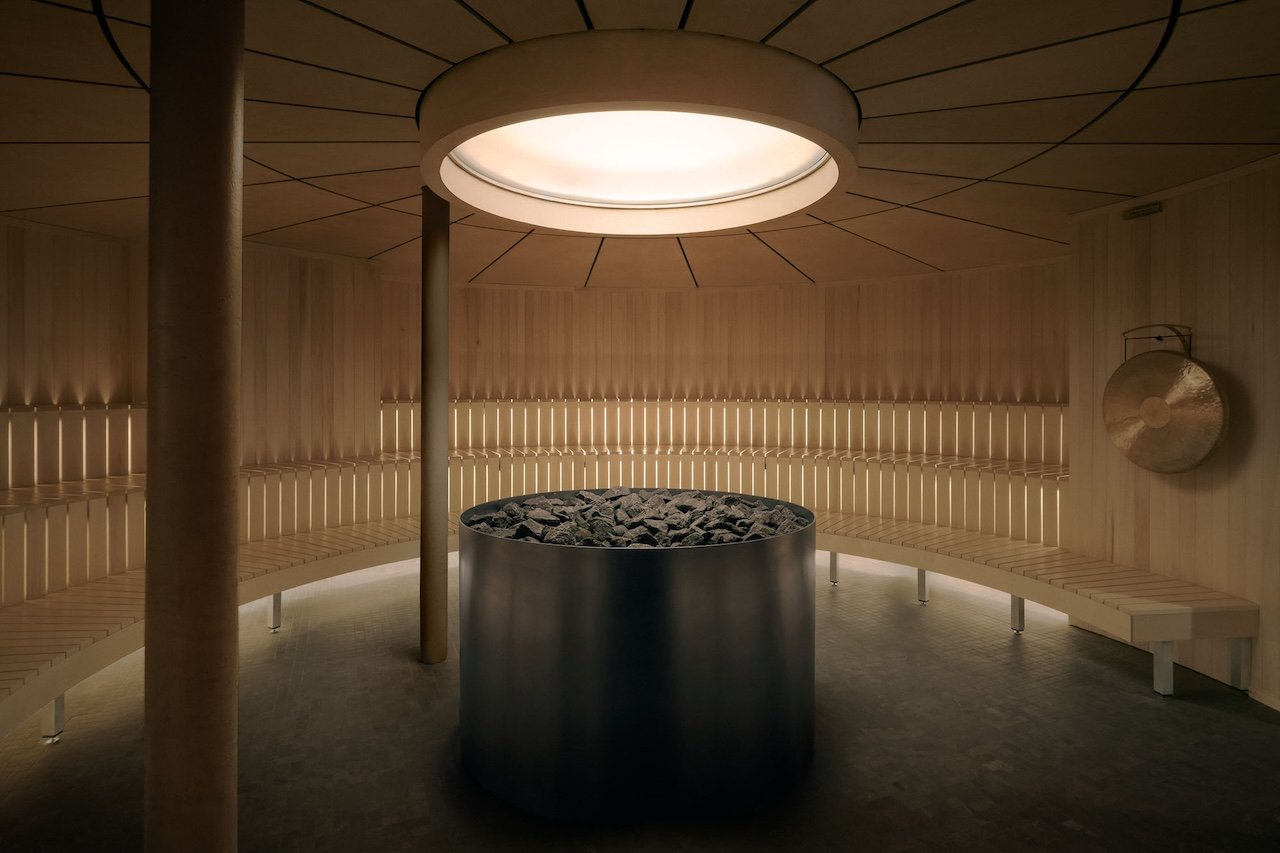
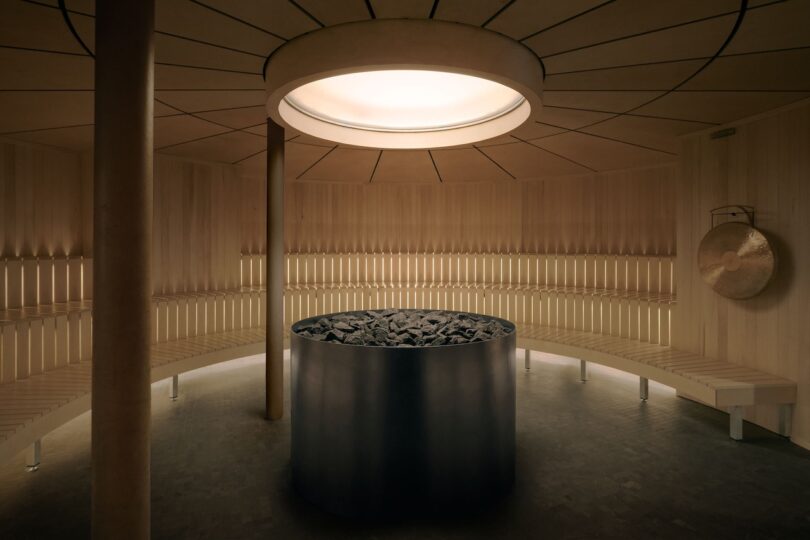
Materially, the project is organized in gradients: cold-rolled steel and aluminum define the public-facing zones, recalling both clinical precision and the reflective depth of the water, before giving way to warm oak and natural stone in the swimming areas. Exiting the locker room, guests enter a sauna environment defined by golden light and surrounding wood. At its center, a custom fifty-person circular enclosure anchors the design—much larger than the four- to eight-person volumes typical of most thermal facilities.


The geometry is intentional: a free-standing cylinder inserted into a rectilinear shell, its monumental radius hosts guided, performative group sessions that emphasize breath, proximity and shared experience.


After the heat comes the immersion. A sculptural shower sequence – hidden behind stone – induces a cool, natural rainfall before leading into a twelve-sized communal pool of cold water, where bodies submerge together under blue light. The result is both physiological and social: circulation is recalibrated, endorphins are released, and conversation continues at a different pace.

The result is less a spa than a structured framework of connection—one that repositions contrast therapy as a collective ritual in a city that has largely outsourced coherence to screens.

To learn more about this and other company projects, visit futuresimple.studio.
Photo by Felix Michaud.




