


When a product has been associated for years with the suburban playground or the 90s condominium porch, reclaiming its reputation requires more than an aesthetic makeover. It requires a paradigm shift. Modern synthetic turf has followed exactly this path: from an improvised material to a structural element in high-quality exterior design. Some European landscape architecture firms, such as Denmark’s SLA or Italy’s Land, incorporate it into private residential projects alongside Corten planters, lava stone floors and designer outdoor furniture.
Not out of necessity, but out of choice. The problem is that the market is saturated with products that bear the same name but have almost nothing in common: buying a synthetic turf without knowing what to look for is the same as choosing a parquet by evaluating only the color of the package. The three details that follow are not aesthetic considerations: they are technical parameters that separate an industrial product from one that, after five years of sun and trampling, still makes sense to keep in the garden.
The cable section is not a catalog detail
The yarn is the building block of any synthetic turf. Its inner geometry, the one that cannot be seen but can be touched, determines everything that happens in time. Low turf usage flat cross section wires: cheap to produce, stiff, unable to regain vertical position after prolonged pressure. The result, after a few months, are those shiny and flattened areas that make a bad installation instantly recognizable.
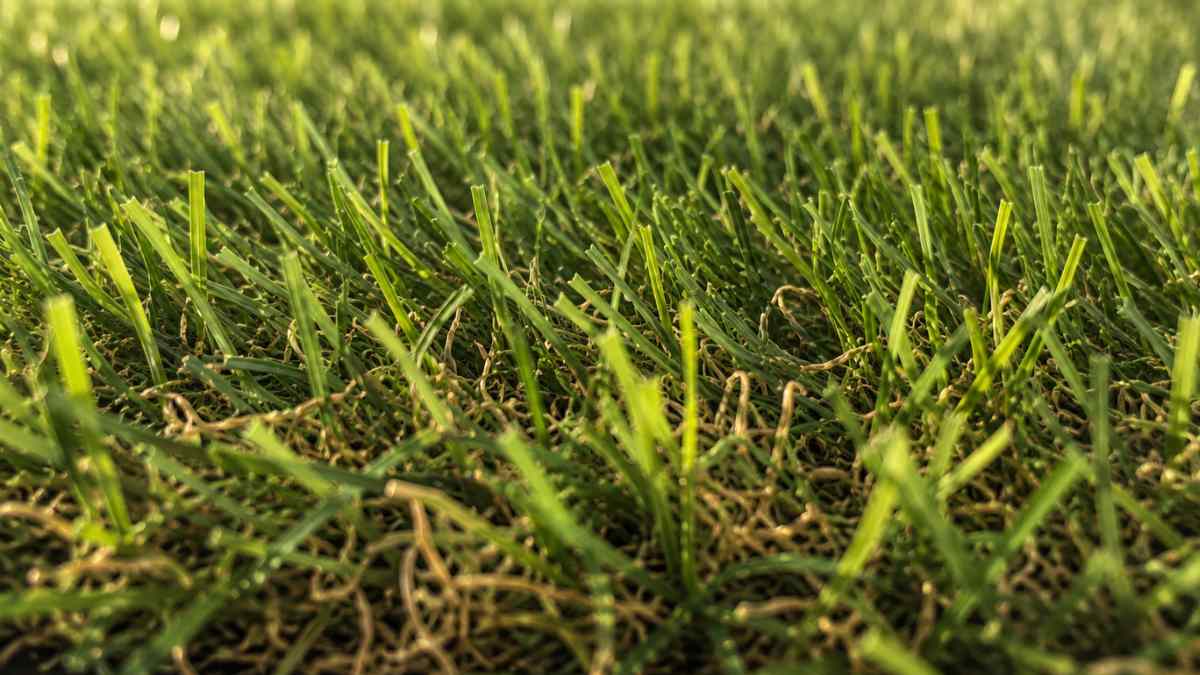
Reference manufacturers such as the Dutch TenCate Grass or the Spanish Mondo have been working for years on extruded filaments with internal geometric sections. The most common forms in the premium segments are three: a C, V and W. This is not technical nomenclature as an end in itself. Each geometry responds to a specific logic: the C section guarantees softness to the touch, the V offers greater structural resistance, the W combines both characteristics with lateral microribs that act as mechanical shock absorbers. When the weight is removed, the wire returns to the vertical position. It’s called the memory effect, and it’s exactly what distinguishes a coat that lasts ten years from one that wears off in two seasons.
An empirical test: press the palm of your hand against the sample for thirty seconds, then lift it up. In a quality product, the threads are straightened in a few minutes. In a poor one, they stay bent.
The color that convinces is the one that is not uniform
A true lawn does not exist on a single green. It has shades, transitions, dry strands at the base, shadow areas between the stems. Reproducing this color complexity is one of the most difficult goals in designing a high-quality synthetic turf and one of the most immediate signs of its recognition.
Cheap products appear a bright, almost fluorescent green color, which turns decidedly plastic under direct sunlight. Higher quality coats work instead multi-thread color blends: three or four shades of green, from lime to forest green, are combined in the same pod. Some premium references from Greenfields, a brand specializing in covers for luxury home use, use five distinct shades to achieve an effect of visual depth that is maintained even in bright light.
Added to this is an often underestimated variable: the direction of the wires. Quality coats do not have all the threads oriented in the same direction. Inserting wires at slightly different angles simulates the natural behavior of cultivated grass, which leans in different directions based on wind, foot traffic and moisture. The result is a surface that changes appearance slightly depending on the observation point, just like real grass.
The sub-carpet: that layer that nobody shows in the pictures
In product data sheets and promotional photos, the focus is almost always on the upper threads. But the structure of a quality synthetic turf provides at least two different levelsand the second is often what makes the difference in the final result.
On the basis of straight polyethylene threads, leading manufacturers introduce a layer of curved threads, usually polypropylene, with colors ranging from beige to brown, through shades of dry green and ocher. This sub-carpet is not a filler: it performs two precise functions. The first is visual: it simulates the presence of moss, dry grass and natural humus at the base of the plant layer, adding a color depth that makes the surface convincing even up close. The second is structural: the curled yarns act as an elastic support for the straight upper yarns, increasing the overall thickness of the blanket and better distributing the pressure of the loads.
In high quality outdoor projects, this construction detail allows the need for infill granules to be almost completely eliminated, reducing maintenance and improving tactile comfort. A lawn without a well-constructed underlayment tends to look thin, almost two-dimensional, especially when viewed from the side or against the light.
What to look at before you decide
When you find yourself in front of a natural specimen, three observations are enough to orientate yourself. First: Bend a piece of wire between your fingers and notice if it has visible side ribs or if it’s completely smooth and flat. Second: look at the surface from a grazing angle, almost parallel to the surface, to check for the presence of the colored underlayer and its density. Third: Check it out sheet weight per square metera fact that serious producers always state on the sheet: below 1,800 grams per square meter, it is unlikely to be a product designed to last.
None of these checks require special technical skills. They just require you to stop looking at price as your first filter. A quality synthetic turf costs between 25 and 55 euros per square meter in the medium-high-rise residential area, excluding installation. The difference with products that cost 8 to 12 euros is not visible on the day of installation. It appears in the third summer, when the sun has already done its work.



