
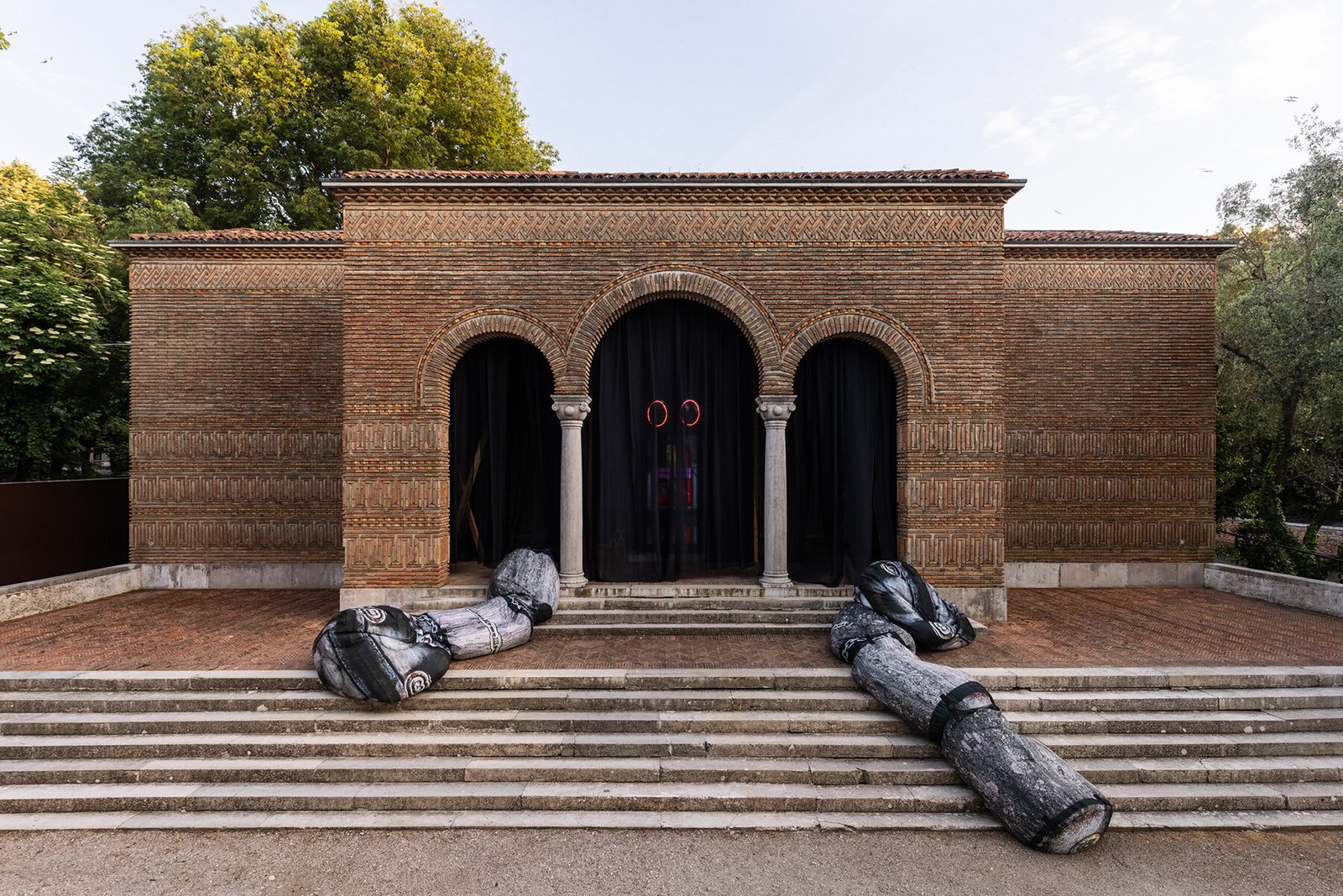

Andreas Angelidakis traps history in Plato’s cave
The Greek pavilion at the Venice Art Biennale 2026 turns this year, turning the architecture of national representation into a psychological and political stage through the Escape Room of Andreas Angelidakis, curated by Giorgos Bekirakis. The Athens-based artist reimagines the pavilion as a contemporary Platonic cave, where truth is fragmented into copies, projections, staged realities and algorithmic illusions. The installation situates the Greek Pavilion itself as a historical body haunted by the nationalism, propaganda, and unresolved tensions embedded in the Giardini. Angelidakis describes the work as “a pavilion divided in half,” investigating “the national history and the history of the exhibition” of the Greek Pavilion at the same time. The two sides operate as competitors “mechanisms” inspired by Plato’s Cave, systems that construct reality and shape collective beliefs.
In conversation with designboom, Angelidakis describes the work as emerging directly from the instability of contemporary reality. “Look at the first comments under any major news story, the discussion is first whether the fact is actually true,” he tells us. “January 6th and the storming of the US capital was the moment that whatever reality is cooked up online spills out into the physical world.” From this point of departure, Escape Room reframes Plato’s allegory for an age defined by post-truth politics and digital spectacle, asking what remains of reality once the cave becomes a screen. For Angelidakis, today’s viewer is after all “tied to their phone”.
“What I’m really suggesting is that the story itself is the prisoner in Plato’s Cave, not the people.” the artist reflects.

all images by Ivan Erofeev
architecture, nationalism and historical fiction collide
Built in 1934, the building that houses the Hellenic Pavilion becomes a subject and artefact within the installation, frozen in what Angelidakis calls symbolic “Year Zero”. The artist connects the opening of the Greek and Austrian pavilions to the same historical moment when Adolf Hitler and Benito Mussolini met for the first time in Venice and Nazi Germany intensified its persecution of homosexuals.
Rather than treating these stories as fixed narratives, the installation repositions them as contested constructions shaped by ideology, architecture, and spectacle. Andreas Angelidakis explains that he has always seen buildings as characters capable of conveying autobiographical and political narratives at the same time. “My work becomes autobiographical through the allegory of a building” shared with designboom. “and in the case of the Greek Pavilion, two parallel histories are mixed, the history of the Nation and the history of the exhibition of the Greek pavilion itself.”
This reading also extends to the architecture of the pavilion, which Angelidakis began to study closely during the development of the project. Trained as an architect himself, the Greek artist points out details such as references to Hagia Sophia embedded in the front columns, revealing how the structure stages overlapping historical identities. The installation further breaks this sense of single national identity by physically dividing ‘Greece’ into two internal pavilions, evoking the National Schism of 1915, when Greece was divided between rival governments. Escape Room situates architecture as an unstable ideological framework, continuing Angelidakis’ long-standing preoccupation with ruins, replicas, and the tension between physical and virtual reality.
One of the exhibition’s quietest yet most politically charged gestures appears through a black fabric intervention at the pavilion’s entrance, referencing the Greek artist Vaso Katraki, who won a prize at the Venice Biennale in 1966 before later being imprisoned for her political beliefs. Angelidakis describes the project as one of the project’s secondary keys, connecting the theme of the Biennale with neglected national histories and repressed cultural memory. “I suddenly realized that the only Greek artist ever awarded in Venice ended up in prison shortly afterwards.” Angelidakis notes. “That became one of the emotional tracks of the play for me.”

Angelidakis fills the interior of the pavilion with large ruins and highlights
fake memories and digital feedback loops bring the escape room to life
Entering the booth, a scenic backdrop incorporates an LED floor and a surveillance system that produces what Angelidakis calls “disco tunnel effect”, which are created as cameras continuously record and play back their own projected image. The self-feeding watchdog loop produces a “eternal moment stretched endlessly”, echoing the circulation of media images on the internet.
Opposite this sight is a pink outline of the pavilion facade extending into spaces originally thought to be church wings. Hanging from the tubular frame are oversized soft sculptures resembling historical memorabilia and fragments of national iconography. Angelidakis compares them to the Greek pavilion, which means both pavilion and booth, where history is repackaged into a consumable commodity. “That’s where historical quotes find their narrative place as fake Merch,” explains. Rendered through exaggerated aesthetics and ostentatious display strategies, the installation at times resembles what Angelidakis calls “gay nightclub”, where spectacle, strangeness, propaganda and consumer imagery collapse into each other.
On one side of the pavilion, says Angelidakis, “drowning in history”, while the other ‘enjoys, welcomes the multitude of interpretations.’ Fiction, here, functions as a mechanism to destabilize dominant narratives. “To reveal the truth is to destabilize what was in place” the artist reflects. Rather than offering visitors a coherent historical reading, Escape Room embraces ambiguity, distortion, displacement, and humor as strategies for navigating the volatility of contemporary political and cultural identities.

chained neon circles glow behind black curtains at the entrance to the Greek Pavilion
drifting through conflicting stories and political fiction
Although the exhibition borrows its structure from the logic of escape rooms, Angelidakis resists turning the installation into a literal game with prescribed solutions. “My escape room has no rules, no distinct direction, but many conflicting ones.” he tells us. Large books invite browsing, visitors are encouraged to linger, rest and even “take a nap after hours of Giardini and Arsenale.” The stand piles up contradictory stories, political references and unresolved tensions. “The stand is full of stories that are not a complete result,” explains Angelidakis. “There are many versions, many perspectives, often contradicting or canceling each other out.”
For the artist, the very form of the national pavilion remains one of the most urgent frames through which to examine collapsing political identities today. It connects the structure of the Biennale to much earlier histories of conflict and state-building, drawing on American philosopher Susan Buck-Morse’s reading of Thucydides and the relationship between ‘attitude’ and ‘war’, political positioning and war. “Athens was a multicultural city where anything went, but the moment the city became a state, your neighbor could turn out to be a Spartan.” explains. The Giardini becomes a space where national myths, colonial histories and ideological architectures remain visible in physical form.
“The Biennale is for me the perfect site to discuss national histories as their constructions gradually crumble.” concludes the Greek artist, leaving the booth at the same time open type. “No one needs to know all these references to enjoy the exhibition,” emphasizes. “I present it all as flashy and fictional, but the research is there for anyone who wants to dig deeper.”

glowing grids, scraps of fabric and theatrical lighting shape the installation

a neon “escape” sign anchors the pavilion’s immersive landscape

chained neon sign inside the Escape Room of Andreas Angelidakis



