


The floor is selected only once. Or almost. Because once installed, dismantling means we have to redo everything: skirting boards, thresholds, doors, any underfloor heating. It’s one of those decisions that weighs more over time than it seems when you sign the estimate. However, most people make their choice after seeing a few samples in the showroom, comparing two or three prices per square meter and choosing based on what they liked best that afternoon. Six months later, with the winter light coming in from the balcony and the scratches already visible in front of the sofa, the reasoning changes. It’s not about having taste or not. It’s about knowing what you’re really buying, beyond color and texture.
Four factors determine whether a flooring choice holds up over time. They’re not technically secrets, but they’re the very things that showrooms rarely explain well and that most webinars are quick to dismiss.
Cruelty is not only a matter of resistance
The Janka scale measures the hardness of wood and is used almost exclusively in professional contexts. It’s a shame, because it’s one of the most useful tools for those who need to choose parquet without being fooled by the name of the product. A European oak is about 1290 lbf on the Janka scale. A pressed vertical bamboo can go up to 1380 lbf, but behaves differently under repeated stress. An American cherry, often offered in warm and welcoming finishes, hovers around 950 lbf: beautiful, vulnerable to heels and dog legs.
The problem is not only how well the floor withstands scratches, but how it ages. Rectified porcelain, which dominates the new construction market, has a very high surface hardness but can be cold to the touch and acoustically problematic without a suitable substrate. Atlas Concordeunone of the Italian manufacturers more present in mid-range showrooms, offers collections such as Boost Wood with wood effect in 20×120 cm format: aesthetically convincing, but installation requires perfect surface preparation otherwise the joints are immediately visible. Technical details matter even before the budget.
The size of the floor communicates with the dimensions of the room
A large shape in a small entrance is not automatically wrong, but requires a considered installation. The traditional rule that form is proportional to room size is a simplification. What really matters is the installation direction and the placement of the sections in relation to the walls and sources of natural light.
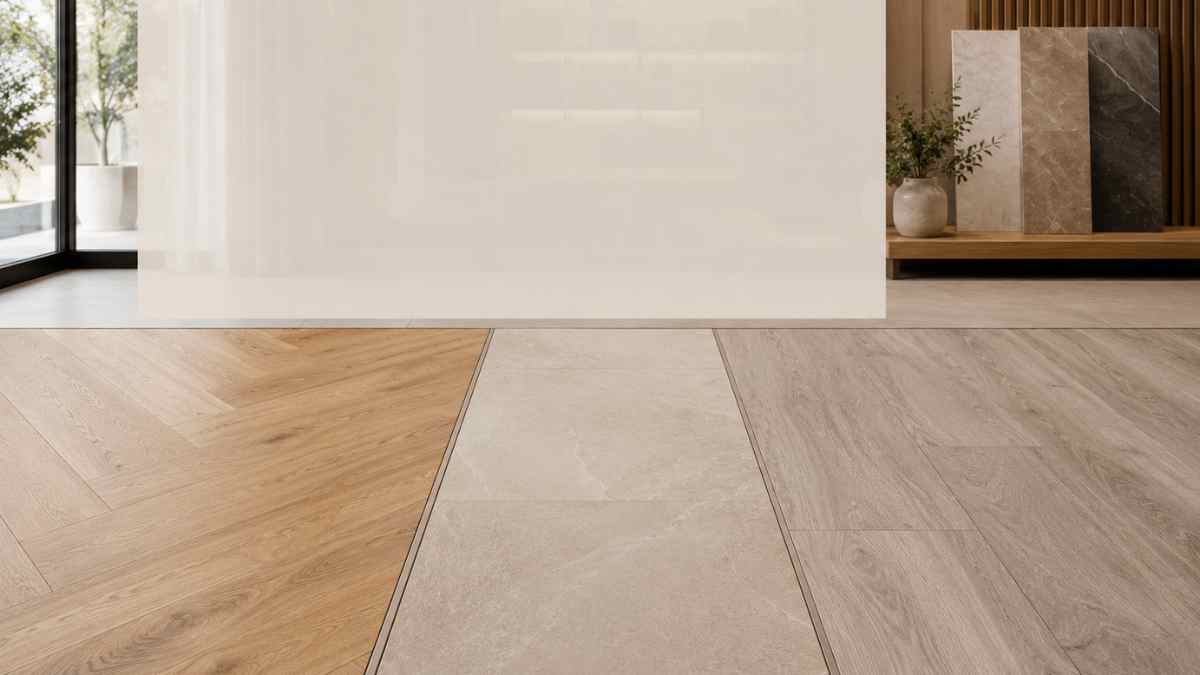
60×60 cm tiles placed diagonally in a 2 meter corridor visually enlarge the space. The same tiles placed parallel to the short walls shorten it. A company like Marazzi, with the Treverkhome collection in 19×150 cm, has introduced long narrow forms that follow the logic of parquet but in ceramic: they work well in rectangular rooms where depth needs to be emphasized. In the squares they reinforce every metrical anomaly that the eye registers even without knowing how to do so.
SPC (Stone Plastic Composite) vinyl, which has captured a significant market share in the 25-45 euro per square meter range, is almost always available in 18×122 cm or similar formats. Practical, waterproof, can be installed on existing floors: but the fixed form is a real limit in some floor plans and not all manufacturers clearly state this in the technical data sheets.
Maintenance: what no one calculates before
Continuous resin flooring is popular for its lack of joints and sense of visual continuity. It is also one of the most demanding floors: it requires regular cleaning with specific products, it does not tolerate standing water and if deeply scratched, the repair requires the hand of an applicator. One product pass is not enough. Kerakollone of the most used brands in quality renovation spaces, sells resin systems with an installation cost of between 60 and 120 euros per square meter only for specialized work: a number that changes the overall calculation if we start from the price per meter of the material.
Mid-range prefabricated parquet, around 35-60 euros per square meter including installation, requires more intuitive but not zero maintenance. THE wear layer at Cheap products can only be 2-3 mm, meaning a single sanding and painting takes it to the limit. Those with a 6 mm layer tolerate two or three operations during the lifetime of the floor. The difference between the two products on the shelf is not always clearly communicated.
For those with small children or pets, the floor’s ability to not show every little imperfection is almost more important than its absolute resistance. Brushed or antique finishes hide the marks of everyday wear better than smooth mirrored surfaces. An aesthetic detail that is, in fact, a functional choice.
The subfloor decides more than the floor itself
You choose the floor. The background is forgotten. Then come the crackles, expansions, bubbles. The existing screed in a house built before 2000 almost certainly has flatness problems: the UNI 11371 standard provides for tolerances of 2 mm over two meters, but checks during installation are rarely systematic on domestic construction sites.
A parquet glued to a wet screed is raised. A vinyl placed floating on an uneven surface produces noises with every step. THE soundproofing mat It doesn’t solve flatness problems, it temporarily covers them. Before deciding on the material, it is worth measuring: a basic laser level and a tape measure are enough to understand the real condition of the surface on which it will be installed.
Some surfaces require a layer of leveling compound prior to installation: additional cost 8-15 euros per square meter which rarely appears in initial estimates. Asking the installer specifically before you start is one of the most specific things you can do to avoid surprises. It’s not red tape, it’s the kind of question that separates a well-organized construction site from one that ends up in an argument over balance.



