


Big hotels have been using this trick for decades. In the corridors of the most photographed suites in London, Milan or Tokyo, the floor is never light grey, never beige, never the neutral shade that “goes with everything”. Underfoot you often find nearly black smoky oak, charcoal marble, charcoal-colored porcelain rocks with barely perceptible veins. This is not a bold style: it is an accurate design choice, based on how the eye reads the space. And this option, until a few years ago relegated to big renovation budgets, is now accessible even outside of luxury hospitality.
What changes when the floor darkens is not only aesthetics. Change the perceived geometry of the room. Change the visual weight of each piece of furniture. It even changes the behavior of artificial light at night. Understanding why it works, and especially how to apply it without turning your home into a bunker, is the only way to put it to good use.
The open box and why beige betrays you
There is a phenomenon that interior designers call open box effect. When the floor and walls are a similar shade, the eye cannot clearly distinguish where the horizontal plane ends and the vertical begins. The effect is not harmonious: the room seems to be gathered in on itself, almost as if the walls are sliding down and merging with the ground. It happens with white on whitebut even more so with the classic combination of light colored parquet and ivory or gray walls, which many choose thinking of making it “safe”.
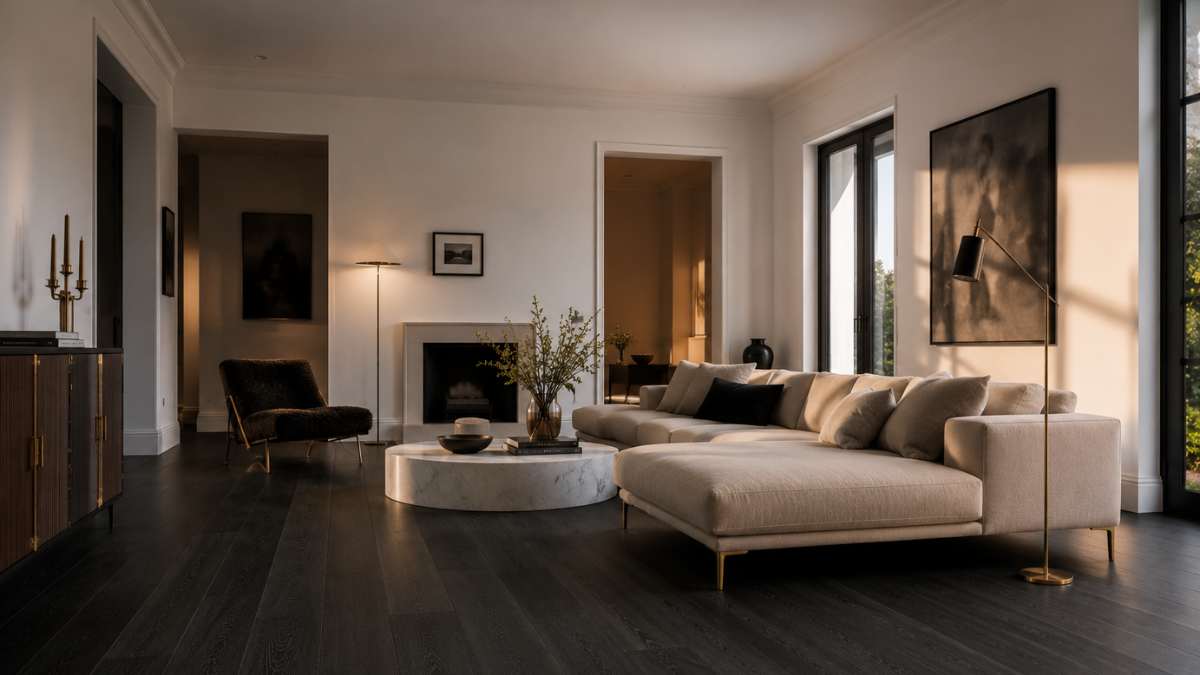
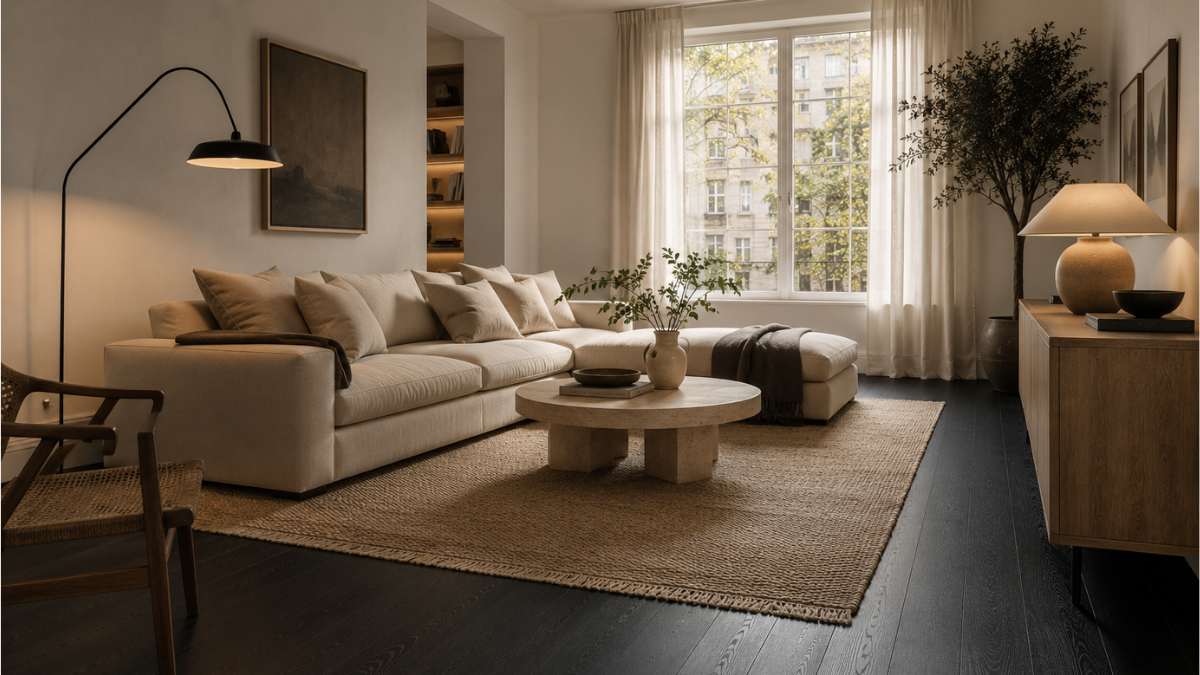
A dark floor on light walls produces the opposite effect. The clear contrast between horizontal plane and vertical surfaces widens the lateral perception of the room: the eye reads the boundaries accurately, and paradoxically the space seems wider, not smaller. It’s the same principle that dark shoes visually lengthen the leg: contrast defines, not suffocates. A seventy-square-meter apartment with smoked oak parquet and lime-white walls will appear larger than an identical one with a light-colored floor and butter-colored walls.
What happens to furniture when the ground sinks
The dark floor does something distinctive to the furniture placed on it: it lifts it off the ground. A light gray sofa on white parquet binds, loses its sharpness, looks almost stuck to the floor like an improvised addition. The same sofa on a charcoal or graphite oak background acquires a sculptural presenceas if floating lightly. Contract designers take advantage of this all the time: Minotti, in its exhibition environments, uses dark backdrops to enhance the silhouette of the seats, which become autonomous figures in the space.
This applies to any type of furniture, but the profit is greater with low and linear pieces: tables with thin bronze legs, buffets made of natural wood, beds with a metal frame. The contrast with the floor visually separates them from the support surfacerestoring three-dimensionality to furniture that would risk appearing flat on light surfaces. A white Knoll marble coffee table on an anthracite stone floor is a composition that stands on its own.
The materials that support the idea and those that sabotage it
Not all dark floors produce the suite effect. The difference is made by the material, not just the color. Cheap wenge-colored vinyl conveys exactly what it costs: a fake thing trying to look like something else. The materials that really work are the ones with which visual depthi.e. surfaces that change appearance slightly depending on the angle of light.
Porcelain masonry with stone is today the most accessible entry point to the final result. Brands such as Rex Ceramiche or Florim produce slabs in 120×120 or 160×80 shapes in anthracite, slate and basalt hues, with surfaces that alternate honed and natural finishes to simulate the depth of the real material. Prices start around 40-60 euros per square meter for installation, a moderate investment in relation to the visual impact. Smoked oak parquet, recommended by manufacturers such as Listone Giordano in the Georg Jensen line or from Boen with the wide boards, it works differently: the grain of the wood adds warmth and natural irregularities that cannot be reproduced, but requires more maintenance and attention to moisture.
What almost never works: dark carpets (they absorb light without giving it back), glossy laminate in dark shades (reflects every fingerprint and scratch), concrete painted dark gray without a professional finish (goes flat and dull in a few months).
The dark floor at night: a different room from the morning
There is an aspect that is rarely considered in the planning phase and which then becomes one of the reasons why some interiors photograph well but live even better: the behavior of the dark floor with artificial light. During the day, in the presence of diffused natural light, a charcoal floor works for contrast, as described. At night, with grazing lighting or floor lamps, it completely changes tone.
Dark surfaces they do not reflect light upwards as they clearly do. This perceptually lowers the luminous center of gravity of the room, concentrates visual heat at eye level and creates the sense of evening concentration that is characteristic of high-end hotels. It’s not magic: it’s the physics of lighting. A room with a light colored floor still looks like a general domestic environment at night. The same room with a dark floor and well-placed indirect lights becomes something else.
To make the most of this, the ideal combination includes low or wall light sources, never just ceiling lighting. Sconces, floor lamps, LED strips hidden under furniture: anything that projects light horizontally instead of vertically. On a dark floor, these sources create depth and layers that are simply lost on a light surface.
How dark is very dark
The question that stops many people in front of the sample is this. And the answer depends on only one variable: the amount of natural light available. Rooms with large windows and south or west exposure can also handle pitch black without feeling hollow. Environments with little direct natural light need calibration: a medium gray slate, a smoky oak still with visible grain, a stone concrete in a light charcoal shade. Not white, which cancels out the contrast. Not pure black, which in dark spaces gives off a cellar atmosphere.
The most honest test: take a sample plate home from the manufacturer and observe it for a whole day, from morning to night with the lights on. What you see in the store, with the neon lighting of the ceramic center, has nothing to do with how it will perform in your space. Florim and Rex offer sampling services: use them before ordering sixty square meters of material.
There is a villa in Lisbon, often used for fashion shoots, with a glossy black slate floor and ice white walls, and in photo reports it always looks bigger than it is. Those who have visited in person say that it is actually quite small. The effect is maintained even with the naked eye.