


Two beds made with the same sheets. Same cotton, same price, same store. One you want to sit on. Not the other one. You don’t see the difference right away, but you feel it: it’s a matter of weight, how the fabric falls, how well a pillow holds its shape without collapsing on itself after three minutes. It’s not a matter of budget. It’s a matter of logic.
In the summer the logic becomes complicated, because the first reaction is to lighten everything. Thin linings, pastel cotton, something fresh. True as a thermal principle, false as an optical principle. Flat and light fabrics create a room with little structure, regardless of the color chosen. The sleeping area loses this material layering, this visual depth, which is exactly what separates a room you look at from one you barely notice.
The weight you can’t see but feel with your eyes
THE fabric weight It’s a technical fact that no average furniture store displays on their labels, yet it’s the factor that separates a throw pillow that works from one that folds by itself after three days. For linen, weight about 180-200 g/m² they give that stiff, natural fall that doesn’t need ironing and that breathes in summer without looking sloppy. Raw unbleached linen, in variations of sand gray or off-white, has an irregular texture visible to the eye: each thread is slightly different from the other, and this creates an effect of depth that 80 g/m² percale cotton will never be imitated.
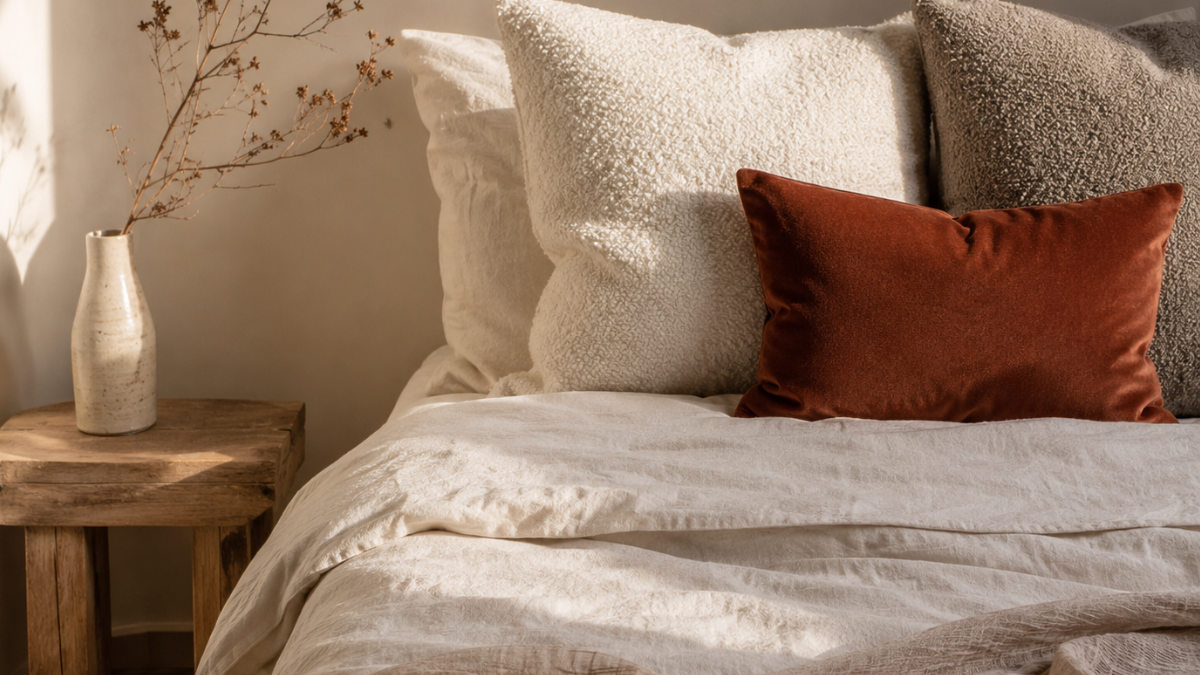
Velvet is the ultimate summer counterintuitive. It’s warm to the touch, yes. But in a decorative pillow that you don’t hug while you sleep, its ability absorb and reflect light otherwise depending on the angle it is worth the investment. Zara Home suggested crushed plush cushions in her summer collections of recent years, in colors ranging from terracotta to forest green: plush 450 g/m² cotton linings, lined with shape-retaining silicone fiber inserts. They cost less than twenty euros and maintain the structure. It’s not the price, it’s the choice.
Padding is the secret no one mentions
The cover may be perfect, but if there is a light polyester filling that shifts at the first touch, the pillow gives it all away. The stuffing inside goose down or dense synthetic alternative (the so-called high-fill siliconized microfibers) change the geometry of the pillow: it stays high, maintains a soft but defined shape, does not fold like a banana. IKEA sells il cuscino interno SPRINGSwith 50% goose down padding, for less than fifteen euros in a 50×50 format. Placed inside any raw linen cover, the result is a boutique hotel pillow. This is not an obvious tip: most people buy ready-made pillows without ever separating the padding from the filling.
For the summer sleeping area, the logic is simple: fewer pillows, heavier ones. Three well-structured pillows look better than six stacked flat pillows. Two 50×50 thickly lined with linen or fine curl that rests on the sides, one 40×60 in velvet in the center, just ahead of the others. The depth is built with the distance between the padsnot with quantity.
How boucle replaced printed cotton
The bouclé, that fabric of French origin with the little loops of yarn used by Coco Chanel for her costumes, it made its way into home furnishings late out of fashion, and is now everywhere. Bouclé Studio of Copenhagen offers it in sofa and cushion covers in cream white and light gray with thick padding. In summer it works because curl is a fabric that breathes, does not retain heat on the body, but is visually rich, almost sculptural.
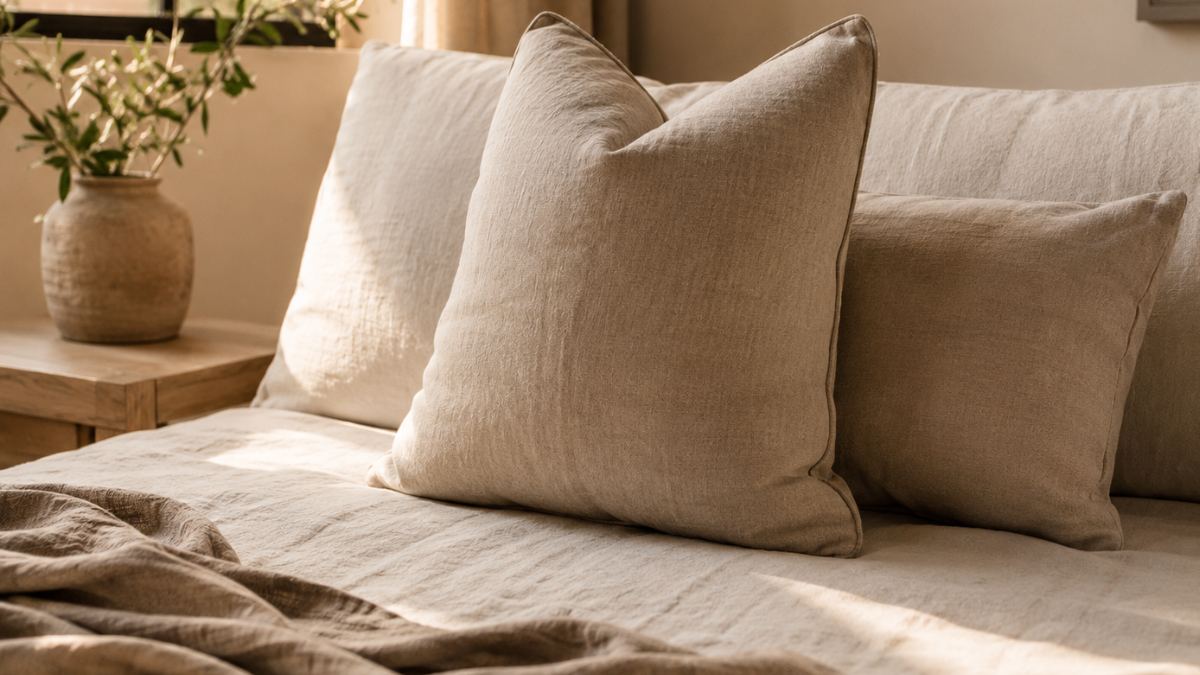
The contrast between a smooth sheet of fresh cotton percale and a rough pillowcase creates this layer of textures that looks like visual complexity: two contrasting materials that complement each other without competing. A summer bed made with washed sheets underneath and curling iron on top it communicates something that an all-cotton flowerbed will never communicate, no matter the price paid.
Make the bed without looking like it’s made
Layout matters as much as material. The summer bed does not need heavy quilts or covers: one Lightweight cotton muslin throwslightly asymmetrical, thrown at the bottom end of the bed, with half falling towards the floor and half remaining on the mattress, it gives an impression of careful relaxation which is exactly what works photographed for magazines are looking for. It is not folded with military precision, it is not abandoned at random: it is placed with a logic of asymmetrical balance.
The pillowcases of the night pillows, the ones you sleep on can be made of cotton washed in neutral tones: optical white, off-white, pearl gray. They don’t add visual texture but they don’t take anything away and let the decorative pillows take center stage. Unironed linen, with its natural folds, is more elegant than steam-ironed percale: the imperfections of the natural fabric say something that synthetic perfection cannot imitate.
On a minimalist nightstand, a dry branch in a narrow vase or a book placed on it flat complete the image without overloading it. The summer sleeping area works when it has few, heavy things with real textures. And when the bed, even messy after a night, retains its visual dignity. This is the real test.



