
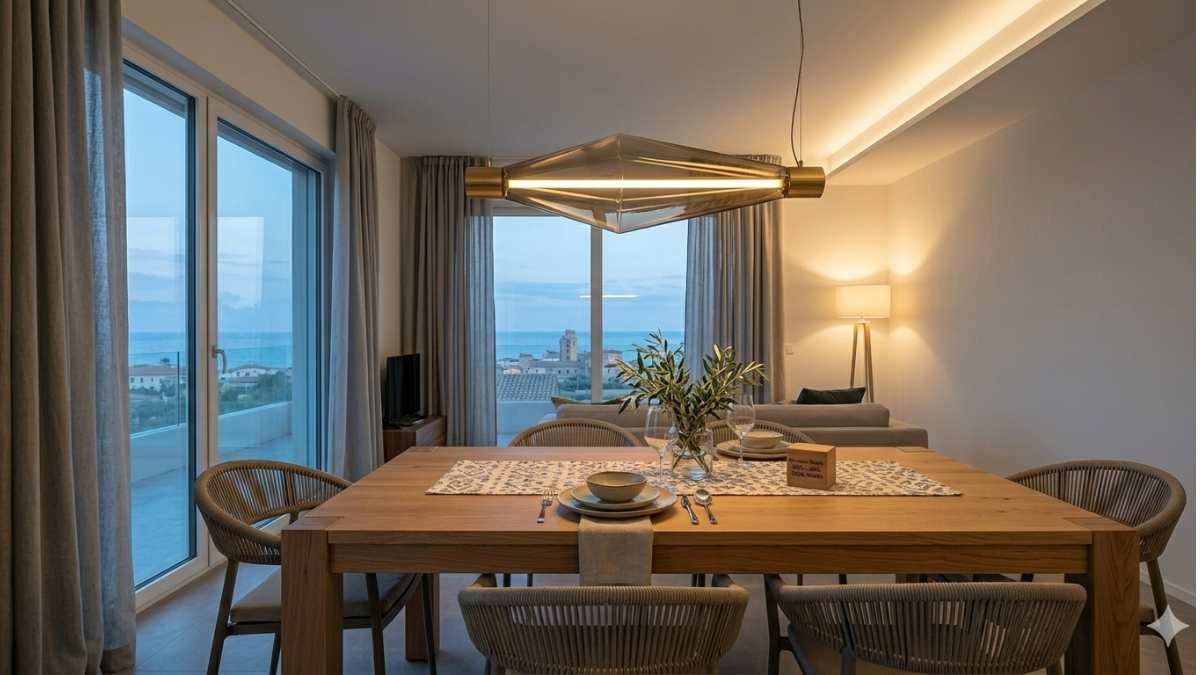

It seems like the most obvious choice when furnishing the dining room, and in fact it is one of the most popular. However, it is precisely this lamp above the table that creates an imbalance that is immediately noticeable, even in the most sophisticated settings.
Almost everyone focuses on the design, color or material, but they ignore a much more important detail: The ratio between the lamp and the table is what really determines the final result. This is also the reason why many dining rooms, although designed by famous designers, are visually “strange” or not very harmonious in the eyes of those who enter the room.
When the bulb is too big and crushes the environment
Imagine walking into a room and seeing a huge domed chandelier hanging over a four-person table. A lamp that is too wide tends to aggressively dominate the scene. It does not enhance the environment, but crushes it. The result is a heavy, almost suffocating effect, which visually reduces the surrounding space and, paradoxically, lowers the perception of the ceiling.
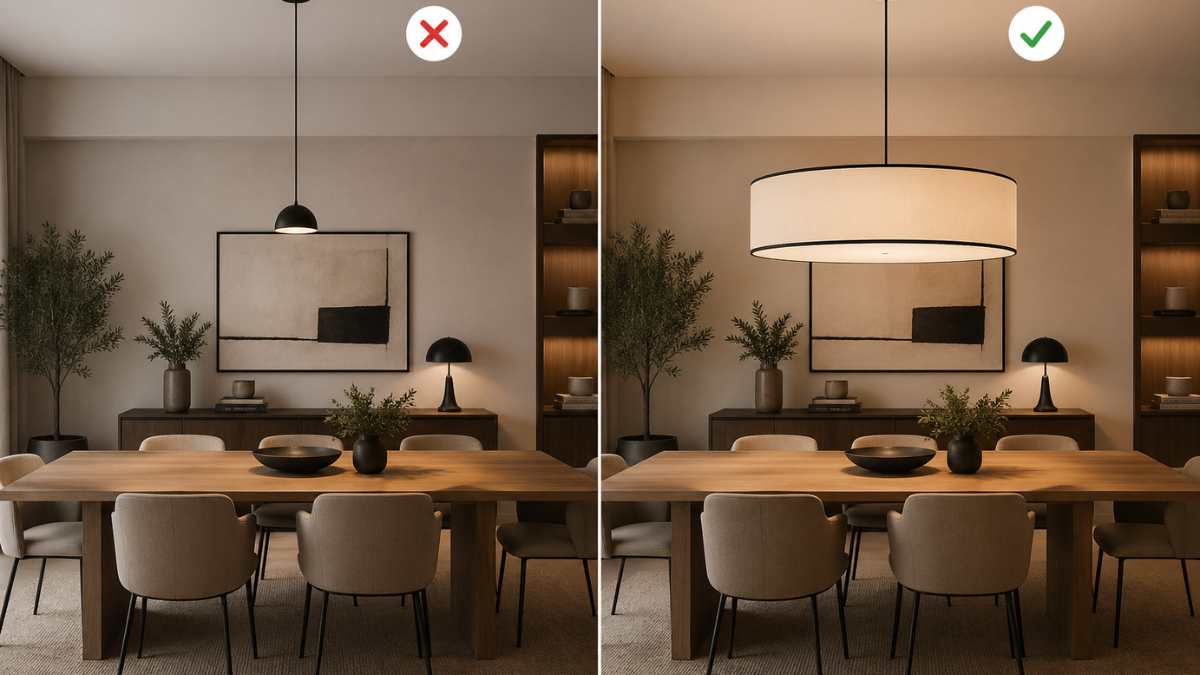
This mistake is much more common than you thinkespecially with the trendy “oversized” posts. In photos they look impressive, but in a typical dining room they create a visual clutter that prevents customers from looking at each other naturally, creating a physical barrier between people.
When it’s too small and the room “disappears”
Conversely, a very small lamp cannot “support” the visual weight of the table. It remains suspended without presence, like an object lost in the void. It doesn’t create atmosphere and leaves the dining room visually unfinished, almost as if the furniture were temporary.
Visually, the result is that of a point of light which illuminates only the center of the table, leaving the edges and plates of the dining tables in dim light. It is one of those silent mistakes that make the environment less sophisticated and “poor”, even when the rest of the furniture is of high quality.
The golden rule: proportion that creates harmony
The rule to avoid mistakes is simple but powerful: the lamp should take up about half to two-thirds of the width of the table. If you have a 120 cm round table, your lamp should ideally be between 60 and 80 cm in diameter. Staying within this range ensures that the light covers the entire surface without overflowing.
Height also plays a fundamental role in our visual experience. The ideal distance between the table top and the bottom edge of the lamp is approx 75-90 cm. This measurement creates an intimate “cone of light” that envelops those seated, without dazzling those standing or obstructing the view of those eating.
Shapes and flows: the dialogue between table and light
In addition to size, you need to consider geometry. The shape of the lamp must communicate with that of the table to create a cohesive visual flow. A long, rectangular table, for example, “calls” for a linear solution, or a series of three identically aligned posts.
Seeing a single, small, round light in the center of a ten-foot table creates a sensation visual instability. Instead, a modern light bar or multiple drop lamps distribute the weight along the entire length, making the whole look instantly more professional and sophisticated.
Why do we keep making this mistake?
The reason is purely psychological: when we choose a lamp, we evaluate it as an isolated object in a showroom or online photo gallery. But in interior design nothing lives by itself. The success of the work depends on the physical and proportional relationship with the painting.
It is precisely this gap between the perception of the object and the reality of the space that creates environments that are “not convincing”. Correcting the scale of your lighting is the fastest way to transform your dining room from “homemade” to “professional” without having to replace a single piece of furniture.



