
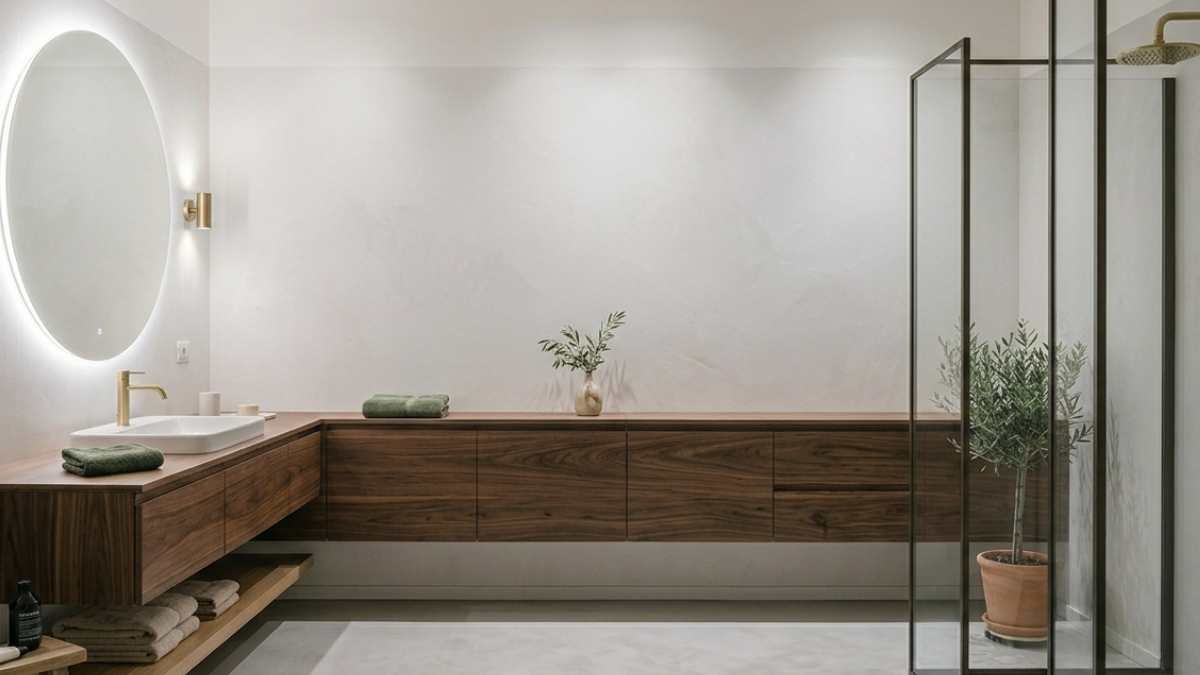

Choosing not to install wall units is not simple removal, but a conscious design gesture: means moving the center of gravity of the class down, exploitation deep drawers and hidden solutionsto leave the upper part of the walls bare, free to host perhaps only a large recessed mirror or designer lamp.
It is an approach that it favors emptiness over fullnessturning even the smallest bathroom into a airy place where the eye never stops at a border, but runs fluidly along the perimeter of the walls.
In these environments, the sink top ceases to be a support base squeezed between two dimensions and becomes protagonist of a clean horizontal linewhich visually expands the boundaries of the room.
How to build bathrooms without wall cabinets
In these bathrooms the the walls become protagonists. They are no longer occupied by hanging furniture or closed volumes, but remain free or almost free, leaving space for continuous surfaces, materials and light.
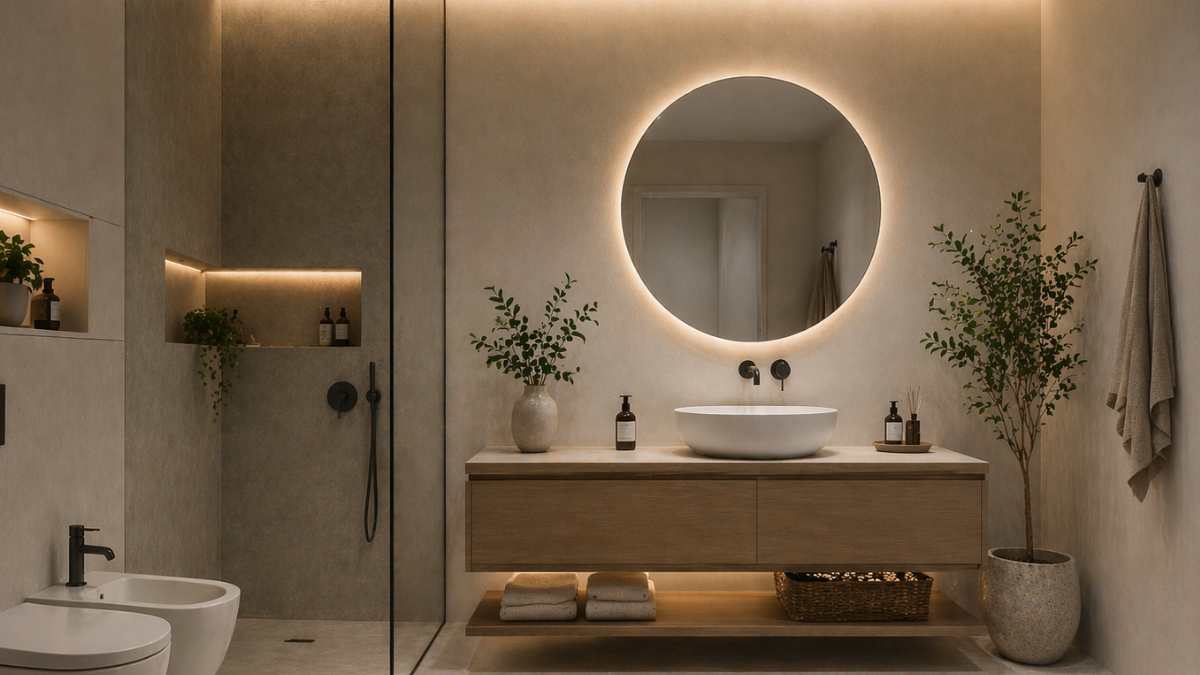
The main furniture is gathered at the bottom. The sink is often placed in a hanging, linear, basic furnitureor in a more architectural structure, almost built into the wall. Above, in place of the wall units, they are large mirrors, often backlit;which enhance light and depth.
The overall effect is very clean. The bathroom looks more modern, neater, closer to one wellness area rather than in a purely functional environment.
Where everything that was in the cupboards ends up
The question is inevitable. If you remove the cabinets, where do you put all the stuff? The answer lies in one different distribution of space. Containers do not disappear, but change position and often become less visible.
A lot of space is reclaimed in the low furniture, which become more spacious and better organized. Deep drawers, internal dividers and extraction systems allow you to contain more objects than a classic wall unit. Another very common solution is to use it wall niches. In the shower or near the sink, small recesses become perfect spaces for storing products and accessories without adding external bulk.
In some cases they match side columnsbut subtly designed, built into the wall or in the same color as the surroundings, so that it does not visually weigh down the space. The space under the sink is also used more intelligently, often with customized solutions.
The advantages: why more and more people choose them
The first advantage is visual. Removing the wall units reveals the bathroom instantly bigger and brighter. Free walls reflect light better, especially if combined with continuous surfaces such as resin or microcement.
Then there is the matter of class. Fewer visible elements means less chance of messy build-up. Everything is hidden or better organized and this makes it easier to keep the bathroom clean over time. Even from an aesthetic point of view, the result is more modern. THE modern bathrooms they tend to favor clean lines, continuous surfaces and basic volumes. Wall cabinets, especially if they are traditional, often interrupt this harmony.
Finally, there is an advantage associated with perception of comfort. A less visually charged environment is also more relaxing.
The limits: when wall units are really needed
It is not a one-size-fits-all solution. In very small bathrooms or with few alternatives, eliminating wall units can create difficulties in managing the space. Wall cabinets have an important advantage: they take advantage of the height without occupying any surface on the ground. Giving it up means you have to plan the rest better or you risk having them less storage space.
There is also a practical aspect. Wall units allow you to have some items nearby, at eye level. Without them, you have to get used to adifferent organization, often more “horizontal”. Finally, not everyone appreciates the idea of hiding everything in low furniture. It depends a lot on personal habits.
The styles that work best
This option fits perfectly in the most modern and trendy bathrooms. THE minimal, Scandinavian or Japanese design-inspired styles they are the ones who appreciate the absence of wall units the most. Surfaces are often continuous, with few ingredients but well chosen. Light wood, stone-effect finishes, resin or micro-cement are among the most used options.
THE the lines are simplewithout unnecessary decorations. Even details such as faucets and lighting follow this logic.
Colors: how the perception of space changes
Colors play a fundamental role. Bathrooms without cabinets work especially well neutral and natural palettes. White, beige, shades of sand and warm grays help to maintain it visual continuity and reflect light.
Darker shades can also work, but require somewell thought out lighting so as not to burden the environment. In many cases a color only or a very slight variation of the same tone, just to avoid visual gaps.
Ultimately, eliminating wall units doesn’t mean you have less space, but you use it differently. It’s a choice that requires more design attention, but results in a lighter, neater, and more cohesive environment. A bathroom that is not only functional, but also easier to live in every day.



