


The quilt is a strange thing: it works great for nine months of the year, then it becomes a problem. Too hot, too bulky, too much of everything. However, removing it from the bed and replacing it with a simple flat sheet leaves this feeling of visual emptiness that does not convince anyone, not even those who claim not to care about home aesthetics. The solution has an exact name: summer layeringthat is, the conscious layering of light fabrics, able to cooperate both thermally and visually.
It’s not about stacking layers haphazardly. Summer layering works when each element has a specific function and the materials chosen are up to the task. This is where fiber quality comes into play: in summer, the body needs fabrics that really breathe, that absorb moisture without retaining it, that behave actively rather than passively.
This automatically rules out almost anything containing polyester or synthetic fibers and brings to the fore a family of plant-based and organic materials that, fortunately, also coincides with some of the most aesthetically interesting propositions on the market.
The fiber decides everything, even before the color
When we talk about summer fabrics for the bed, linen is almost always the first name that comes up, and not because of fashion. THE OEKO-TEX certified organic linenlike that used by brands like Libeco or the Cultiver range, it has a hollow fiber structure that allows constant air circulation and moisture absorption of up to 20% of its weight without feeling damp to the touch. It gets softer with every wash, creases photogenically and lasts for years. However, it has a value that reflects the supply chain: a blanket in a washed linen double bed by Libeco is around 180-220 euros.
Il long fibers percale cottonespecially in the GOTS certified organic variant, it is the most affordable alternative without substantial compromises. Long-staple spinning, as in Supima or Egyptian cotton fabrics, produces a smooth, fresh and almost lint-free surface, with a low specific weight that guarantees a perceived natural lightness.
Very different from cotton jersey or flannel, which remain winter staples despite reassuring retailer names. Finally, the cotton muslin organic, woven with double gauze, it is perhaps the most underrated material in the industry: light as paper, lays without bulk, absorbs well and dries quickly. Brands like Mushie use it for kids, but Bed Threads and The White Company have made it a staple in their summer collections for adults.
The Scandinavian style: abstraction and natural texture
Those working with a Scandinavian or minimalist aesthetic will find an almost native system in summer layering. The logic is his less layers, more material quality. The base is a plain sheet of organic percale, preferably in off-white, gray or sand. Above, organic cotton muslin blanket double gauze, in shades of stone gray or natural white white.
No decorative pillow covers, no unnecessary pillows: two matching pillowcases, no more than a third of washed linen in a slightly darker shade for contrast. The end result is what is found in photos of apartments in Stockholm or Copenhagen: orderly, almost austere, but with a tactile quality that can be seen in the photo as well. A useful detail: the blanket is left folded in half at the bottom of the bed, not spread across the surface. This gesture changes the visual reading of the entire environment.
The Mediterranean style: color, craftsmanship, asymmetry
The Southern European aesthetic, that of white plaster houses with terracotta details and striped fabrics, translates into a freer and bolder color layering. The reference material remains linen, but here we prefer unbleached linens with yarn-dyed stripes, as in the collections of the Maison de Vacances or the artisanal investments of the Portuguese textile workshops of the Guimarães region. A flat striped sheet is deliberately left outside the corners of the mattress, almost draped.
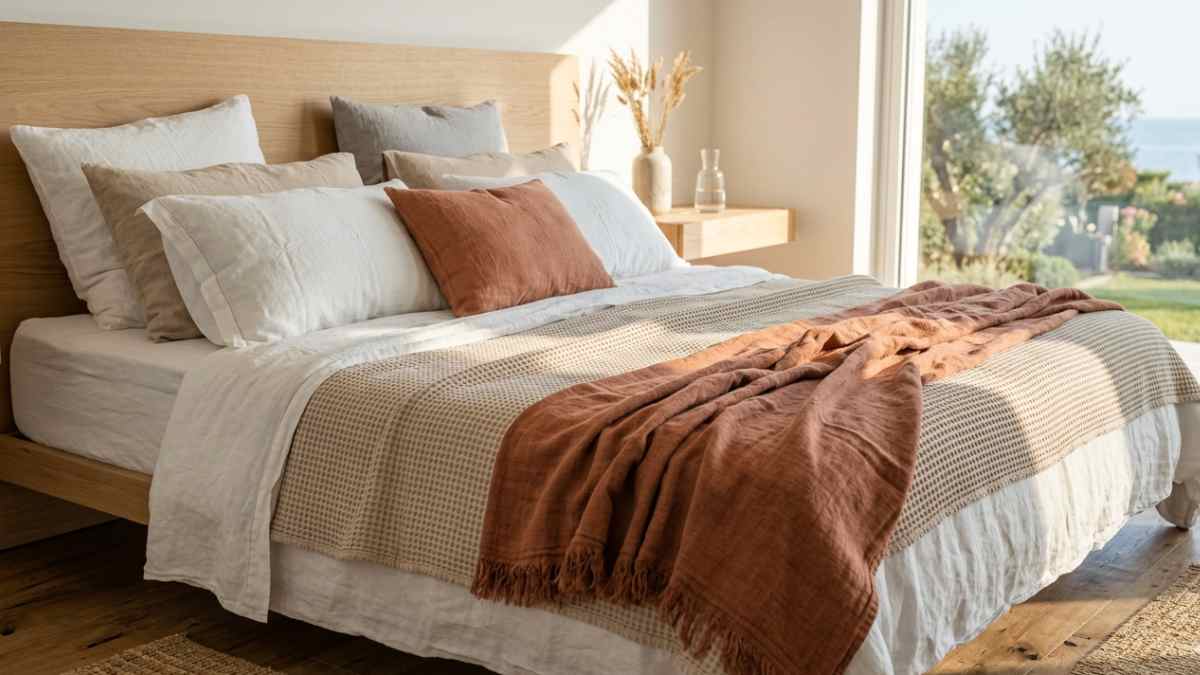
Up, one fringed organic cotton loom blanketin shades of terracotta, ocher or Aegean blue, used asymmetrically, moved to one side of the bed. Decorative pillows can be in cotton padding with hand embroidery, but not exceeding: three maximum, different sizes. Asymmetry is part of the design, not an approach. This style tolerates linen creasing better than any other frame and turns it into a cohesive aesthetic.
The organic-modern style: earth tones, soft volumes
In recent years, a third visual register has been consolidated, inspired by the Japanese wabi-sabi aesthetic filtered through contemporary European design: fabrics in warm neutral tones, generous volumes, certified and visually recognizable fibers. Tekla fabricsa Danish brand founded in 2017, is perhaps the most consistent example of this on the market: heavy organic muslin blankets, in colors such as Walnut or Ivory, are designed exactly for this type of layer.
The structure is: organic percale sheet in oat color, oversized organic muslin blanket that is left free to form natural folds, two large pillows in matching stonewashed cotton. Possibly a secondary blanket of ultra-fine organic merino wool, folded right at the foot of the bed, which can be used on less warm nights. The total weight of the main layer does not exceed 400 grams per square meter: fresh, but visually dense. The palette always works in a maximum of three shades, all with warm or dusty undertones, never pure primaries.
How it is stratified in practice: order and proportions
Regardless of the style you choose, the mechanics of summer layering follow certain exact physical proportions. The first layer, in direct contact with the body, should be the lightest and most absorbent: flat sheet or thin muslin blanket, weighing about 120-150 g/m2. The second layer adds visual texture without thermal weight: a more structured blanket, in woven linen or cotton, weighing 200-280 g/m2. THE The third layer is optional and decorativebut the photographic interpretation changes completely: a light check, a jacquard cotton blanket at the foot of the bed, an excess of pillows only if they are consistent in material.
What makes this work, rather than chaotic, is that every element is in the same color family or in a deliberate, never random contrast. And that all fabrics have the same surface quality: mixing rustic linen with synthetic satin cotton creates a visually decaying effect that no composition can preserve.
A summer bed with good layers changes appearance by itself during the day: in the morning with the folds of sleep, in the evening restoring, at night only the thinnest layer is used. It’s a system that works differently than the fixed quilt, and that’s exactly its strong point.



