


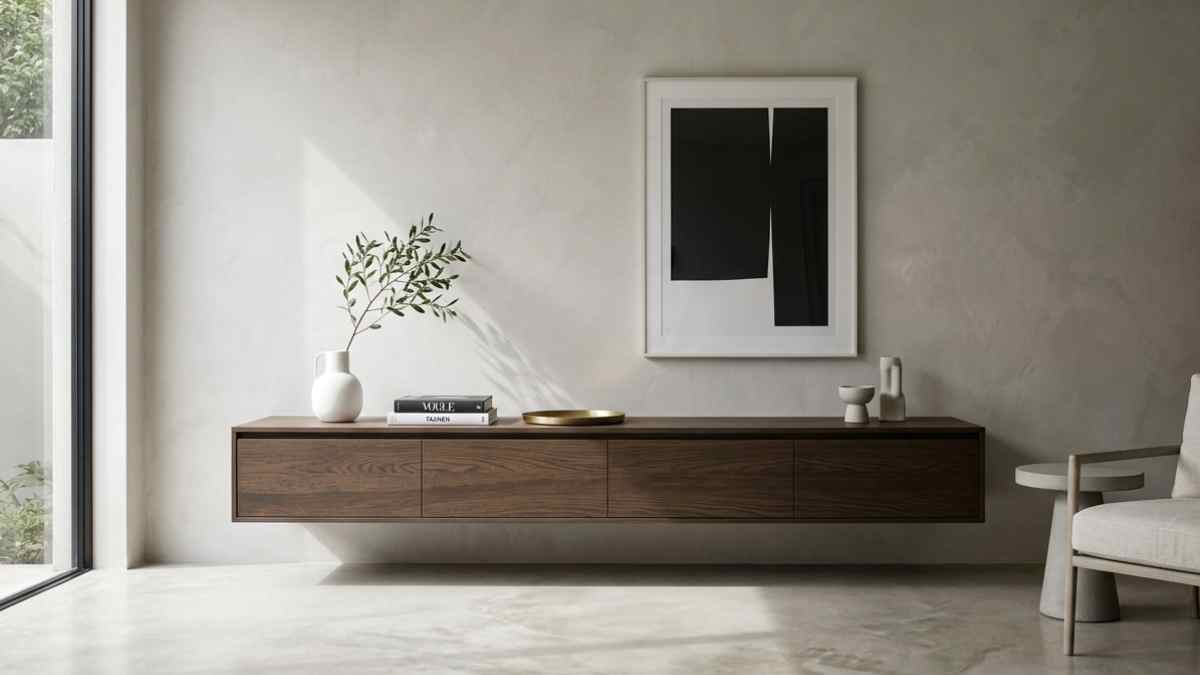
Someone decided, at some point, that furniture with legs was out of fashion. And he was right, at least on an aesthetic level: a hanging piece of furniture visually brightens the space, creates that clean horizontal line that is so popular in furniture magazines, and makes the floor seem larger than it is. Ikea knows this well in turn THESENovamobili offers it in a bathroom version with floating drawers and the market has responded enthusiastically. The problem is that no magazine ever photographs the bottom end of these units after six months of residential life.
There, in that little strip of shadow between the furniture and the floor, accumulates exactly everything that a vacuum cleaner struggles to reach: compacted dust, hair, debris of anything. It’s not a flaw in the furniture: it’s geometry. And it requires a practical response, not a delivery.
The height from the floor is not a small detail
When choosing a hanging piece of furniture, the first mistake is to rely on the standard height recommended by the manufacturer without thinking about it. Most bathroom models are installed about 15-20 cm from the floor: enough to give the illusion of lightness, not enough to comfortably fit the head of a traditional vacuum cleaner.
The solution often involves a different option in the project phase: request installation in 30-35 cm from the floor allows you to access with a flat robot vacuum cleaner such as Roomba j7 at iRobot (approx. 8.4 cm high) or, more simply, with a flat floor brush. The Spanish brand Saltvery popular in mid-level renovations, it offers the possibility to change the mounting height in its online configurators: a detail worth asking explicitly from the installer.
On the opposite side of the spectrum, placing furniture just 10cm or less effectively creates an inaccessible subfloor: dust gets in, not out. At that point the only alternative is a side closing panel that completely seals off the space, turning the hanging cabinet into something that looks like a floor cabinet, but with moisture trapped underneath. Not the best choice.
Robot vacuum cleaners, telescopic brooms and the dignity of those who clean on their knees
Discussing cleaning accessories may seem like a low topic for an interior design article, but this is precisely where the difference lies between an environment that works and one that turns into a fixed afterthought. Flat robot vacuum cleaners have redesigned the rules of the game: models like the Roborock S8 Slimat just 7.98 cm high, go under most hanging furniture installed at standard height and do it independently. Approximate price: around 350-400 euros, a figure that for many is justified only by eliminating the stress of daily manual cleaning.
For those unwilling or unable to invest in a robot, the answer comes from vacuums with a flat head and a flexible telescopic handle. The line Leifheit Profi, also distributed in Italy by Brico and Amazon, offers 42 cm wide floor heads with a 180 degree hinged joint: it can be inserted under furniture without kneeling, it can be rotated, it can be recovered. Of course, it still requires you to do so. But it is different from the strip of wet cloth pushed blindly with the foot, which remains the most common and least effective technique.
Another underrated element is the type of flooring. Smooth finish like glazed porcelain It makes it very easy to move the powder out in a single pass. Instead, a micro-ribbed or brushed resin surface holds debris and makes cleaning under furniture a minor tactical battle.
The bathroom is worse than the living room, and not just because of the humidity
In the bathroom, the hanging cabinet accumulates not only dust but also lime salts, toothpaste splashes and product residues that solidify over time. The back corner, the one between the bottom of the furniture and the wall, often becomes inaccessible with any conventional tool. A little discussed but effective solution is the removable bottom panel with clip: some manufacturers like it Arbi Arredobagno they already have it in configuration, others are customizing it. It allows you to remove the back panel and have direct access to the space, without disassembling the furniture. It’s not a glossy feature, but it’s worth more than any matte finish.
In terms of installation, sealing the back of the furniture to the wall with a bead of neutral silicone solves a different problem: it prevents moisture from accumulating in the blind space between the furniture and the wall, where mold finds ideal conditions. The aesthetics do not suffer, and the economy in a wall to be renovated is not inconsiderable. This intervention, which takes less than ten minutes, is recommended by almost all certified installers and ignored by almost all homeowners.
Minimalism and conservation: the pact that no one explicitly signs
Hanging furniture is an aesthetic choice that brings with it an implicit contract: you accept a certain level of extra attention to cleaning, in exchange for a space that breathes. It’s not a design flaw, it’s the nature of any solution that favors the form. The best interior design projects that include hanging furniture in the living room, such as those designed by the Milanese studio Piero Lissoni for Living Divani, they consider sustainability as a project parameter like proportions. In regular residential contexts, without a showroom budget, this rationale often competes with cost per square meter and the rush of renovation.
Think about installation height before drilling holes in the wall, choose floors with a smooth finish, consider buying a flat robot vacuum cleaner as an integral part of the furniture rather than as a separate accessory: these steps turn an aesthetically successful piece of furniture into something that will stand the test of time. Visual minimalism doesn’t have to cost hours of invisible work.
Furniture floats on the floor. The floor, at least, can be cleaned.



