
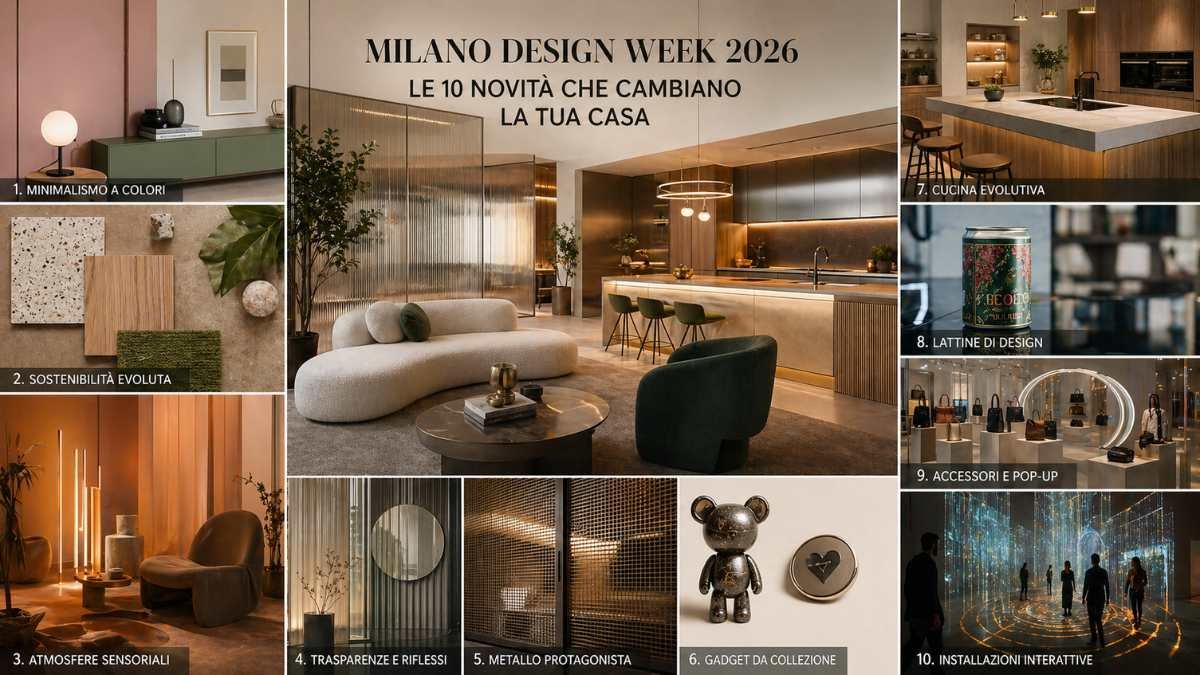

Milan Design Week 2026 confirmed a change that was already in the air for a few years, but which has now become apparent: the home is no longer designed only to be functional or aesthetically coherent, but to be experienced in a deeper, almost sensory way. It is no longer a matter of choosing furniture or colors, but of building environments that interact with those who live there, changing perceptions, habits and even the way we live our daily lives.
What emerges is not a sudden revolution, but a clear direction. The trends observed between Salone del Mobile and Fuorisalone are not isolated, but part of an increasingly coherent language, which combines design, technology and perception.
Minimalism in color: less austerity, more identity
Minimalism isn’t going away, it’s changing shape. Clean lines are accompanied by a new color freedom, breaking the rigidity of completely neutral interiors. Palettes become more vibrant, but never random: full, often deep colors, embedded in very tidy environments.
The result is an interesting balance. The environments remain necessary, but no longer cold. The house acquires character without losing legibilityand this translates into more personal spaces, less standardized than in the recent past.
Advanced sustainability: from concept to integrated system
Sustainability is no longer referred to as innovation, but as a basis for design. It is not just about recycled or certified materials, but about a broader approach that concerns the entire life cycle of objects.
Many brands have presented solutions in which innovative materials such as bioplastics or natural composites are combined with more efficient production processes. The real difference is embeddedness: sustainability is no longer seen, but perceived in the way an object is designed, used and intended to last.
The house becomes sensual
One of the most evident aspects of Design Week 2026 is the increasing role of the senses. Light, sound, textures and even scents enter the domestic project in a more conscious way.
The installations we saw at Fuorisalone showed environments that react to the presence of people, that change light or atmosphere, that accompany movements. This logic, still experimental, is starting to enter domestic spaces as wellespecially in living areas and bedrooms, where a more immersive and less static experience is sought.
Slides, reflections and new ways of dividing the space
The concept of separation between environments continues to evolve. Traditional walls leave room for lighter solutions, which filter light instead of blocking it. Mirrors with new shapes, reflective surfaces and ribbed construction are used not only as decorative elements, but as tools to modify the perception of space. Environments become more fluid, more dynamic, without losing their definition.
The return of metal, but in a modern key
Metal returns as the protagonist, but in a more sophisticated version than before. It is no longer just a technical or industrial material, but a decorative element capable of enriching surfaces and details. Metal mesh, brushed or matte finishes, furniture inserts and lighting create games of light and texture. Metal becomes a way to add depth without adding weightespecially when combined with warmer materials such as wood.
Evolutionary kitchen: where aesthetics and practical use meet
Among the most interesting spaces is definitely the kitchen, which continues to transform into a hybrid space between function and representation. The innovations observed during Design Week 2026 confirm a precise direction: the kitchen is no longer just a functional space, but a central space of the home, designed to be lived in and displayed.
The innovations are not only about design, but also about daily use. We see more and more modular solutions, surfaces that change function, elements that disappear when not needed. Benches that expand or transform, smarter containment systems, ever more subtle integration of home appliances. Materials also play an important role. Durable yet tactile surfaces, matte finishes that reduce signs of use, combinations of wood and technical materials. The goal is to make the kitchen easier to use without sacrificing aestheticsand this balance is increasingly evident.
Objects, collection and infection with the world of fashion
Along with the structural elements, great attention to detail and object is highlighted. The return of gadgets and collectibles, often associated with the “street” world, speaks of a more personal, less formal home. The initiatives seen during the Fuorisalone, such as the designer boxes distributed by Gucci or the pop-ups dedicated to accessories at the Quadrilatero, show an increasingly strong infection between design and fashion. The home also becomes a space for cultural expressionnot just functional.
Interactive installations: the future is already visible
The most interesting installations are not limited to observation, but directly engage the audience. Projects that combine architecture, light, sound and materials to create immersive experiences. What we see today in the most experimental events is often what will enter homes tomorrow, perhaps in simpler forms. Interactivity is no longer a futuristic concept, but a specific directionwhich will increasingly influence the way spaces are designed.
A home that truly changes the way you live
Milan Design Week 2026 didn’t just show new objects, it confirmed a deeper change. Home is no longer just a set of functions, but a system that includes perceptions, feelings and habits. What results is a new balance, in which aesthetics, technology and everyday life meet in a more natural way. It’s not about following trends, but about understanding how these transformations can really improve the way we experience spaces.



