


Anyone who lives in a loft knows this: dealing with summer heat is a constant negotiation. It is not a matter of comfort understood as luxury, but of physics applied to everyday life. The roof absorbs heat for hours, accumulates it and gives it back generously at the worst times, ie from three o’clock in the afternoon and throughout the night. Traditional houses have attics, stairs, an air layer between the roof and the roof of the top floor.
Not the attic: it lives just below the roof, in an area that thermal engineers call the “unprotected building envelope.” Which, translated into everyday terms, means that every choice you make in there carries twice the weight of any other room in the house. However, the attic remains one of the most sought-after spaces in the Italian real estate market, precisely because of these volumetric and light features that become the main problem in summer. Understanding how this type of space really works is the first step to stopping being subjected to it.
The enemy is not the sun, it is the thermal inertia of the roof
The temptation to go all-in on curtains and blinds is understandable, but treat the symptom instead of the cause. The heat that makes an attic uninhabitable in the evening hours does not enter through an open window: it is already inside, accumulating in the structure during the central hours of the day. A brick roof exposed to the sun reaches surface temperatures 70-80°C on the hottest days. This mass, once heated, releases heat inward for hours, even when the outside temperature has dropped.
The most effective structural solution is the external insulation of the field, performed with high density wood fiber panels or with projected polyurethane foam, which breaks the thermal bridge before it forms. Products such as Gutex Ultratherm panelsmade from wood fibres, they have a thermal transmittance of around 0.038 W/mK and the advantage of thermal inertia which slows the penetration of heat rather than simply blocking it. It’s not a cheap or quick fix, but those who have done it rarely go back. For those who want to stay within the realm of minor procedures, even a layer of sheep’s wool applied under the inner board produces measurable results.
Ventilation: two windows open at night are not enough
Night ventilation works, but only if it is managed as a system, not as an instinctive gesture. Opening two opposite windows when the outside temperature drops below 24°C creates an air flow capable of reducing the perceived temperature by 3-4 points within an hour. The critical point is the direction: the air must cross the space diagonally, not enter and exit from the same side. On pitched roofs, skylights in a high position act as a natural outlet for hot air, taking advantage of the chimney effect. Velux, which has been producing roof windows for decades, developed the range GGU with remote control equipped with a rain sensor and programmable opening: you set a night program and the window operates by itself, even when you are already in bed.
Ceiling fans are underpriced in Italy compared to Northern Europe. A model with wide blades, placed in the center of the room, does not reduce the air temperature, but creates a perception of freshness through the evaporation of the skin corresponding to approximately 2-3°C less in thermal sensation. Big Ass Fans, an American brand that is now also widespread in the European market, produces residential models with a diameter of up to 180 cm designed specifically for irregular volumes such as attics.
Curtains, films and screens: the order in which they are chosen changes everything
Solar shading should be evaluated from outside to inside, not the other way around. An interior curtain, even a dark one, blocks light but not heat: infrared radiation has already passed through the glass and turned into heat inside the room. A external shieldingwhether it is a sheet, a blind or a motorized blackout system placed outside the window, it intervenes before the heat enters. Velux estimates that its external awnings reduce solar gain by 74-94% compared to 45-60% for internal awnings.
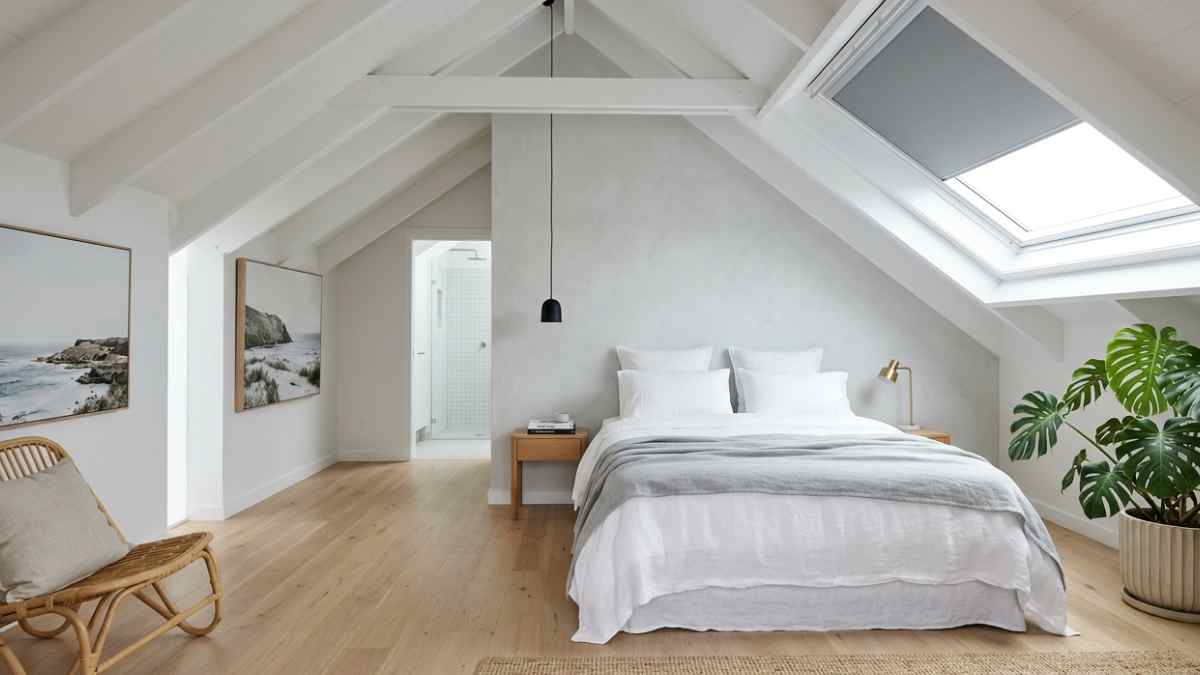
Solar glass films are an often overlooked in-between solution. The products of the series 3M Prestige Applied directly to the existing glass, they reduce solar transmission by up to 60% while maintaining good visibility and maintaining the natural light factor that makes the loft attractive. The cost per window is 80-150 euros with professional installation, significantly less than replacing low-e glass panes.
For inclined windows, there are also darkening systems with a reflective aluminum coating: the heat bounces off before it is even absorbed by the frame. Fakro, a direct competitor to Velux with prices on average 15-20% lower, have a range of blackout accessories compatible with their windows, which also includes silver coated roller blinds.
Air conditioning without ducts: solutions for those who cannot drill holes in the walls
The attic is often the most difficult room with a central system. Split air conditioners remain the most efficient option, but require a hole for the pipes to pass through and an outdoor unit to be placed in a manner compatible with condominium and landscape regulations, which in many historic Italian areas is not insignificant. THE portable monobloc air conditioners they represent an acceptable compromise for short seasons, being aware that the hot exhaust pipe reduces the performance of the device if not done correctly: the exhaust hole must be thermally insulated, otherwise the heat you are trying to eliminate is partly returned to the environment.
A category that is growing in the home sector is that of monosplit systems without external unit: They work with a built-in condenser that expels heat through a wall grill. Dyson has launched the Hot+Cool Formaldehyde range in Europe, which, while not technically an air conditioner, combines cleaning, heating and ventilation in a single device suitable for small spaces. For those looking for a more efficient solution, direct expansion systems from LG and Mitsubishi Electric feature slim indoor units (19cm deep) designed for pitched ceilings, with arms adjustable up to 30° of pitch.
The attic as a system: furniture, materials, behavior
A well-insulated and ventilated space can be made uncomfortable by poor furniture choices. Synthetic fabrics retain body heat and worsen thermal perception: Linen, raw cotton and bamboo fiber are alternatives that work in the summer without altering the aesthetics of the environment. The Danish brand Firm Living has built part of its identity on stone-washed linen fabrics, suitable for just this type of seasonal use, with neutral palettes that integrate well with the exposed woodwork that characterizes the lofts.
Dark surfaces absorb heat: Dark stained oak floors, exposed black beams, slate overlays are aesthetic choices that are in line with certain trends, but of course expensive in the summer. It’s not a matter of eliminating them, but of balancing them with light, fabric walls that reflect light instead of absorbing it. A glossy lightweight concrete floor, such as those made with branded microcement Topcement in shades of sand or antique white, it reflects both light and radiant heat in a measurable way.
Ultimately, living in a loft in the summer is a matter of layering: no single solution solves the problem, but three or four coordinated interventions radically change the experience. Insulation stops heat before it gets in, ventilation expels it when the outside temperature allows it, screens block it at critical times, and materials avoid its accumulation where you live. The attic that becomes uninhabitable in the summer is usually only missing one of these levels. Which depends on the history of each roof.



