


Every January, home improvement stores sell more plastic containers than the rest of the year combined. It’s the moment when the gap between the real home and the one in the social media photos becomes unbearable and the instinctive response is to buy something that bridges the gap. Boxes, dividers, wicker baskets with chalkboard labels. Then February rolls around, and those new containers are already overflowing with the same stuff as before, with the added bonus of spending money to hide it better.
The problem with home organization isn’t a lack of containers. It’s just that almost no one looks at what they already have before buying what they don’t need. A clear glass vase, a rigid cardboard box, a rack of magazines forgotten in a corner: they have precise geometry, a structure that endures and cost exactly zero euros.
The glass vase is not a vintage item, it is a system
Jars of preserves or jams, after being washed and labeled with hot water and bicarbonate, have a structural stability that most plastic containers do not achieve. The glass does not deform, does not absorb odors, does not turn yellow. On top of the bathroom sink, a jar of 500 ml It quietly holds all your makeup brushes upright, with better accessibility than any dedicated brush holder.
The logic extends: smaller jars, from 150-200 mlthey are the right size for cotton pads, swabs, hair ties. Lined up on the shelf, they create a visually neat composition that doesn’t look out of place compared to what some lifestyle brands sell for twenty euros apiece. In the army has a whole range of ceramic containers for the bathroom, the Reset collectionwhich aesthetically copies this logic exactly: simple shapes, wide opening, vase-like proportions. The difference is the price.
In the kitchen, screw-top glass jars become the most efficient system for loose spices, tea bags, seeds, and small legumes like red lentils. A shelf of same-sized jars, with handwritten or printed labels, has an immediate legibility that shelves of open original packaging can never have.
The shoe box as drawer architecture
Quality shoe boxes, the thick cardboard that mid- and high-end brands use for packaging, have enough structural rigidity to last years in a drawer. Without a cap, they become modular dividers with a feature that commercial plastic dividers almost never have: They are adapted to the actual dimensions of the drawer cutting them with scissors.
In the deep drawers of the wardrobe, two or three boxes placed side by side create separate cells for socks, underwear and T-shirts folded vertically according to the flat folding technique, which allows you to see all the items without taking any of them out. Marie Kondo He published this method, but its practical application does not require the bamboo dividers sold in stores inspired by his method: a size 42 diaper box has just the right proportions to hold a row of socks vertically.
In kitchens with wide, deep drawers, lower shoe boxes separate flatware from knives, spatulas from wooden spoons. The advantage over expanding plastic dividers is that they don’t move every time the drawer is forced open because the weight of the contents holds them in place.
The magazine rack is the most underrated of organizers
In kitchen furniture, vertical management is the problem that no drawer can solve. Cutting boards, baking trays, pot lids: these are flat objects that when stacked horizontally become inaccessible once a third layer is added. Taken out and placed vertically on a magazine rack, they become consultative like books on a shelf.
A metal magazine rack, tabletop with lattice walls or horizontal bars, can easily support the weight three or four cutting boards and two caps of different sizes. Placed in a cabinet with a door, it takes up approx width 15 cm and frees up all the remaining horizontal space. Pressed cardboard magazine racks work for light cutting boards, but buckle under the weight of iron or cast iron baking pans.
The same logic applies to the study area or the entrance. A magazine rack on the desktop separates documents in progress from notebooks, magazines you consult from those you need to read. String furniture has built an entire modular system based on this principle of verticalizing objects, with prices starting at 80 euros for the core modules. The desk magazine rack you already have at home does the same thing at no cost.
Yoghurt pots, fruit trays and the hinged rack in the kitchen drawer
The rigid plastic jars of Greek yogurt, the ones from 500 grams with straight walls and a flat bottom, they have a stable cylindrical shape that makes them perfect as a chest of drawers for small items. Clothespins, corks, hooks and small tools: each in its own jar, each jar in the drawer. No one slips, no one bottoms out.
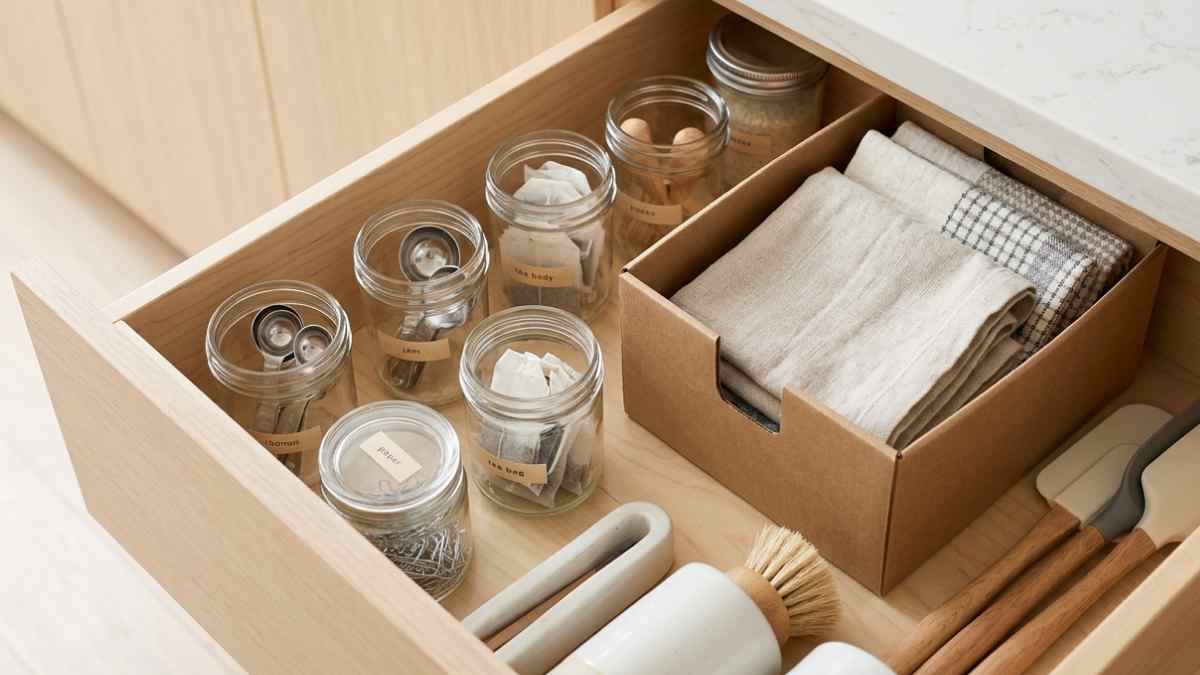
The clear fruit trays, the rigid plastic ones with holes in the bottom, act as modular hives for spice bags, coffee filters, sugar packets. Placed next to each other in a drawer, they create a grid that adjusts to the available width simply by adding or removing trays. It is conceptually no different from modular organizers Joseph Joseph sells in turn DrawerStore at prices between 25 and 45 euros, with the difference that the fruit trays are already at home and must be recycled.
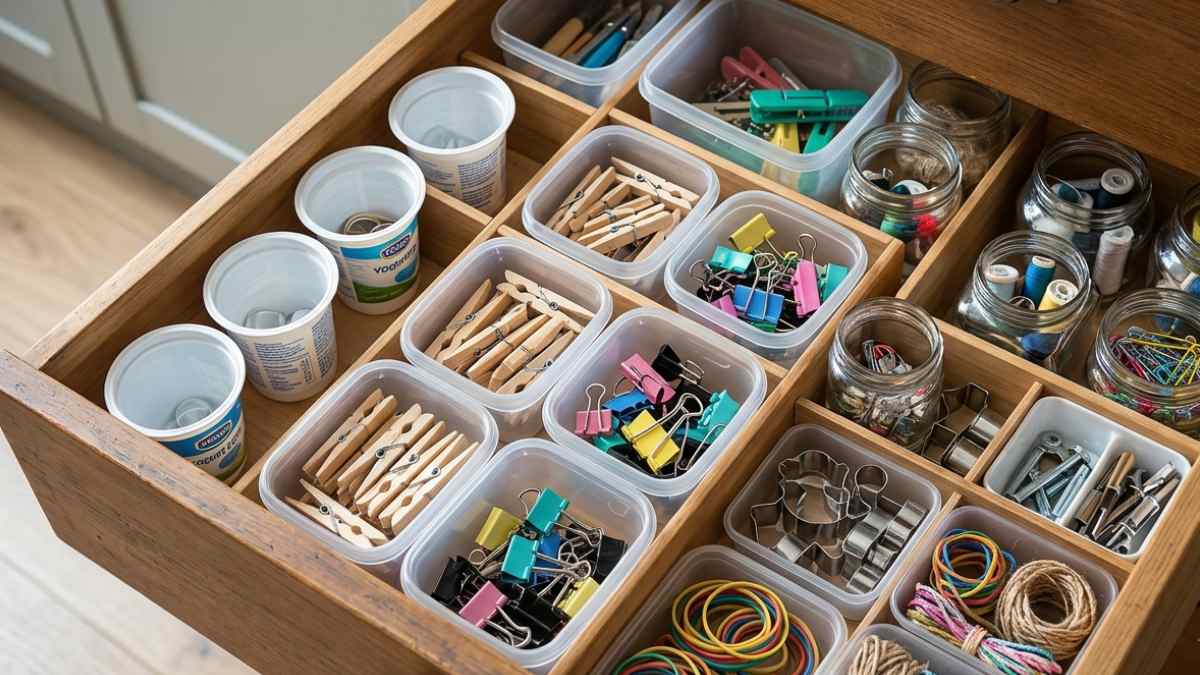
The only real limitation of these materials is aesthetic: they don’t have the clean finish of an engineered product. But inside a closed drawer this limit does not exist. And in exposed settings, an unlabeled glass jar has an aesthetic dignity that many colored plastic containers will never achieve.
At the bottom of a drawer right now there’s probably a jar, a box, a rack of magazines waiting to come in handy. You don’t need to buy anything. You need to open drawers with a different intention than you normally open them with.



