

DB: The installation uses sound waves to mirror whale calls and sonar. How do you imagine these vibrations reach the visitor?
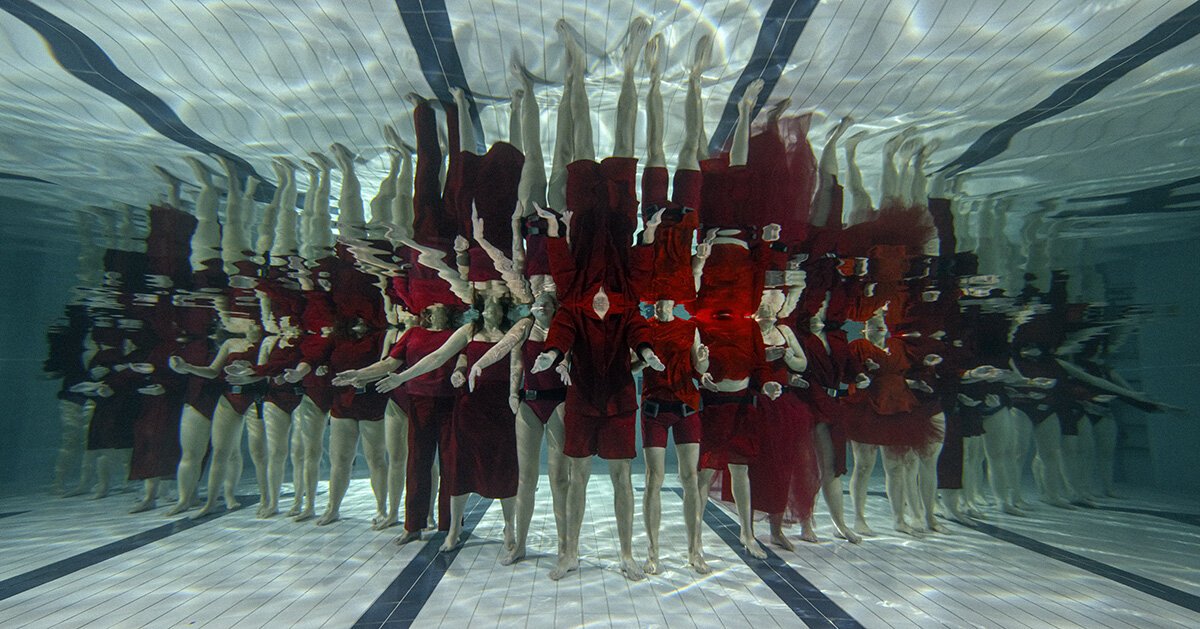
BB & DK: We would like the sound experience to be audible, visual (see: the choreography of sign language) and – at selected moments – physically felt in the body, as whales experience sound in water. The desired effect is inspired by underwater acoustic phenomena that correspond to the sensations caused by the voices and echolocation of cetaceans, and which are also close to the experiences of the Deaf, who perceive sound waves through vibration. We aim for the waves that appear at certain times to be immersive, not aggressive. Solutions are currently in the design stage, with careful consideration of the effects of sound waves on living organisms and the environment.

rehearsing immersive choreography for the Poland booth
DB: You combine cinema, sign language, underwater recording and choreography. Which medium proved the most durable and which opened new conceptual doors?
BB & DK: We work through connections and mutual insurances. Above water and underwater cinema, choral singing and electronic music, choreography, sign and vocal languages – these mediums meet and enter into dialogue with each other. The project is multi-layered: we combine the capabilities and languages of different tools, while exploring the possibilities and possibilities of transforming, distorting and above all enhancing and empowering them. It is where these qualities meet, and within their relationship, that the most exciting discoveries and conceptual doors emerge. This approach aligns with the overarching theme of flow, fluidity and connectivity within difference through mutual listening.

Performers move collectively, inspired by schools of fish and shared bodily rhythms
DB: The theme of the 2026 Biennale focuses on the ‘minor keys’, sensitive registers that are often overlooked. How do you see Liquid Tongues working in a minor key and how are they defiantly powerful?
BB & DK: IIn her curatorial concept for the Biennale 2026, based on the musical metaphor of “minor keys”, Koyo Kouoh invites us to a contemplative encounter with what is sensitive and overlooked every day – quiet voices, neglected narratives, micro-memories. It encourages us to develop subtle forms of resistance, to create new relationships, sensitive experiments, to create polyphonic scores of communities that hear, feel and echo each other. Liquid Tongues develops this idea, attempting to push beyond what we imagine to be the limits of communication and create subjective hearing and deaf communities, taking into account different perspectives. This proposed version of the future also looks at an animal perspective.
Roger Payne’s now-legendary 1970 recordings Songs of the Humpback Whale led to a ban on whaling and brought these animals back from the brink of extinction. The complexity of their sounds made us realize their intelligence and cultural complexity. This story shows the power of rescued voices transmitted through art.
The narrative of the installation will be based on stories of loss and forgetting, rebuilding and creating reality anew. This is the story of Payne’s work and the importance of his recordings. It’s a new and unprecedented (or perhaps old and reborn) collection of hundreds of solitary humpback whales off the west coast of Africa. It is the creation of works on the the sky – a ceremonial drum of the indigenous people of Greenland – although no one knows its sound before their brutal colonization. This is work to restore Hand Talk – Plains Indian Sign Language – the global sign language of the hearing and Deaf indigenous people of the Great Plains of North America. These stories allow us, nevertheless, to think about the reconstruction of the world around us.

Video Sketches – Bogna Burska, Video Sketches for ‘Liquid Tongues’ | image Magda Mosiewicz, performers: Bogna Burska, Daniel Kotowski, courtesy of the artists
Defiantly Loud is based on the concept of Deaf Gain, which sees deafness not as a disability, but as an identity and culture, offering unique perspectives and possibilities. Deaf Gain turns being Deaf from a loss to a gain by showing how Deaf people contribute to the world’s diversity. This approach also has its advantages for listening to people. Rather than seeing deafness as something to be fixed or treated, it is seen as a characteristic that can uniquely contribute and benefit society. Deafness is often described as living in a ‘world of silence’. However, the signature can be dynamic, expansive, and even aggressive. its intensity shifts from sound to sight. From Deaf Gain’s point of view, loudness doesn’t have to be linked to vocalization – it’s a way of confirming presence. The work also includes vocal cries and Deaf voices, but these are presented on their own terms, outside of phonocentric hierarchies.
Choir in Motion, the group performing on screen, is an experimental social choir with its own story, combining music, performance, visual art and spatial practice. The group survived the loss of its home – the founding cultural institution where it had grown for several years – by emerging as a grassroots initiative of shared creativity and action. Born in early 2024 from this social energy, Choir in Motion is a self-organizing, open initiative that sustains its community – one that seeks to play, act and speak together, while remaining receptive to new voices and perspectives. Revolt of the Deaf: Renewal directed by Bogna Burska and edited by Daniel Kotowski (Zachęta, 2025), is a work where Choir in Motion appeared for the first time in a vocal/meaning ensemble (hearing and deaf). The play talked about communication problems, universal languages and the 1988 Deaf student revolt at Gallaudet University. While working on this project, a remarkable Deaf and Hearing community was created, across language barriers.

Liquid Tongues explores communication beyond vocal language | image Magda Mosiewicz, performers: Bogna Burska, Daniel Kotowski, courtesy of the artists
DB: The project deals with marginalized languages and more than human communication. What kind of futures feel possible when we stop assuming that language must be spoken and human?
BB & DK: When we stop assuming that language must be spoken and/or human, entirely new post-anthropocentric futures open up, in which humans no longer see themselves as an exceptional or dominant species. This perspective allows us to observe how non-human biological beings communicate and interact in rich and complex ways.
It also allows us to imagine that the norms we take for granted around language – especially those arising from phonocentric hierarchies such as what counts as “proper” language, who speaks, who is allowed to speak, and who is heard – can, depending on the context, change or break down. What is seen as weakness or loss from a dominant perspective can become a source of strength and gain – a shared gain.
By paying attention to non-verbal and more-than-human communication, we can explore the possibilities of multisensory, non-linear and collective languages, creating futures in which communication is more inclusive and relational, while being sensitive to different ecosystems.



