

Massimiliano Malagò imagines literary narratives as furniture
Calculating Volume examines how literature, domestic space and urban living conditions informed the renovation of a Greenpoint apartment in New York. Developed by architect Massimiliano Malagò in collaboration with client Kathleen Pongrace, the project translates themes of repetition, storage, time and permanence into a series of household objects and spatial interventions shaped by the realities of contemporary city life. The renovation arose out of discussions around the pressures of living in New York, where rising housing costs, limited space and constant urban transformation affect everyday domestic conditions. Pongrace, formerly director of marketing for the Strand Bookstore, needed additional storage space for an expanding personal library, prompting the project to address both practical space constraints and broader considerations of hoarding and survival in dense urban environments.
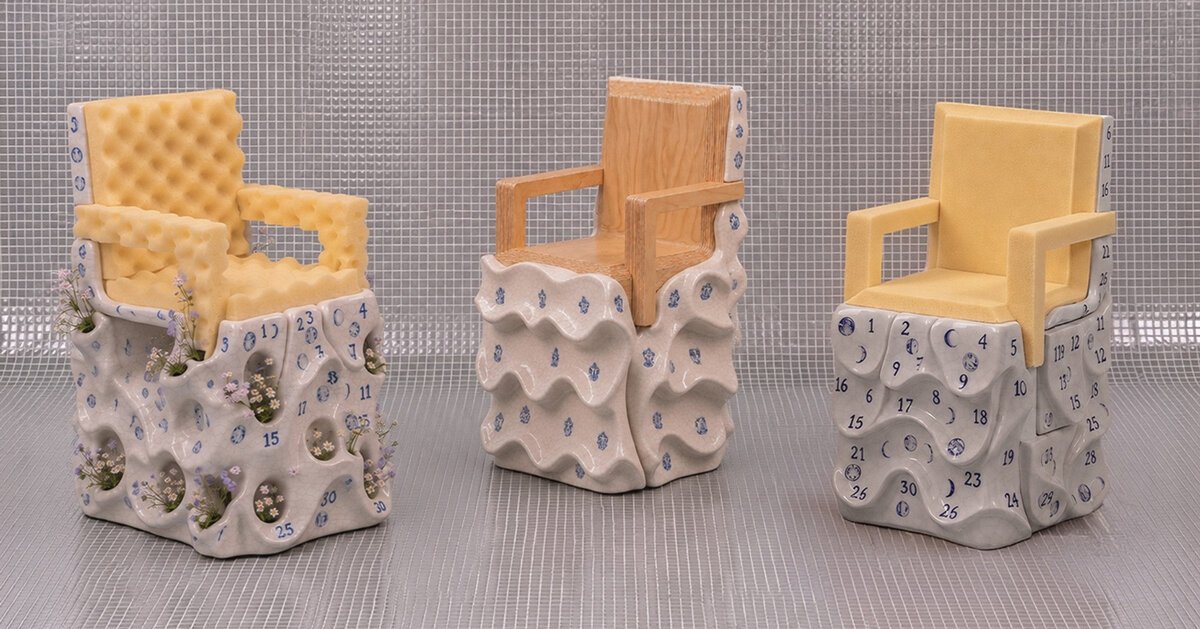
Literary references became central to the design’s conceptual framework. Solvej Balle’s On the Calculation of Volume I, in which the protagonist repeatedly relives the same day, updated ideas about circular routines and temporal repetition related to life in New York. Simone de Beauvoir’s Tous les hommes sont mortels introduced themes of permanence, loss, and the experience of surviving changing social and urban conditions. These narratives were translated into furniture that functions simultaneously as functional household objects and material studies of time, attachment and urban continuity. A series of chairs designed for apartment combinations ceramic tile, plywood, aluminum storage components and biosynthetic foam. The ceramic bases refer to the glazed terracotta facades, subway tiles and utilitarian surfaces associated with New York architecture, while also meeting the practical demands of domestic life, including resistance to wear and tear from the client’s cat.

all images courtesy of Massimiliano Malagò
Equilibrium Time Chairs, Spatial Accumulation and Urban Living
Many chairs are organized around the contrast between durable and temporary materials. The ceramic structures appear soft or partially liquefied, with the tiled surfaces forming teardrop-like geometries that refer to the accumulation and blurring of time. Instead, foam bearing elements are intended to deteriorate gradually through use, introducing a material distinction between permanence and decay. A chair incorporates hollows for flowers, adding an extra layer of time through living organic elements.
Storage is integrated directly into the furniture through hidden compartments, metal supports and sliding pockets, reinforcing the project’s focus on accumulating space in compact domestic interiors. Another chair incorporates references to the architectural vernacular of Greenpoint and Williamsburg, while introducing openings under the seat that leave room for the client’s cat to inhabit the object.
Throughout the project, developed by designer Massimiliano Malagò, furniture becomes a framework for examining how household objects absorb the psychological and spatial conditions of urban life. Through ceramic surfaces, layered materials, built-in storage and references to literature, Mania New Yorkea positions the apartment interior as a reflection of the repetition, adaptation and negotiation of space in New York City.

Ceramic tile surfaces evoke the glossy architectural facades of New York

furniture translates literary narratives into domestic objects

Biosynthetic foam contrasts with durable ceramic structures

Droplet-like tiled geometries cause time to blur

Hidden storage spaces are built into the furniture

the work reflects the spatial pressures of modern life in New York



