


Classic awnings have a construction logic designed for large verandas: extendable arms, side guides, optional motorized, aluminum structure anchored to the wall above the French window. On one of his balconies 6-8 square meters with a masonry parapet and blind side walls, the same logic becomes a problem. The awning requires room to maneuver that the balcony does not have, a support structure that is often not compatible with condominium walls, and a budget that starts at 400-500 euros for basic installation. For a narrow rental apartment balcony, it is rarely the right solution.
The shade cloth was born in a different context: large residential and commercial outdoor spaces, where flexibility of placement is an advantage compared to fixed structures. Placed on the balcony, it maintains these advantages and adds one that classic awnings do not have: it can be disassembled, folded, stored when not needed and reassembled in different configurations depending on the season or time of day. The cost of an average glider starts from 20-30 euros for the triangular versions from 3×3 meters and goes up to 80-120 euros for the rectangles in technical fabric HDPE with reinforced stainless steel rim and rings. It doesn’t compare to the cost of an installed awning.
Awning vs. canvas: what really changes on the balcony
The awning Expandable has an advantage that the sail is not easily reproduced: the opening direction is horizontal and frontal, which means that it effectively shields the sun coming from the front without touching the parapet and without requiring lateral anchor points. On a balcony with direct exposure to the afternoon sun, a good-sized awning creates precise and controllable shade with a simple mechanism.
The cloth works differently: it is needed at least three anchor points to stretch properly and these stitches should be spread over different surfaces. On a porch with existing posts or structures this is easy. On a balcony with only two side walls and a front parapet, it requires adjustment. It is not impossible, but it requires you to think about the geometry of the space before buying the product.
The classic awning better resists strong winds because the metal support structure absorbs the pressure. An insufficiently stretched sail swells in the wind, puts pressure on the anchor points and can tear or slip. A well-tapped and properly angled sail will handle moderate wind conditions without issue, but remains a less structurally sound solution. On balconies that are exposed to frequent and strong wind, the awning with a stable construction is objectively more suitable.
Aesthetically, cloth has an advantage that classic awnings struggle to replicate at an average price: the clean and contemporary look of a curtain stretched diagonally over a balcony is visually more refined than a PVC roller awning with an exposed cassette. This is why shade sails have become a recurring element in advanced exterior design projects, since On disk a Paola Lentithat incorporate them into outdoor furniture compositions with high-quality technical fabrics.
Triangular or rectangular: two products with different logics
The choice between a triangular and rectangular sail is not only aesthetic: it changes the actual coverage, the number of anchor points required and the ease of fitting in an irregular space.
THE triangular sail it is more flexible in terms of placement because it is easier to find three anchor points than four on a small balcony. The triangle shape lends itself to partial and asymmetrical coverings: if the aim is to shield only the strip of the balcony exposed to the late afternoon sun, a triangular cloth placed diagonally does just that without covering the entire surface. The limit is coverage: a triangle always leaves the corners uncovered, and in a rectangular balcony the geometry never coincides perfectly with the space to be shielded.
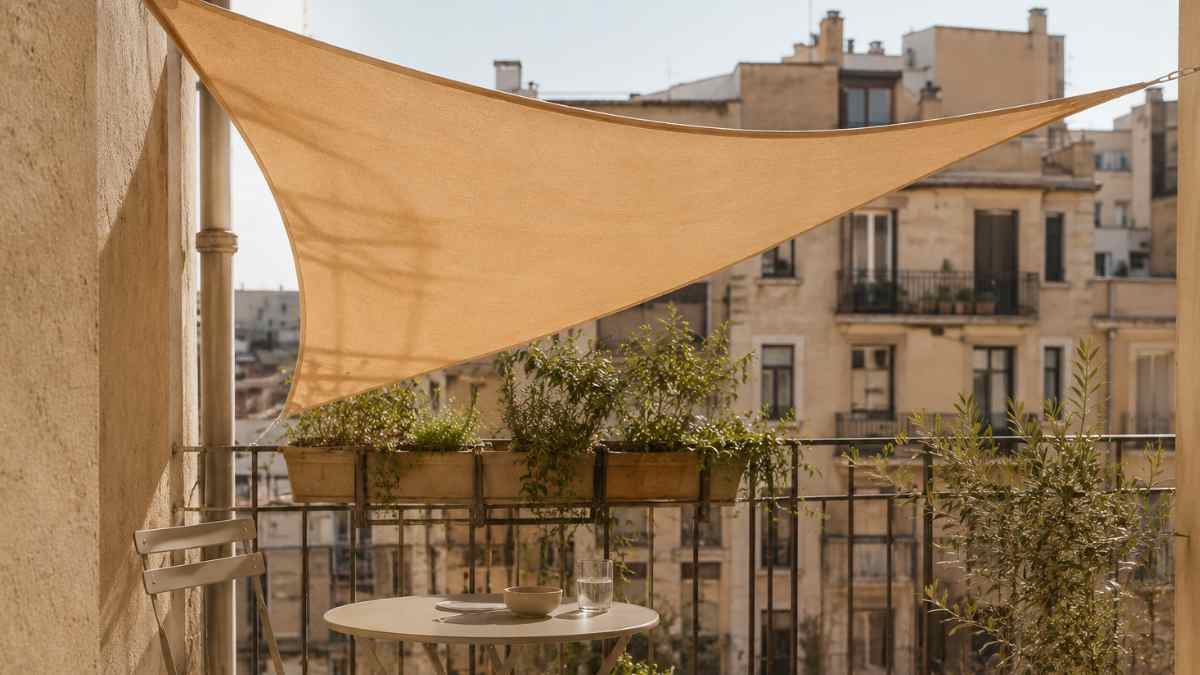
THE rectangular cloth It best covers a rectangular space, which is the shape of almost all balconies. With four anchor points at the corners, stretched horizontally or with a slight slope, it creates an even shadow roof over the entire surface. The problem is that on a balcony with only two available walls, finding four properly spaced anchor points requires additional solutions such as telescopic poles or parapet clamp brackets. It’s not an insurmountable obstacle, but it adds complexity and cost compared to the triangular version.
For a narrow balconythe most effective combination is often one rectangular cloth slightly smaller than the surface of the balconystretched with two high points on the back wall and two low points on its sloping front parapet 10-15 points. This configuration creates a sloped screen that channels rainwater toward the parapet rather than pooling in the center and maintains enough tension to withstand moderate winds.
Anchors on the balcony: specific solutions when fixed points are missing
The main problem with installing a sail on a balcony is the lack of anchor points. A porch has posts, columns, perimeter structures. A typical balcony has two side walls, a back wall with French window and a front parapet. It’s not much, but it’s enough with the right tools.
I screw expansion hooks on the side walls is the most solid anchor point available on a balcony. A stainless steel hook with an expansion anchor on a concrete or brick wall holds a pull 80-100 kglargely sufficient to stretch a sail even in windy conditions. The limitation is that they require you to drill into the wall, which in a rented apartment is often excluded from the contract.
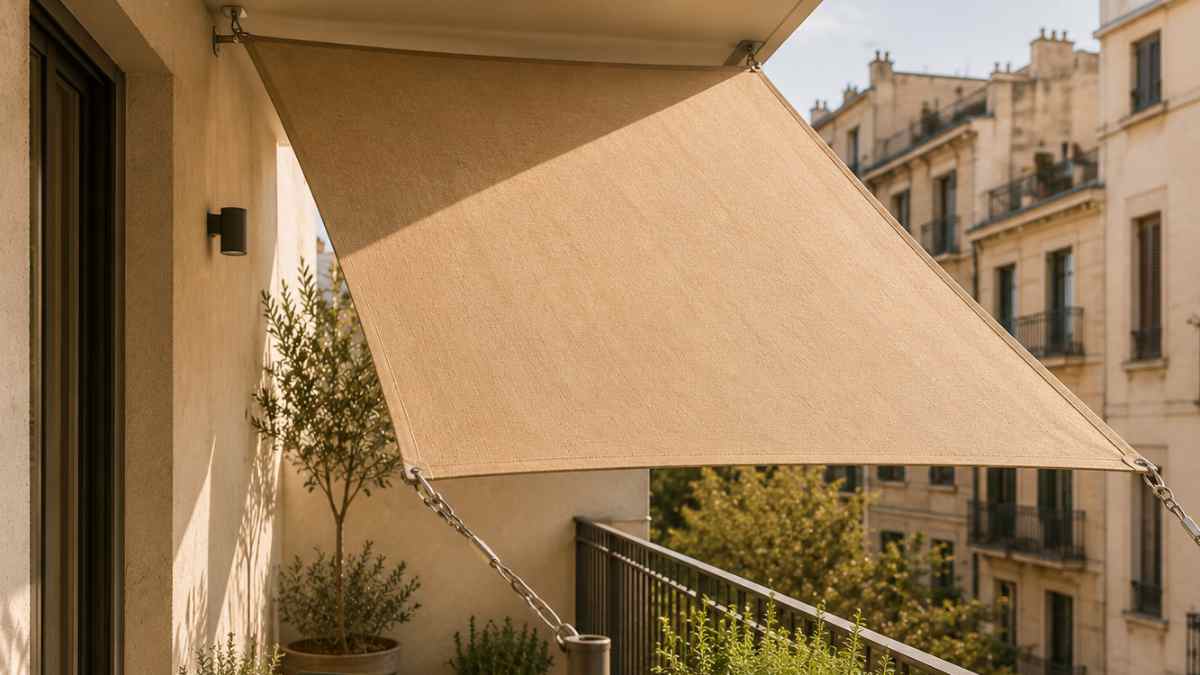
For those who cannot pierce, ie parapet clamps is the most common solution. They are adapted to the upper edge of the parapet without structural modifications and support loads 40-60 kg in traction, sufficient for the low anchor points of the sail. They are not suitable as high anchor points because the geometry does not allow it, but in combination with high load adhesive hooks on the side walls for the upper points, they create a complete system without drilling.
I structural adhesive hookslike those of the line Command Outdoor di 3M or its equivalent systems Tensehold up 7-10 kilos each on a smooth dry surface. They are not sufficient on their own to anchor a sail in windy conditions, but work well as secondary anchor points to spread tension over several points. The key is to use them on clean, dry surfaces and not subject them to direct adhesion: the curing time before load application is at least 72 ore.
I external telescopic polesthe aluminum ones that extend between the floor and the ceiling of the balcony with a pressure system, create additional vertical anchor points without any structural modification. Placed in the corners of the balcony, they provide firm support to the side anchor points of the sail and can be completely disassembled in a few minutes. The cost is approx 25-40 euros per pole and are available in hardware stores and on Amazon in versions up to 3.5 meters in height.
Fix tension and rake: why a loose sail doesn’t work
A loose shade cloth is a problem on two fronts. Functionally, the loose fabric forms pockets in which rainwater collects: with just a few centimeters of rain, the weight of the collected water can exceed 20-30 kilos in a medium-sized sail, a tendency that anchors are not designed to handle. Structurally, the loose fabric moves with the wind rather than against it, creating repetitive dynamic stresses that press against holes and seams much more than the static tension of a tightly stretched sail.
The correct tension can be recognized by a simple test: pressing with your hand in the center of the sail, the fabric should not hang more than 3-5 cm under moderate pressure. If it hangs longer, the sail is too loose. If the fabric is as stiff as a drum, the tension is too much and risks tearing the holes or distorting the anchor points.
Inclination is just as important as volume. A perfectly horizontal sail collects water in the center. A tilt even fair 5-10 points just make the rainwater flow towards a corner instead of collecting it in the center. The angle towards which the water flows should be towards the outer parapet and not towards the back wall of the building. On a balcony, this means that the highest anchor point should be on the back wall and the lowest on the front parapet, with a height difference between the two of at least 15-20 cm in a cloth of his 10 feet in length.
Fabrics: what to buy and what to avoid
Fabric makes the difference between a sail that lasts one season and one that lasts for years. The cheap sails standard polyethylenethose below the 15 eurosthey degrade quickly with exposure to UV rays: color fades in one season, fabric becomes brittle and tears in the eyes within two years of normal use.
Pass them in HDPE (High Density Polyethylene) with anti-UV treatment are the benchmark in the category. The fabric is breathable and light water permeable, which reduces wind resistance and eliminates the problem of water pockets in moderate rainfall. The optimal weight for home use is between 160 and 200 grams per square meter: below this threshold the fabric is too light to resist the wind, above this it becomes stiff and difficult to fold. The most popular brands in this category are Corasol, Sunfighter and its technical lines Videxwith prices in between 40 and 90 euros for sails 3×3 or 3×4 meters.
THE stainless steel holes it’s a detail worth checking before you buy. Galvanized steel peepholes rust within a season or two in contact with moisture, stain the fabric and break right at the point of greatest stress. Medium and high quality sails use stainless steel holes 304 or 316visually identical but incomparably more resistant to corrosion over time.
Triangular cloth in HDPE, three well-spaced anchor points and the right inclination towards the parapet: on a small balcony, it’s all you need to have shade from May to September without installers, without condominium permits and without spending as much as an awning would. The afternoon it takes to assemble it is the real cost of the operation.



