


In small rooms the problem is always the same: finding space. In large rooms, however, the problem is almost the opposite. There is space, too much, and instead of offering relief it ends up creating a feeling of incompleteness. It’s not about how much you put in, but how that square is mentally organized. A forty square meter room furnished with a sofa, a table and a TV on the wall is not a large, well-furnished room. It is a small room with air around it.
The problem, to put it bluntly, is the absence of a psychological center. The eye enters space and does not know where to go. Everything floats. The sofa looks abandoned in the middle of the room, the rug underneath seems to have been placed there by accident, the light fixtures are too far from any point of attraction. Nothing calls the other. The solution does not come from adding random furniture, but from building small discrete residential units, each with its own logic and internal coherence. What they say in English vignette: Compositions that function as autonomous scenes within the wider space.
The armchair that becomes a seat
One of the most readable mistakes in large sizes is the armchair placed in a corner with nothing else around it. Sitting alone, without a lamp, without a support surface, it looks like an object waiting to be placed. An armchair becomes a microcosm when you give it a floor or floor lamp, a small round table next to it, and, underneath, even half a carpet that roots it to the floor. At that point it’s no longer a decorative element: it’s a precise space, with legible function. You sit there reading, being alone, looking out the window.
Flos has developed lamps such as Arco precisely for this type of composition: the steel arch extending over the seat creates a kind of invisible dome, a psychological boundary between this part of the room and the rest. The original 1962 model, designed by the Castiglioni brothers, still works because it’s not just aesthetic. It’s geometry. This curved arm defines a perimeter without using walls.
For a less expensive solution, a combination of an armchair like the Lounge Chair by HAY, a Slit coffee table by &Tradition and a Bellhop lamp by Ferm Living works in the same direction: three elements that talk to each other and build a corner with its own raison d’être.
The carpet is not a decoration, it is a border
In large rooms, the carpet ceases to be an accessory and becomes an urban planning tool. Defines where a range starts and ends. A sofa without a carpet in an open space is an additional item. The same sofa on a 300×400 cm carpet becomes part of a system. The front legs of the sofa should be on the carpet, not touching it. The center table must fit completely inside. The side seats, at least with their front legs, must touch the fabric surface. Only in this way does the carpet fulfill its structural function.
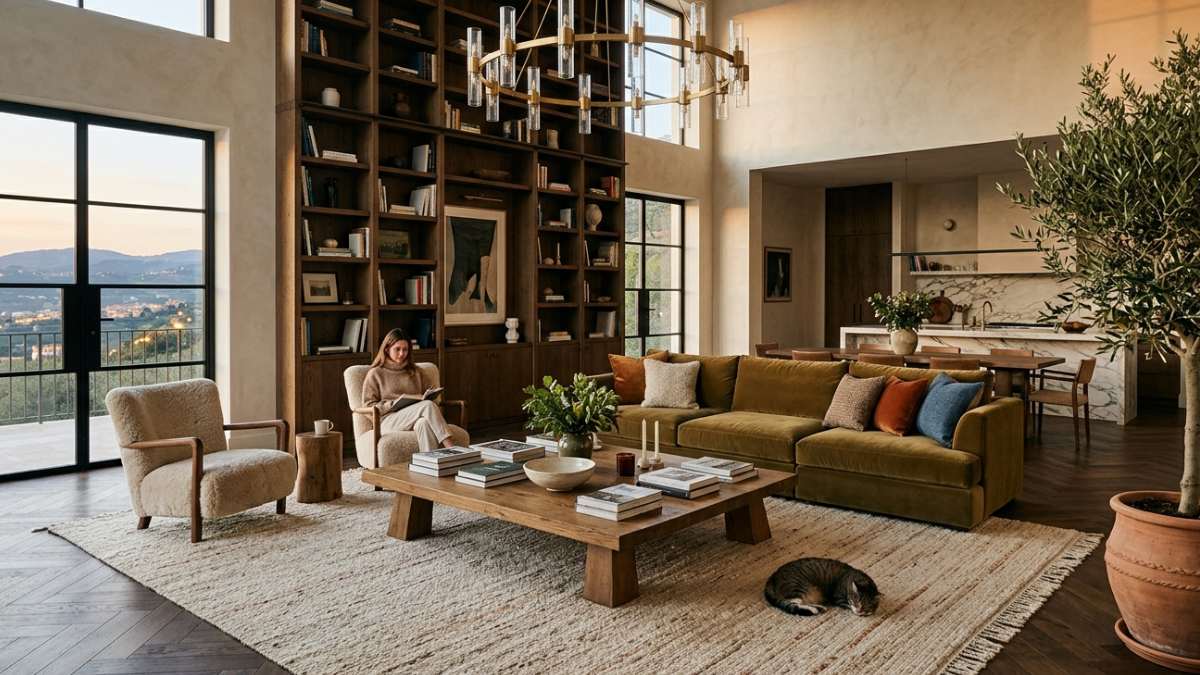
The choice of format is as important as that of the design. A natural wool Beni Ourain Moroccan rug, with its irregular geometries and tall pile, works well because it has enough visual presence to support a substantial space without overwhelming it with color. Minimum recommended size for a 30m2 living room: 250×350 cm. Below this threshold the result is that of a very small island in the middle of the sea.
Brands such as Nanimarquina, founded in Barcelona by Nani Marquina in the 1980s, work explicitly on the relationship between carpet and interior architecture. The Doblecara and Wellbeing models are designed with large surfaces in mind, with weights and thicknesses calibrated for environments that require a strong presence without excessive visual weight.
The console behind the sofa solves the vertical gap
When a sofa is placed in the center of the room, away from walls, the back becomes a problem. This zone between the back and the nothingness behind is visually destabilizing. A low console, between 75 and 85 cm high, placed in contact with or a few centimeters from the back, closes this spatial trauma. It doesn’t have to be big. It just needs to be there and inhabited: a table lamp, some stacked books, an object with volume like a sculpture or a tall vase.
The console also plays a role visual demarcation: separates the sofa space from the one behind it, whether it is another functional space or simply free space. Ikea offers the Bestå low profile as an economical solution, but for a more convincing effect a metal console like the Modular by String Furniture or solid wood like those from Muuto’s Crate series will better support reading in the room.
The same principle applies to an open bookcase placed perpendicular to the wall, which in a large space can separate two areas without closing them off. Cassina has worked on this kind of solution with systems like the Raumteiler, which are living partitions rather than just shelves.
Other cores that give dimension to the room
The logic of the microcosm is copied. A dining table in a single living space gains coherence when the table is treated as an independent entity: a pendant lamp located in the center above it, about 70 cm from the top, visually defines the position of the table in relation to the ceiling and the room. This vertical relationship between lamp and surface is one of the most effective gestures to give weight to an element that would otherwise appear to be able to move at any moment.
A floor-to-ceiling bookcase on an entire wall does something similar: it gives scale to the room while making it legible. It does not fill the void, but organizes it. It provides a dimensional reference that the eye uses to measure the rest of the space. A space without vertical references seemed emptier than it is.
One final example: the entryway in generously sized homes. A ceiling hanger, a bench with storage and a small mirror do not decorate the entrance. They build it. Without them this space is a corridor with uncertain functions. With these elements it becomes a place with an identity, the first microcosm you pass by entering.
A big room works when you can forget how big it is.



