
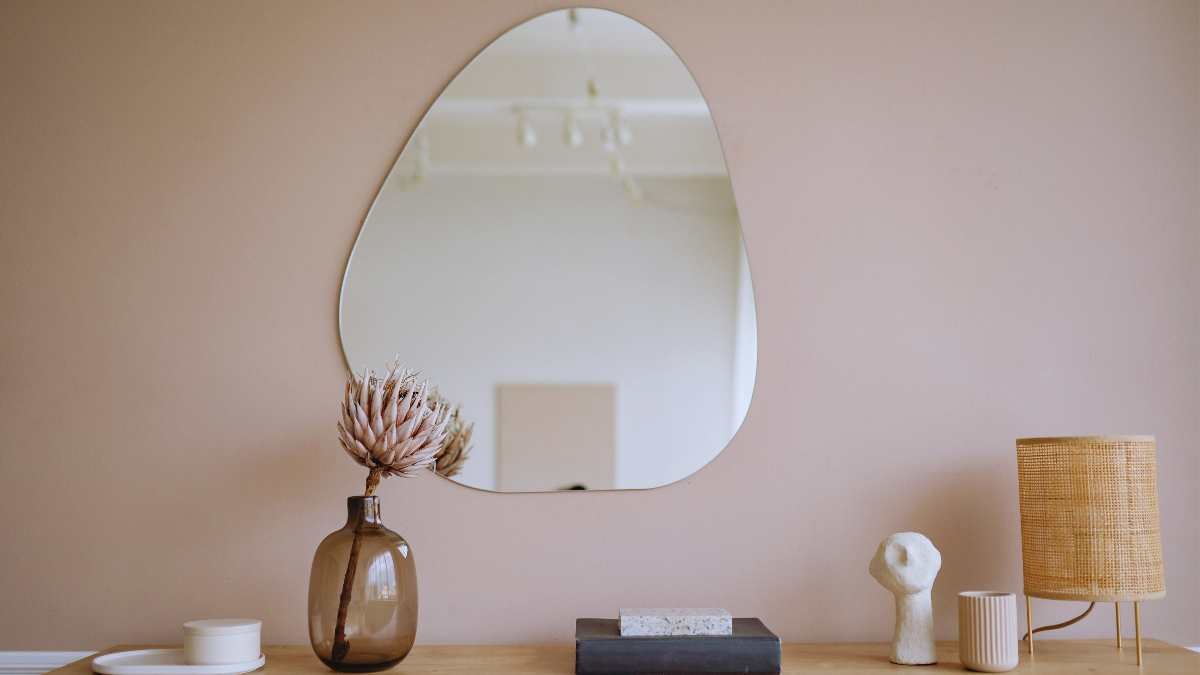

Anyone who has furnished a small entryway has sooner or later come to the same conclusion: you need a large mirror. Catalogs say it, YouTube videos confirm it, anyone with the slightest familiarity with furniture suggests it. It reflects light, expands the space, immediately gives a modern look. It seems like one of those tips that is so well established that it doesn’t even need verification.
The problem is that it works in theory and often fails in practice. Not because the advice is completely wrong, but because a mirror doesn’t just reflect light. It reflects everything in front of it. And at the entrance of a residential house, what you have in front of you is rarely a white, empty wall: it’s shoes, bags, jackets, the living room in the background, the everyday chaos that would go unnoticed on any other surface.
The result is paradoxical. You buy a mirror to solve an optical problem and end up multiplying it.
A mirror doesn’t just reflect light
In recent years the large mirrors at the entrance have become almost automatic. Vertical, huge, resting on the ground or with very thin black frames. The idea seemed perfect: they reflect the light, make the space seem larger, immediately give a modern effect.
The problem is that a mirror doesn’t just reflect light. It reflects everything. Shoes near the door, cables, bags, corners of the living room, piles of objects that the eye would normally ignore. When the entrance is small or opens directly into the living room, this surface ends copy exactly what you wanted to hide.
Piero Lissoni, who has designed some of the most austere residential interiors of the past twenty years, considers the mirror active element in the composition of the spaceno neutral makeup. Mirroring the wrong place adds a permanent nuisance, not the solution.
The problem is multiplied in open spaces
In modern apartments where the entrance leads directly to the living room or kitchen, this The front mirror becomes one of the most problematic details. It simultaneously reflects multiple environments, movements, changes in light. The result is not a room that feels bigger, but a room that it looks fuller.
At night the effect worsens. With artificial lights and stronger shadowsa large mirror enhances the feeling of a crowded environment. A reflected lamp, the living room table, the passage to the kitchen: everything seems closer, more present, visually stronger. It’s the same principle that makes restaurants that use large mirrors on the side walls always look messier than those without, even when they’re half empty.
Floor-mounted mirrors in narrow entryways further enhance this effect because they mainly reflect the low end of the room: floor, shoes, furniture legs, objects left near the door. Exactly the elements that increase the perception of disorder.
Frames and aspect ratios change everything
It’s not just a matter of location. Very thick black frames or models with strong industrial profiles add a further visual break point in an already dense space. In a narrow entryway, a two-inch-wide black frame on a large mirror is like adding a dark piece of furniture that serves no purpose.
The models that work best today are proportionally more limited, with thin frames in brass, natural oak or without a frame at all. Soft shapes, oval or with rounded corners, visually weigh less than classic huge rectangles and are best integrated into entrances that focus on a neutral palette and natural materials.
How to use the mirror without becoming a problem
The solution is not to remove the mirror, but change its position and proportions.
Mirrors placed laterally in relation to the entrance instead of frontally reflect natural light or clear walls without constant copying of the living room. It is a difference of a few centimeters in the choice of the support point that completely changes the perception of the space.
In the latest setups brands like Muuto and Hay almost always have mirrors at the entrance smaller than a few years agowhich is often combined with thin bentwood consoles or racks and positioned to reflect a wall or source of natural light rather than the rest of the apartment.
An entrance that looks really shiny is not one that reflects everything. That’s where the gaze can move without encountering visual noise. And sometimes you just need to move the mirror half a meter to immediately feel the difference.



