
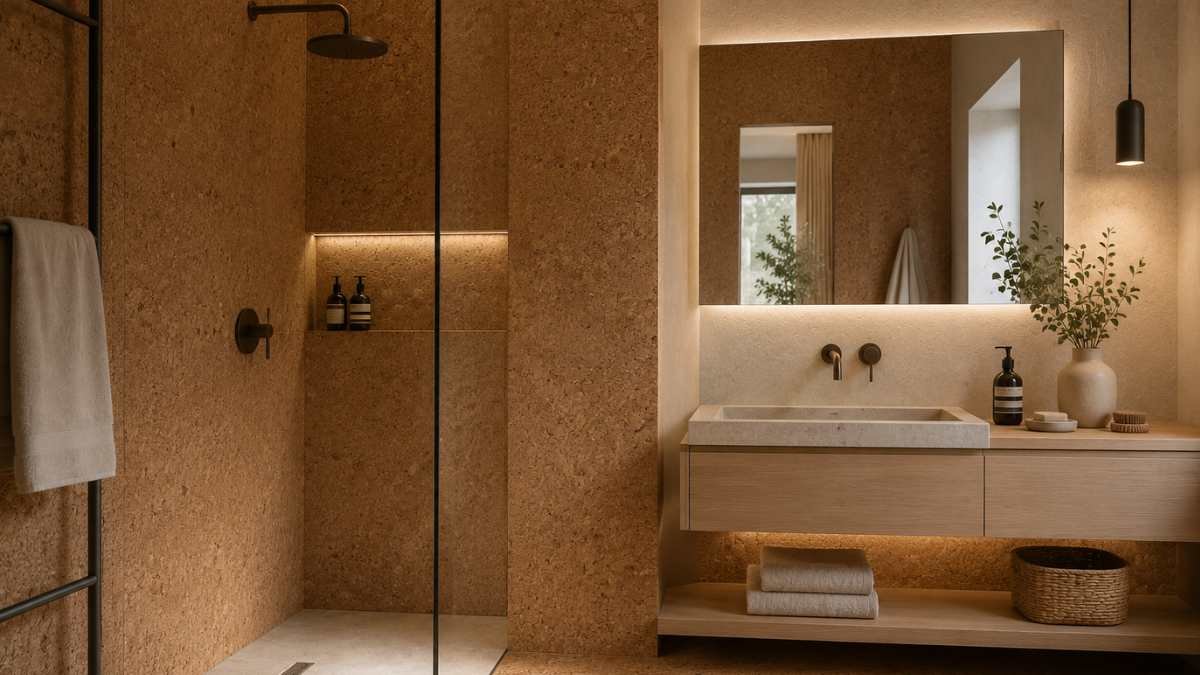

The modern bathroom has reached a standard perfection that has made it, in many cases, unpleasant to inhabit. Continuous porcelain surfaces, joints reduced to a minimum, hanging sanitary ware, monochromatic walls. It’s clean, it’s neat, it’s just like it looks in the magazines. And it’s also one of the home environments where people are least happy.
The problem has an exact name: visual cold. It is not a matter of actual temperature, but of perception. Hard, reflective surfaces without organic texture create an environment that the eye perceives as clinical. Get in, do the right thing, get out. It is not a place where you can breathe.
Il cork solves this problem in a way that no other material can replicate, and it does so by bringing with it a range of technical qualities that are by no means secondary to the bathroom.
A material that is not afraid of moisture
The reason cork is not instinctively considered for the bathroom is that it looks fragile, organic, exposed. In fact it is one of the most moisture resistant materials found in nature. The reason lies in suberinaa biopolymer present in the cell walls of the cork that makes it naturally water repellent. Does not absorb water, does not rot, does not deform. It’s the same principle that made it suitable for sealing bottles for millennia.
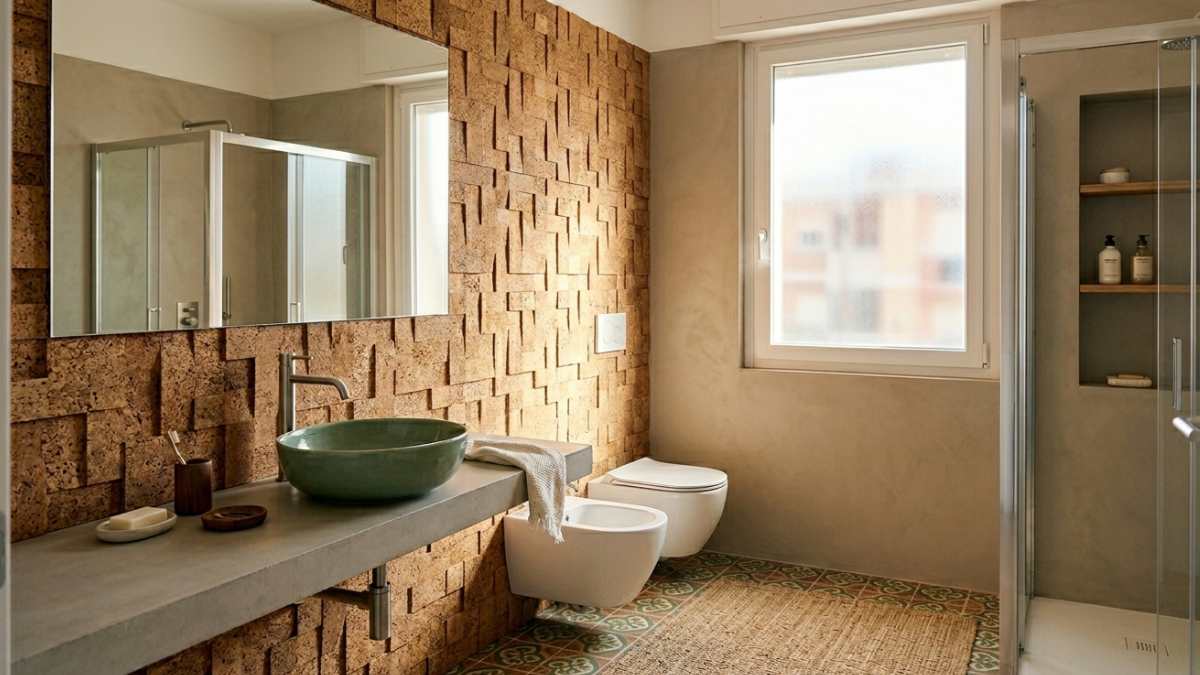
Plus, unlike many waterproof materials, cork also breathes. It allows water vapor to circulate without trapping moisture, which means in a bathroom less condensation on the walls and less risk of mold. It is no coincidence that it has been used for centuries in cellars, humid environments by definition, without spoiling.
How the perception of the bathroom is changing
A cork wall in a white bathroom does something that tiles can’t: it absorbs sound instead of reflecting it. The tiled bathroom has a distinctive reverberation, that acoustic harshness that amplifies any noise. Cork, with its cellular structure made up of millions of micro-cavities of air, absorbs about 30 percent of high frequencies. The environment immediately becomes quieter, more intimate, more private.
Visually, the The natural texture of cork brings warmth so that no paint applied to a smooth surface can give. It is not the same to paint a wall in warm beige and cover it with natural cork: the depth of the texture, the slight variation in tone that characterizes the material, the response to the light that changes during the day are things that belong to the material, not the color.
How and where to apply it
Cork in the bathroom works best on a single wallthe one in front of the shower or the one behind the sink, where it is not directly exposed to running water. Using it on all walls creates a saturation effect that takes away the airy atmosphere of the space. A single wall, however, creates a contrast with the more neutral surfaces around it, which is exactly the kind of visual tension that makes a bathroom interesting.
Tecnosugheri, an Italian company that produces 3D modular elements in post-industrial recycled cork, offers panels with patterns that create depth and relief on the wall. They are not raw cork in the most rustic sense of the term: they are products designed for contemporary environments, with finishes that go well with modern bathroom fittings and brass or brushed steel faucets.
For the floor the situation is slightly different. THE Cork flooring in the bathroom requires glued installation over the entire surface, non-floating, so that water does not enter the joints. With this precaution, it stands up perfectly to daily use and offers comfort to the touch, that softness and warmth underfoot that stoneware will never offer.
What does it go with?
Natural cork, in its shades ranging from light honey to smoke, is easily combined with almost everything. With white it creates a soft contrast that warms without weighing it down. With the sage green or warm gray joins an organic palette which in recent years dominates the most interesting bathroom designs. With natural wood, it creates a coherence of materials that makes the bathroom look thought out even when it is the result of a few expensive choices.
What it cannot withstand is the combination with very shiny or very dark surfaces. Cork has an opaque and material presence that clashes with glossy black or highly reflective marbles. In these contexts it loses its effect and ends up looking out of place.
The modern bathroom does not need other technical materials. You need something to remind you that someone lives there.



