
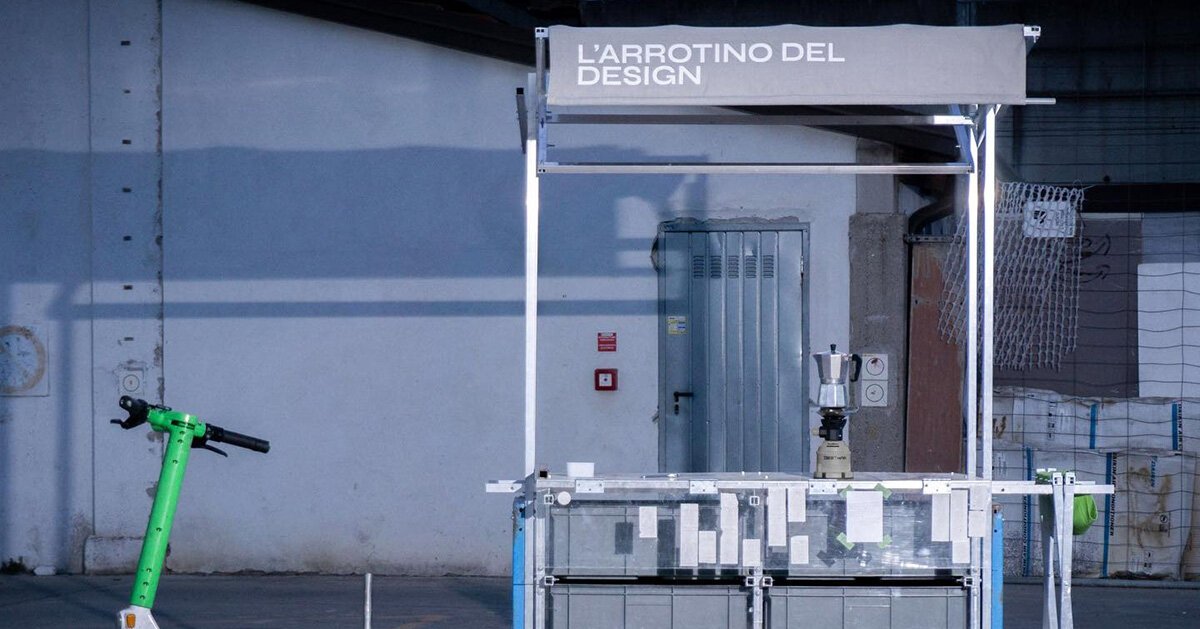

arrotino del design directs attention to local repair
During Milan Design Weekfacilities often appear as polished objects that briefly drop into the city before disappearing again. The Studio Method suggests something slower, smaller and much more integrated into everyday life. Their project, Arrotino del Design, is inspired by the long-standing Italian figure of the itinerant repairman, the arrotino, a familiar figure who once moved through neighborhoods repairing household items while becoming part of neighborhood life. “Basically, he was this repairman who goes around the neighborhood and fixes things, and he’s very integrated into the community.” explain designers Riel Bessai and Pedro Daniel Pantaleone. “That’s why we took that number as a starting point.”
It was developed during New InstituteIn the CIVICITY residency program, the work comes from Studio Method’s time spent in Quartiere Adriano, a peripheral neighborhood in Milan. There, the duo quickly realized that the area didn’t need designers to come up with big solutions. Instead, they encountered already existing systems of care, social ties and collective activity operating through community centres, local organizations and informal networks.
“The question wasn’t really what can we go there and do,” reflect, “But more what can we already learn from these neighborhoods and what can we bring back?”

all images by Camilla Morino & Lorenzo Basili unless otherwise noted
from short draft to “micro-brief”
This change of perspective became the foundation for Arrotino del Design. Studio Method began to rethink the design brief itself, without the end goal of creating a unique object or installation. The duo critiques the conventional design week exhibition format, where works are often detached from their surroundings and displayed in interchangeable white box spaces. “Normally you arrive with a product, show it and then leave,” they explain. “It could be in Milan or another city, it doesn’t matter. It is disconnected from the place.’
Against this model, Studio Method developed the idea of ”micro-briefs”, small, highly localized requests that arise directly from residents’ daily lives. The mobile cart, attached to a hacked Lime scooter, travels through Milan collecting these requests while simultaneously acting as a workshop, meeting point and repair station.
“What if designers worked with real specific local problems” Studio Method asks. “How can we work together to solve these little issues in the neighborhood?”
Some of these micro-briefs are practical. During the residency, the designers rebuilt broken folding tables for the local senior center, where residents gather for dances and community events. Elsewhere, damaged tiles became part of a structural intervention, while a broken pipe was turned into a planter. The gestures are deliberately modest. However, their significance lies precisely in this refusal of spectacle and a focus on attention to maintenance, repair and collective care rather than proposing another monumental vision of the city.
“We started to shift the focus away from these big big ideas, towards specific issues” the duo highlights, “Maybe thinking smaller is actually a way of thinking bigger.”

the mobile stroller is attached to a hacked Lime scooter
building trust instead of solutions
One of the project’s major challenges involved resisting what the designers describe as the “reflexive savior” embedded in contemporary design culture. The Studio method spent time allowing relationships and exchanges to develop naturally and avoided approaching residents with ready answers. “The good thing about the residency was that we had enough time,” they explain. “It didn’t feel like we were trying to sell anything.”
This slower process turned the project into an evolving exchange platform. Residents began approaching designers organically, sometimes asking for practical repairs, other times becoming curious about construction tools, digital modeling, or reuse strategies. One resident even offered a meal in exchange for help, establishing a mutual dynamic that became central to the project’s philosophy. “We tried to make something happen and then have people approach us,” say the designers. “We wanted to create a platform where these things could occur naturally.”
Repair often became the entry point for wider discussions around creativity and writing. “People were like, ‘OK, you do repairs, fix my glasses,'” they remember. “And we would. But then we started to wonder, at what point does repair become design?’
For the Studio Method, the answer lies in the moment when creativity, improvisation and agency enter the process. Their interventions go beyond restoration and towards transforming discarded or damaged materials into opportunities for experimentation and collective learning.

acting simultaneously as a workshop, meeting point and repair station
compensation planning weeks
Throughout the residency, the duo repeatedly faced a shared burnout around Milan Design Week itself. Residents often felt disconnected from the event taking place around them, while designers expressed fatigue with its commercial intensity and repetitive production cycles.
Instead of positioning itself completely against Design Week, Arrotino del Design attempts to compensate for it. The project introduces another rhythm to the city, focusing on friendliness, participation and continuity rather than visibility and consumption. It is important that the project continues even after the planning week is over. The basket will remain attached to the Magnete community center in Adriano, continuing its role as an active neighborhood tool rather than becoming another temporary installation archived after the exhibition.
Studio Method describes the residence as an inversion of perspective, asking what residents can contribute to the design itself. Arrotino del Design suggests a gentler understanding of practice, based on listening, sharing and shared acts of repair.

Arrotino del Design is inspired by the long-standing Italian figure of the traveling repairman

reviewing the design plan itself

damaged tiles became part of a structural intervention

the gestures are deliberately modest

developed during the CIVICITY residency program of the Nieuwe Instituut | image by Ilco Kemmere

a public repair station where neighbors gather around repair operations | image courtesy of Nieuwe Instituut



